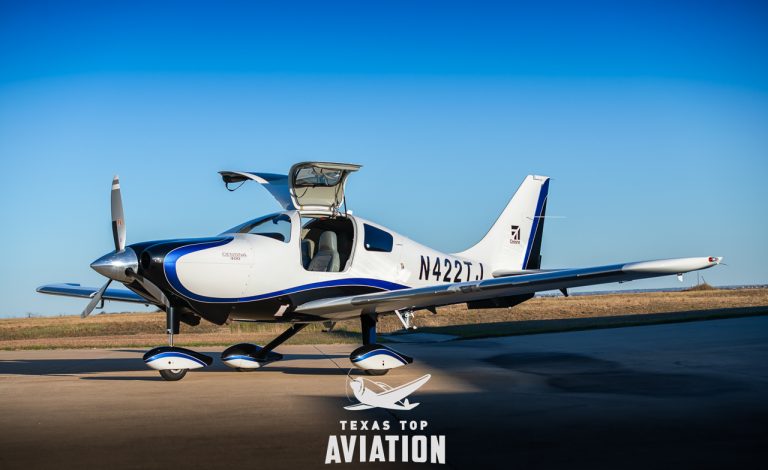
N422TJ

  • As Fast as a Cirrus — Better Tech, and Less?

    2008 Cessna 400 Corvalis TT N422TJ on the ramp — a faster, better-value alternative to a Cirrus SR22T
    2008 Cessna 400 Corvalis TT (N422TJ) — 235 KTAS and Garmin G1000 glass, priced under a comparable Cirrus.

    If you’re weighing a Cessna 400 vs Cirrus, start here. The 2008 Cessna 400 Corvalis TT cruises at 235 knots true — the fastest fixed-gear piston single ever certified. It’s faster than a turbocharged Cirrus on the same fuel and the same class of engine, and it costs less than a comparable SR22T. If you’re shopping a high-performance single for speed and value, N422TJ deserves a hard look.

    The Airplane Cirrus Shoppers Overlook

    The Cessna 400 is a Lancair design — a clean-sheet, all-composite airframe built to go fast. Cessna certified and refined it, and built N422TJ in 2008. It seats four, carries a real load, and handles weather. Most buyers shopping a high-performance single default to Cirrus, so airplanes like this one get overlooked. That’s where the value is.

    Faster on the Same Fuel

    The 400’s 235 KTAS is a true max cruise at 25,000 feet on oxygen. A 2011–2012 Cirrus SR22T (Gen 3) trues about 211 KTAS. Both burn 100LL and run turbocharged Continental engines in the same ~310-horsepower class.

    That’s about 24 knots up high — roughly 45 minutes off a 1,000-nautical-mile leg — with no bigger engine and no more fuel. And it isn’t only a flight-levels number: at 10,000 feet the 400 still trues about 180 KTAS, roughly 10 knots faster than an SR22T at the same altitude.

    Side profile of the all-composite, fixed-gear airframe
    Lancair-designed, all-composite, fixed-gear — the airframe that makes 235 knots possible.

    The Value Gap

    N422TJ is priced at $350,000. A comparable Gen 3 SR22T typically trades between $450,000 and $550,000 used. (A new SR22T is a $1M-plus airplane — not the comparison.) Against the newer turbo Cirrus, that’s roughly $100,000 to $175,000 less for a faster airplane.

    Cessna 400 Corvalis TT N422TJ on the ramp, front three-quarter view
    N422TJ — no damage history, complete logs since new, Van Bortel-maintained.

    Cross-Shopping a Turbonormalized Cirrus SR22

    A lot of buyers looking at N422TJ also weigh a Cirrus SR22 with the Tornado Alley turbonormalized engine. It’s a fair comparison — the same ~310-horsepower-class Continental, the same all-composite fixed-gear layout, the same 100LL — so here’s the honest math.

    Speed and engine: the turbonormalized SR22 trues around 211 KTAS; the 400 does 235. The 400 also runs a true twin-turbocharged TSIO-550-C, not a turbonormalized system — a true turbo makes boosted power up high, which is a big part of that speed edge.

    Avionics and price — 2006–2008: those Cirrus came with the Avidyne Entegra panel. N422TJ’s Garmin G1000 with WAAS and Synthetic Vision is a clear step up — better glass for comparable or less money.

    Avionics and price — 2009 and later: Cirrus moved to Garmin Perspective (G1000-class) glass, but the price moved with it. A 2009 SR22 turbonormalized with Perspective typically runs around $400,000 or more — one representative listing is $429,900. N422TJ is $350,000: less money, comparable glass, and 24 knots faster.

    The SR22 still brings the CAPS parachute and the Cirrus owner community. But on speed, engine, and price, the Cessna 400 stays ahead.

    MetricCessna 400 Corvalis TT (N422TJ)Cirrus SR22T — Gen 3 (2011–2012)Cirrus SR22 Turbonormalized (2006–2009)
    Max cruise (25,000 ft)235 KTAS~211 KTAS~211 KTAS
    Cruise at 10,000 ft~180 KTAS~170 KTAS~170 KTAS
    EngineTwin-turbocharged Continental TSIO-550-C (true turbo, ~310 hp class)Turbocharged Continental (~310 hp class)Turbonormalized Continental IO-550-N (~310 hp class)
    Glass panelGarmin G1000 — WAAS + Synthetic VisionCirrus Perspective (Garmin)Avidyne Entegra (2006–08) / Garmin Perspective (2009+)
    Fuel100LL100LL100LL
    Airframe / gearAll-composite, fixed gearAll-composite, fixed gearAll-composite, fixed gear
    Useful loadComparable (often equal or a touch better)ComparableComparable
    Whole-airframe parachuteNoYes (CAPS)Yes (CAPS)
    Typical used price$350,000~$450,000–$550,000~$300,000–$450,000 (est.; 2009 Perspective ~$400K+)
    Cessna 400 Corvalis TT vs. Cirrus SR22T (Gen 3) and the turbonormalized SR22. Speeds and prices are typical estimates; verify against the aircraft records and current market.

    The fastest fixed-gear piston single ever certified — and it out-runs a turbo Cirrus on the same fuel.

    The Avionics You Can’t Buy Anymore

    Garmin G1000 glass panel with WAAS and Synthetic Vision (SVT)
    Garmin G1000 with WAAS and Synthetic Vision (SVT) and the GFC-700 autopilot.

    N422TJ has a Garmin G1000 with WAAS and Synthetic Vision (SVT) and the GFC-700 autopilot. WAAS gives you LPV approaches — near-ILS precision at runways nationwide.

    This matters because the WAAS upgrade path for the G1000 in these airframes is closed. A Cessna 400 that left the factory without WAAS can’t be upgraded — it will never fly an LPV approach. So a WAAS-plus-SVT 400 like this one is a scarce find. You either buy one that has it, or you don’t get it.

    Glass cockpit with dual Garmin G1000 displays and leather interior
    Both G1000 displays with synthetic vision — a modern, integrated flight deck.

    Built to Actually Go

    This airplane is equipped to be flown hard and often:

    • Thermawing electric de-ice with a backup alternator — a de-ice system (not certified known-ice)
    • Factory air conditioning
    • Speed brakes
    • Hot prop, built-in oxygen, and ADS-B Out
    Cabin door open showing cabin access and seating
    A comfortable four-seat cabin built for real trips.

    The engine is a twin-turbocharged Continental TSIO-550-C with about 1,503 hours total time — the original engine, 1,503 since new. No damage history, complete logs since new, maintained by Van Bortel.

    Leather interior seating
    Leather interior, comfortable for four.

    An Honest Word: What the Cirrus Does Better

    One thing every Cirrus has that the 400 doesn’t: the CAPS whole-airframe parachute. Pull the handle and the airplane comes down under canopy. For a lot of buyers that’s the deciding factor, and it’s a fair reason to choose a Cirrus. Cirrus also has a large owner community and a strong support network.

    Useful load is comparable across all three airplanes — the 400 is often equal or a little better. If the parachute and the community are your priorities, a Cirrus may be the right airplane, and we can help you find one. If your priorities are speed, avionics, and value, the 400 is hard to beat at this price.

    Cessna 400 vs Cirrus: Quick Answers for Shoppers

    Is the Cessna 400 faster than a Cirrus SR22T?

    Yes. The Cessna 400 Corvalis TT trues up to 235 KTAS at 25,000 feet versus about 211 KTAS for a Gen 3 Cirrus SR22T — about 24 knots faster on the same 100LL and the same ~310-horsepower class of turbocharged Continental engine, or roughly 45 minutes saved on a 1,000-nautical-mile leg. At 10,000 feet the 400 still trues about 180 KTAS, roughly 10 knots faster than an SR22T at that altitude.

    How does the Cessna 400 compare to a turbonormalized Cirrus SR22?

    The Cessna 400 trues 235 KTAS versus about 211 KTAS for a turbonormalized SR22, and it uses a true twin-turbocharged Continental TSIO-550-C rather than a turbonormalized system. A 2006-2008 SR22 turbo has the older Avidyne Entegra panel, while the 400 has a Garmin G1000 with WAAS and Synthetic Vision. A 2009-and-later SR22 turbo with Garmin Perspective glass typically costs around $400,000 or more, versus $350,000 for N422TJ. The SR22 still offers its CAPS whole-airframe parachute.

    Does the 2006-2008 Cirrus SR22 have a Garmin G1000?

    No. Cirrus SR22s from 2006-2008 typically came with the Avidyne Entegra glass panel; Garmin-based Perspective glass arrived in 2009. The 2008 Cessna 400 came with the Garmin G1000, and N422TJ has the WAAS and Synthetic Vision version.

    How much less is a Cessna 400 than a comparable Cirrus SR22T?

    N422TJ is priced at $350,000, while a comparable 2011-2012 Cirrus SR22T (Gen 3) typically sells for about $450,000 to $550,000 used — roughly $100,000 to $175,000 less for a faster airplane.

    What is the fastest fixed-gear single-engine airplane?

    The Cessna 400 Corvalis TT, at 235 KTAS maximum cruise, is the fastest fixed-gear piston single-engine airplane ever certified.

    Does the Cessna 400 have a parachute like the Cirrus?

    No. A whole-airframe CAPS parachute is the one meaningful capability the Cirrus offers that the Cessna 400 does not. On speed, avionics, and useful load, the 400 matches or beats a comparable SR22 or SR22T.

    Can the Cessna 400’s Garmin G1000 be upgraded to WAAS?

    No. The WAAS upgrade path for the G1000 in these airframes is closed, so a non-WAAS Cessna 400 can never gain LPV approach capability. N422TJ already has WAAS plus Synthetic Vision, which makes it a scarce find.

    Does the Cessna 400 carry less than a Cirrus SR22?

    No. Useful load is comparable — the Cessna 400 is often equal to or a little better than a comparable SR22 or SR22T.

    Contact Texas Top Aviation

    ✈️ See the full N422TJ listing, specs & photos →

    Call to see N422TJ or to talk through the Cessna 400 vs Cirrus decision: (512) 270-1298 · txtopaviation.com. Austin & San Antonio, TX.