Looking for somewhere to take a trip this fall? Sedona, Arizona should warrant strong consideration. Just shy of 100 miles north of Phoenix, Sedona is one of the most beautiful areas in the southwest United States. From Texas, depending on how fast your airplane travels, you could make it to Sedona in a day, with a couple of stops in between. You’d definitely want to spend a few days to enjoy the scenery and maybe jump over to the Grand Canyon while you’re in the area.
The Airport
As you approach the Sedona Airport (KSEZ), you become somewhat distracted by the scenery around you. Don’t be too distracted as the approach is a little tricky. If you are landing north, on Runway 3, the calm wind runway, don’t let the surroundings fool you. Stay on that PAPI and don’t be short, as the runway is on a 500 foot mesa. In instrument conditions, the MDA for the RNAV approach to Runway 3 dumps you out about 1,300 feet above the airport elevation, giving you plenty of time to set up to land.
When using runway 21, don’t make your pattern too wide as there are some pretty tall rocks (around 7,000 feet) north of the field. The Airport/Facilities Directory gives a warning to pilots in strong southwesterly wind conditions. Be aware of strong downdrafts coming in on final for runway 21.
The runway itself is in excellent condition, and plenty long at just over 5,000 feet. The FBO is a little dated, but the folks there are great. They were redoing the ramp this summer, so beware of that. Airplane parking is no problem, but actually getting to the FBO is a little tricky. The Mesa Grill is a very nice good restaurant just a short walk from the FBO. When I was there, I chowed down on a buffalo burger. It definitely hit the spot.
What To Do
Sedona is the outdoorsman’s paradise. Starting off, to get a great overview of the area, hop on the Red Rock Scenic Byway (SR 179) about an hour before dusk. You’ll get to see some spectacular views while it’s still light, then you can’t beat the sunsets in Sedona.
For hiking, you have a myriad of options, from the Cathedral Rock, to the Oak Creek Canyon, to the Devil’s Bridge Trail, all are beautiful, though most are not for the faint of heart (especially the Devil’s Bridge). Even though the fall is cooler, make sure you pack plenty of water for the hikes.
Want something to do in the evening? Go up to the Chapel of the Holy Cross to watch the sunset. After the sun goes down, go do some stargazing. You’ll get to take a tour of the stars at the Sedona Star Gazing location in Oak Creek. You are shown all the constellations and stars by professional astronomers, and blankets and chairs are provided.
Art connoisseur? You’ll find plenty of art galleries around town with a ton of beautiful, original artwork. There are also several theaters and golf courses around Sedona, giving everyone a little bit of everything.
If you’re up for it, the Grand Canyon is about a 2 hour drive north of Sedona, or a quick flight up to the Grand Canyon Airport (KGCN).
In search of a good getaway? Try Sedona. You’ll be sore from lots of hiking and sight seeing, but it will definitely have been worth it.
Texas Top Aviation is proud to announce that Hank Gibson has completed the training to become an American Bonanza Society Instructor, or ABS Instructor. He is now qualified to give instruction in Beech Aircraft.
As an ABS Instructor, Hank brings over 2800 hours of flying experience in a variety of aircraft to the cockpit of Beechcraft. Along with his ABS Instructor Designation, Hank is also a Cirrus Standardized Instructor Pilot (CSIP) and a Cessna FITS Accepted Instructor in both Cessna high and low wing piston aircraft (CFAI+). Hank is proud to add the ABS Instructor designation to his list of qualifications.
The process of becoming an ABS Instructor is quite comprehensive. The coursework consists of 20 powerpoint lessons covering anything and everything related to flying Debonairs, Bonanzas, Travel Airs, and Barons. The ABS Instructor course is quite in depth and detailed, giving the graduate a full understanding of the Beechcraft piston line of aircraft. To find out more about ABS Instructors, see the ABS website.
Hank is now giving initial and recurrent training in Beech Debonairs and Bonanzas. Please visit the Texas Top Aviation Bonanza Training page for more information on Bonanza and Debonair initial and recurrent training. Interested in Bonanza or Debonair training with a qualified ABS Instructor? Contact Texas Top Aviation today!
Texas Top Aviation is proud to announce that Hank Gibson has completed the training to become an American Bonanza Society Instructor, or ABS Instructor. He is now qualified to give instruction in Beech Aircraft. As an ABS Instructor, Hank brings over 2800 hours of flying experience in a variety of aircraft to the cockpit of…
6th Annual Armed Forces Weekend Celebration & Fly-In, May 20-21, in Brady, TX and Curtis Field (KBBD)!
Friday Night on the Square – FREE
Fly-In Saturday, 9-4 – FREE
A Night in London with Sentimental Journey Orchestra
Saturday night 7-11 PM
Tickets for Dinner & Dance, $30 available at www.morganmilitaryaviationmuseum.com.
6th Annual Armed Forces Weekend Celebration & Fly-In, May 20-21, in Brady, TX and Curtis Field (KBBD)! Friday Night on the Square – FREE Fly-In Saturday, 9-4 – FREE A Night in London with Sentimental Journey Orchestra Saturday night 7-11 PM Tickets for Dinner & Dance, $30 available at www.morganmilitaryaviationmuseum.com. Some fuel is available for…
Yes, you heard correctly. Last fall, Cirrus released a program called Cirrus Embark. The Cirrus Embark program offers 3 Free Days of Training to new purchasers of used Cirrus aircraft. The 3 Days is equivalent to the Cirrus VFR Transition Training Course.
Previously, Cirrus offered free factory training to anyone who purchased a new Cirrus from the Cirrus factory. Now, anyone buying a used Cirrus gets the same offer through Cirrus Embark at their home airport with a local CSIP training provider.
IFR pilot? No problem. The Cirrus IFR Advanced Transition Training Course is 5 days in length, but the Cirrus Embark program covers the first 3, reducing the out of pocket pay to only 2 days.
Free training? Yes, you heard correctly. Last fall, Cirrus released a program called Cirrus Embark. The Cirrus Embark program offers 3 Free Days of Training to new purchasers of used Cirrus aircraft. The 3 Days is equivalent to the Cirrus VFR Transition Training Course. Previously, Cirrus offered free factory training to anyone who purchased a…
This is the second part in a series on drones and Unmammed Aerial Systems (UAS). To read Part 1, Drones: A Brief History, please click here.
I’m surprised how often I’ve been asked about drones by concerned passengers as they load up for a charter flight. Most commonly I’m asked how many drones I’ve seen while I’m flying, or how many drones I’ve hit/ almost hit. Sadly, the media has made this drone crisis into something that it isn’t. I’ve never seen a drone while I was operating a full scale aircraft, and I’ve certainly never been put into a situation where I felt that a drone was a threat to my safety or the safety of the flight. In fact, I only personally know one pilot who has reportedly seen one around an airport and that was an isolated incident (and a non-event).
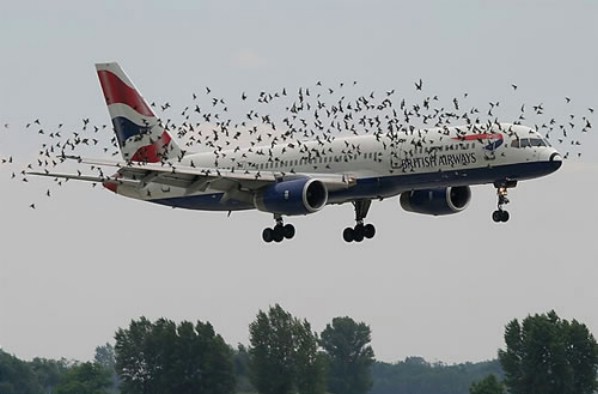
The reality is that while Unmanned Aerial Vehicles can be a real danger to full scale aircraft, incidents aren’t actually all that common and detailed information is often lacking or missing altogether. It is likely that some of the reported drone incidents were actually a case of a pilot confusing a loose balloon or a bird for a drone. This, combined with the media’s sensationalizing of every “close” encounter nationwide has led the public to believe that the problem is much bigger than it actually is.
In actuality, when the AMA (Academy of Model Aeronautics, the USA’s governing body for model aircraft) analyzed the data from the FAA’s 764 recorded Drone sightings, only 27 of them (3.5%) were actually recorded as “near misses” or “near collisions.” Additionally, only 10 of the records (1.3%) indicate that pilot was required to take evasive action.
The records also include reports of drone sightings at altitudes which would be impossible for civilian models to attain (19,000-24,000′). Finally, some of the sightings took place in areas which are specifically set aside for model aircraft and drones to operate. In those cases, the person flying the drone when it was reported was actually doing so in a safe and legal manner in an area designated for that specific purpose. If you’re interested, the whole article is available here and has a lot of great information.
As pilots, it is important that we do our part in helping reduce the risk of drone strikes. The biggest thing that we can do to help is to report any activity that we see so that it can be investigated and hopefully the drone operator can be found and dealt with. Try to get as much detail as possible about the incident, such as the size, color, location, direction and altitude of any sighted UAVs and report it to the closest tower or controlling agency.
Recently, the people in Washington have come up with a bunch of new rules to regulate the operation of model aircraft. As of this year, every unmanned aerial vehicle between 0.5 and 55 lbs must be registered with the FAA and have an FAA issued registration number located on the model itself. The logic here is that if someone crashes a drone where it shouldn’t have been operated, the officials will be able to identify the owner of the model and take action.
Model manufacturers and vendors have also agreed to start providing information about a program called “Know Before You Fly” (KBYF) in the packaging of the drones. This program seeks to help educate new hobbyists to the rules and responsibilities associated with model aviation. For more information on KBYF, here is a link to their website.
In the end, the sad reality is that it’s a combination of many factors: new technology making models cheaper and easier to fly, GPS navigation and automation, the media blowing the incidents out of proportion, and inexperienced and foolish operators which have caused the growing concern and required the FAA’s action. I think that it is important to understand that thousands of people have been flying radio controlled models for many years responsibly and this has never been a problem. The AMA has rules (which are the same ones now adopted by the FAA) regarding flying location, altitudes, speeds, and more which have kept both the modelers on the ground and the pilots in the air safe until now. Its a classic case of a few foolish individuals who have caused all modelers to be cast in a bad light.
There is no reason to fly in fear, though. A pilot should always be watching for hazards as he or she is flying, regardless of the variety. In fact, according to the FAA’s website, there were 142,000 wild life STRIKES with civil aircraft in the USA between 1990 and 2013. That seems like a much bigger concern to me than the 764 reported drone SIGHTINGS. As with any new technology, drones are suffering from growing pains. As the rules fall into place and new operators become better experienced, hopefully we will hear about fewer incidents on the evening news. Anyway, I’ll stop “droning” on. Fly safe.
Andrew Robinson is a 135 Charter Pilot and flight instructor who lives with his wife and 2 daughters in Pennsylvania. He flies Pilatus PC-12s and instructs in Beechcraft Bonanzas.
I’m surprised how often I’ve been asked about drones by concerned passengers as they load up for a charter flight. Most commonly I’m asked how many drones I’ve seen while I’m flying, or how many drones I’ve hit/ almost hit. Sadly, the media has made this drone crisis into something that it isn’t. I’ve never…
If you have been searching “Cirrus SR22T for sale” or reading up on the Cirrus Vision Jet, you are looking at genuinely excellent airplanes. Both have earned their reputations. This is not an article about why you should not buy one. It is about a third airplane that almost never shows up in a Cirrus search — and what the numbers look like when you set it next to the two you are already considering.
190 ktDA62 Cruise
762 lbFull-Fuel Payload
648 nmRange, 4 Adults + Bags
1 WeekTraining, No Travel
What the Cirrus SR22T Gets Right
Let us start where we should. The SR22T is one of the most successful piston singles ever built, and for good reason. Turbo-normalized power that holds performance up high. A Perspective+ flight deck that is about as good as glass gets in a single. Side-yoke handling most pilots fall for inside ten minutes. And CAPS — the whole-airframe parachute that changed how our whole industry talks about safety.
Add strong resale, a deep service network, and one of the best owner communities in aviation, and you have an airplane that is very hard to argue with. If you fly two people and light bags on 300 to 500 nautical mile legs, we would tell you to go buy one — and we would help you find the right one. We also teach Cirrus SR20, SR22 and SR22T training here in Texas, so this is not an outsider’s opinion of the airplane.
The conversation changes when the mission grows.
Cirrus SR22T vs. Diamond DA62: The Numbers Side by Side
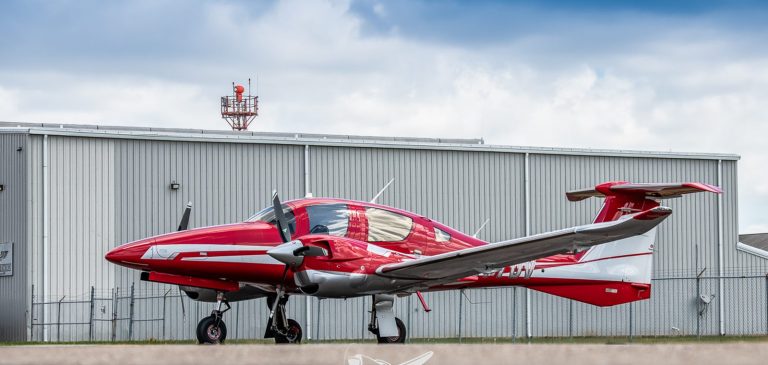
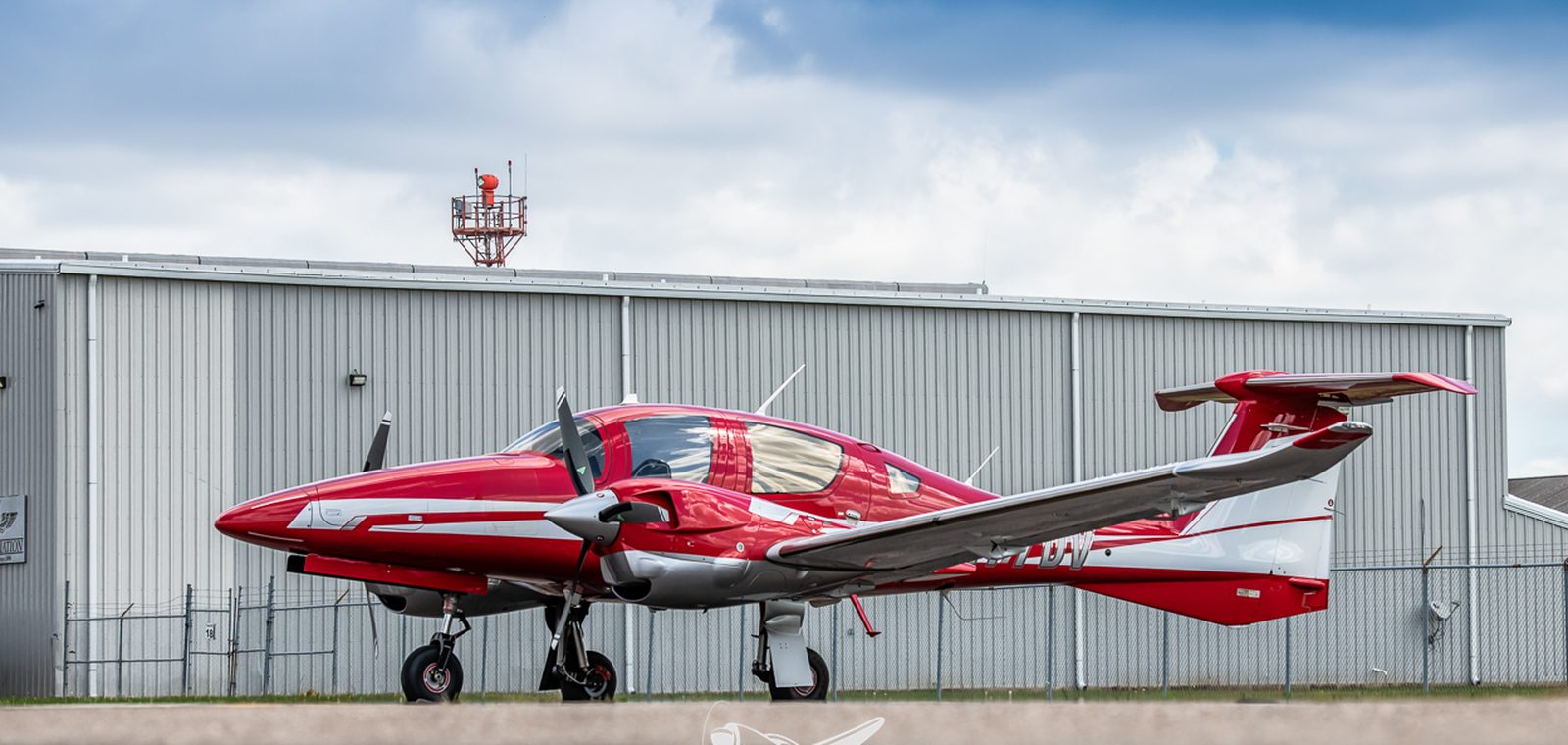
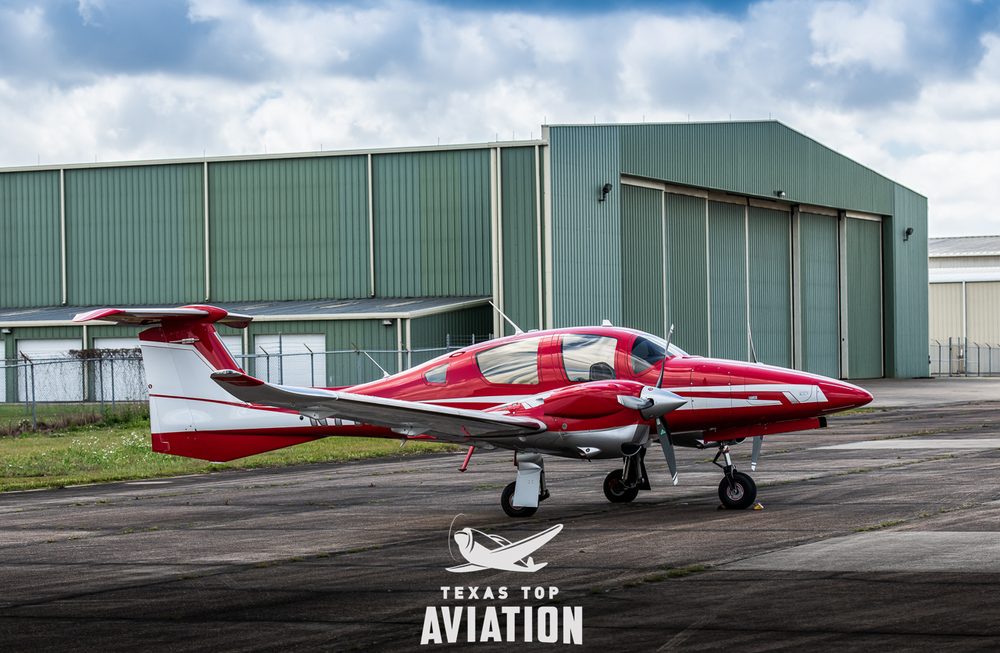
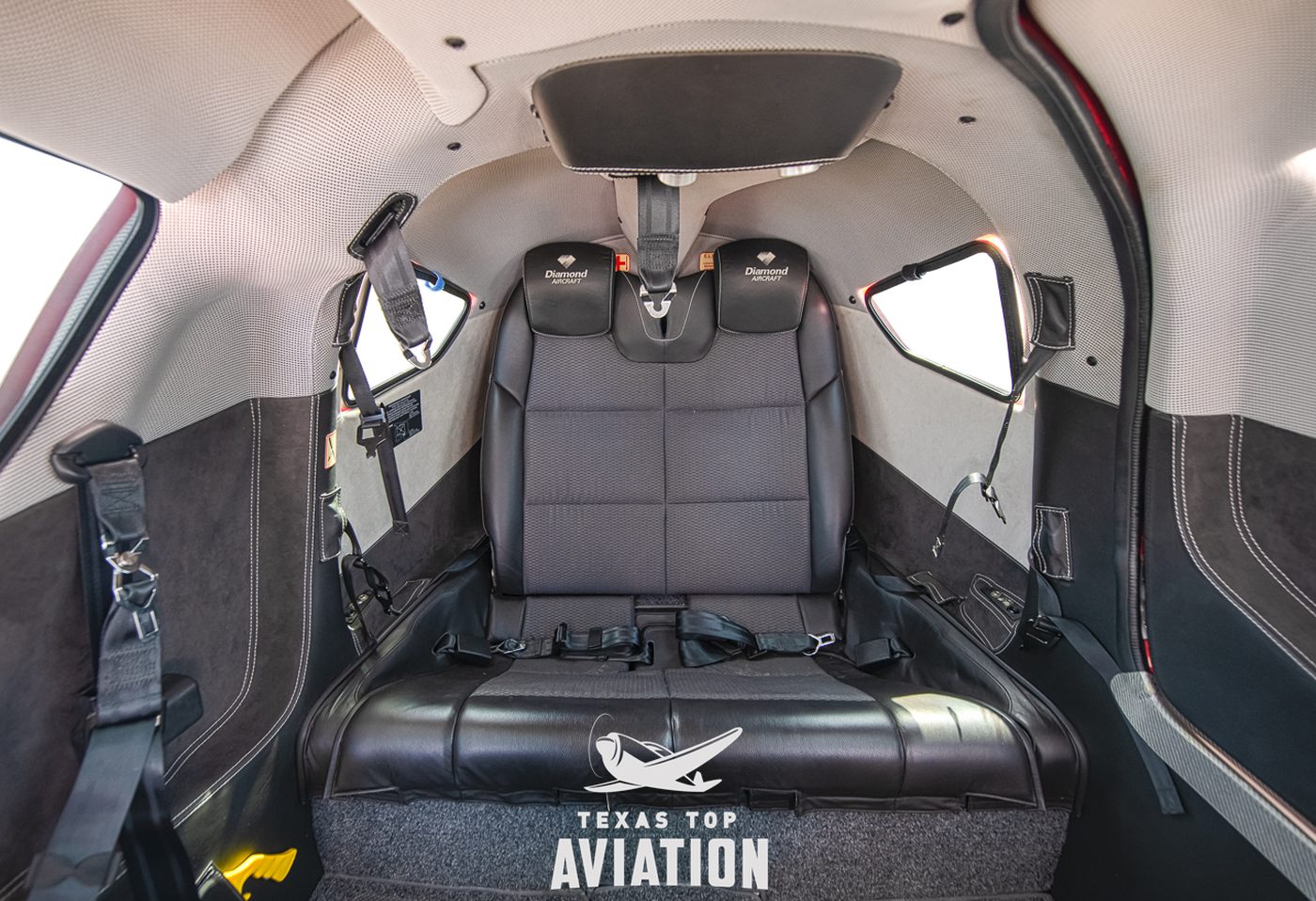
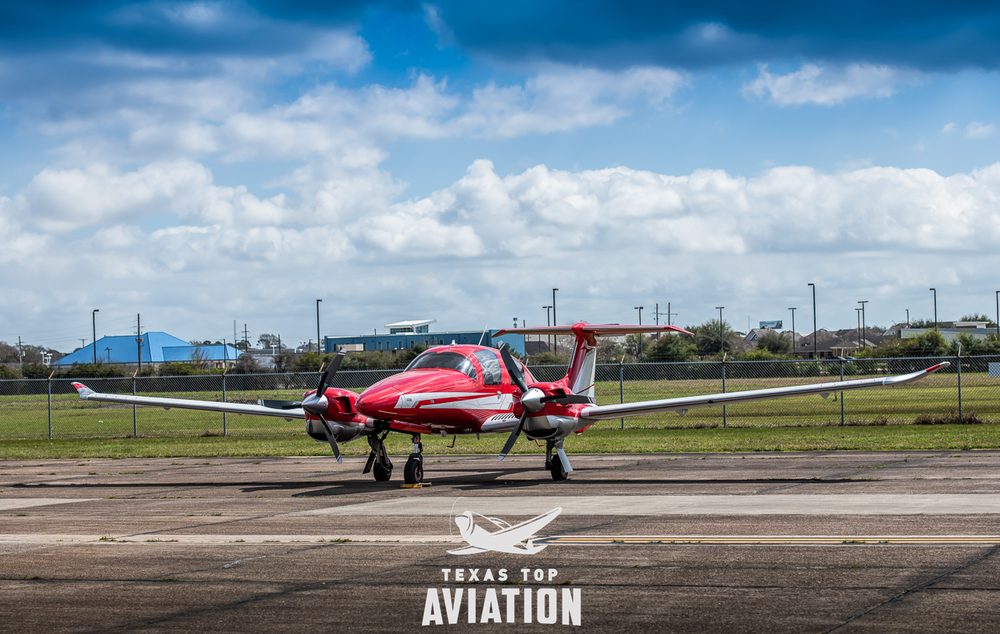
The Diamond DA62 is a seven-seat, twin-engine, Jet-A-burning composite airplane that most Cirrus shoppers have never sat in — usually because it simply never came up in the search. Here is how the two line up on the numbers that matter.
Specification
Cirrus SR22T
Diamond DA62
Cruise speed
184 KTAS @ 85% power / 10,000 ft
190 KTAS @ 90% power / 10,000 ft
Fuel burn
18.3 GPH @ 85% (16.4 GPH @ 75%)
19 GPH total (9.5 GPH per engine)
Fuel type
100LL AvGas
Jet-A (~$1.75/gal cheaper)
Seats / rows
5 seats, 2 rows
7 seats, 3 rows
Useful load
~1,125 lb (3,600 lb MTOW)
1,341 lb (5,071 lb MTOW)
Full-fuel payload
~575 lb
762 lb
Range, 4 adults + 75 lb bags (835 lb)
~320–350 nm
~648 nm (45-min reserve)
Takeoff over 50-ft obstacle
2,080 ft
1,575 ft
Landing over 50-ft obstacle
2,535 ft
1,447 ft
Single-engine service ceiling
—
11,000 ft
Engine-out redundancy
CAPS parachute
Second engine
Recurring safety-system cost
~$20,000 CAPS repack / 10 yr
None
Rating required
High-performance endorsement
Multi-engine (~1 week, at home)
Cirrus SR22T figures are taken from the Cirrus SR22T G6 Pilot’s Operating Handbook (P/N 13772-007, Reissue A): cruise at ISA and 3,400 lb, takeoff and landing over a 50-ft obstacle at sea level, ISA and 3,600 lb max gross.
Read that speed line carefully, because it is closer than the marketing on either side suggests. At 10,000 feet the DA62 has about six knots on the SR22T — real, but hardly decisive. Climb higher and the advantage flips outright: the SR22T is turbo-normalized, so at 18,000 feet the POH shows 198 KTAS on the same 18.3 gallons an hour, comfortably faster than the DA62. If raw speed is what you are buying, the Cirrus has a genuine answer.
Where the DA62 separates itself is everything around the speed. It burns Jet-A, which runs roughly $1.75 a gallon under 100LL at most FBOs and is available at airports where AvGas gets harder to find every year. And the full-fuel payload gap is 187 pounds. Payload is where light-airplane trip plans quietly fall apart.
Four Adults, Bags, and the Range That Actually Matters
Spec sheets get written for two people. Real trips are not flown that way.
Load four adults and 75 pounds of luggage — call it 835 pounds — and the SR22T has to leave fuel on the ramp. On a typical G6 empty weight that leaves room for roughly 48 of its 92 usable gallons, and realistic range lands around 320 to 350 nautical miles with IFR reserves. Put that same 835 pounds into a DA62 and you are looking at roughly 648 nautical miles with a 45-minute reserve.
To be fair to the airplane: with full fuel and two people aboard, the SR22T is genuinely long-legged. The POH shows 763 nm at 10,000 feet and 791 nm at 18,000 feet on a 45-minute reserve. The range only collapses when you fill the seats — which is precisely the mission this comparison is about.
That is not a rounding error. That is one fuel stop versus none on a Texas-to-Colorado weekend. And the DA62 does it across three rows, with two seats still open behind you.
About the Cirrus Vision Jet G1
If your search has moved from the SR22T up to the Vision Jet, that airplane deserves real credit too. Cirrus did something nobody else managed: a single-pilot personal jet, with CAPS, delivered in volume, flown successfully by owner-operators. That is a genuine achievement in this industry, and we teach Cirrus Vision Jet training ourselves.
The G1 specifically, though, asks for a level of commitment that surprises a lot of first-time jet buyers.
Cirrus Vision Jet G1: What Ownership Actually Asks Of You
Acquisition: approximately $1.8 million.
Fuel burn: 60–70 GPH of Jet-A.
Full-fuel payload: only 300–400 lb — roughly two adults and a soft bag.
Range: about 800 nm on paper, but heavily payload-limited in practice.
Type rating: a full FAA type rating is required — roughly two weeks of initial training in Knoxville, Tennessee.
Insurance dual: 25+ hours of additional dual instruction beyond the type rating.
Recurrent: annual simulator recurrent training back in Knoxville, at $15,000–$25,000 per year, every year.
Runway: 3,192 ft takeoff / 3,011 ft landing over a 50-ft obstacle.
Climb: drops to 1,100–1,200 fpm at heavier weights, and loses thrust at high density altitude airports — exactly where you want margin.
Worth saying plainly: the G2 and G2+ are meaningfully more capable airplanes — better payload, better hot-and-high performance, updated flight deck. That is a different and more interesting conversation, and one we are glad to have. Everything above is specific to the G1, because the G1 is the airplane most often cross-shopped at DA62 money.
Compare that training path to the DA62. A multi-engine rating is all that is required — roughly one week, typically at your home airport, with no hotel and no travel. There is no annual sim requirement in another state, and no recurring five-figure training line item on the budget.
Runway Numbers Open Up the Map
Performance over a 50-foot obstacle is where your airport list gets long or short. The DA62 clears it in about 1,575 feet on takeoff and 1,447 feet on landing. The SR22T needs 2,080 and 2,535 feet. The Vision Jet G1 needs 3,192 and 3,011 feet.
That is roughly 500 feet less than the SR22T on departure and nearly 1,100 feet less on arrival — and against the G1 the gap is wider still. Practically, that difference is what gets you into the shorter ranch, lake and mountain-adjacent strips that a lot of the best flying runs on. That is not a spec. That is a different set of weekends.
The Parachute and the Second Engine
CAPS is a real safety system and we will not say otherwise. It has saved lives, and it deserves the respect it gets. It also carries a cost most buyers do not budget for: the rocket and canopy repack runs about $20,000 every ten years, and it is not optional.
The DA62 answers the same question a different way. Lose an engine and you still have one making power, turning counter-rotating props, managed by a FADEC that keeps it to a single lever per side. One number to know either way: the DA62 single-engine service ceiling is 11,000 feet, so on one engine it will hold altitude over most terrain but not over the high country. Neither answer is wrong — they are two philosophies about the same risk. The DA62 version just does not come with a recurring five-figure bill.
Frequently Asked Questions
Is the Diamond DA62 faster than a Cirrus SR22T?
Only down low, and only slightly. At 10,000 feet the Diamond DA62 cruises at 190 KTAS at 90% power on 19 GPH of Jet-A total, while the Cirrus SR22T G6 POH shows 184 KTAS at 85% power on 18.3 GPH of 100LL. Higher up the SR22T is the faster airplane — its turbo-normalized engine holds 198 KTAS at 18,000 feet on the same fuel flow. The DA62 advantage is fuel cost, payload and runway, not raw speed.
How much can a Diamond DA62 carry compared to a Cirrus SR22T?
The DA62 carries a 762 lb full-fuel payload across seven seats in three rows. The Cirrus SR22T has a useful load of about 1,125 lb and a full-fuel payload of roughly 575 lb. Loaded with four adults and 75 lb of bags — 835 lb total — the DA62 flies about 648 nm with a 45-minute reserve, while the SR22T is closer to 350 nm.
What training does a Cirrus Vision Jet G1 require compared to a Diamond DA62?
The Vision Jet G1 requires a full FAA type rating: about two weeks of initial training in Knoxville, Tennessee, plus 25+ hours of additional dual for insurance, plus annual simulator recurrent back in Knoxville that runs $15,000–$25,000 per year on an ongoing basis. The Diamond DA62 requires only a multi-engine rating — about one week, usually at your home airport, with no travel.
Can a Diamond DA62 use shorter runways than a Cirrus SR22T or Vision Jet?
Yes. Over a 50-foot obstacle the DA62 takes off in about 1,575 ft and lands in about 1,447 ft. The Cirrus SR22T needs about 2,080 ft and 2,535 ft, and the Cirrus Vision Jet G1 needs about 3,192 ft and 3,011 ft. The Vision Jet G1 also sees climb rate fall to 1,100–1,200 fpm at heavier weights and loses thrust at higher density altitude airports.
Does the Diamond DA62 have a whole-airframe parachute like Cirrus CAPS?
No. The DA62 redundancy is a second engine rather than a parachute. One practical difference in ownership cost: the Cirrus CAPS repack runs about $20,000 every ten years and is mandatory, while the DA62 has no equivalent recurring safety-system expense.
Shopping a Cirrus SR22T or Cirrus Vision Jet? A numbers-first look at how both compare to the Diamond DA62 on speed, payload, range, runway performance and the real cost of training.
The AOPA’s Air Safety Foundation will be returning to Texas this coming week with their After the Crash: Surviving An Aircraft Accident seminar. Though aircraft accidents are rare to most pilots, they still happen. It is best to be prepared with the proper knowledge and supplies in case you are stranded in a remote area while awaiting help to arrive.
The seminar will cover the following items:
How and what to pack in a survival kit
Ways to help search parties find you
What to do first immediately after the off airport landing
How to survive will awaiting rescue
The seminar will be put on in Houston, San Antonio, and Austin on three consecutive nights, the 20th-22nd, so everyone will get a chance to attend. The location and times are below.
No signup is necessary, just show up and be ready to learn. The seminar does count for WINGs credit and there will be a sign in sheet at each event.
The AOPA Air Safety Foundation puts on numerous seminars throughout the country during the year covering a wide variety of topics relevant to general aviation pilots. The content is always interesting and the presenter always knowledgeable and entertaining. Hope to see you there!
Tuesday, January 20th
Wyndham Hotel, Houston West
14703 Park Row Blvd.
Houston, TX 77079
7:00pm-9:00pm
Wednesday, January 21st
Doubletree Hotel, San Antonio Airport
37 NE Loop 410
San Antonio, TX 78216
7:00pm-9:00pm
Thursday, January 22nd
Omni Hotel, Southpark
4140 Governor’s Row
Austin, TX 78744
7:00pm-9:00pm
For more information on the event and the locations, please click here.
The AOPA’s Air Safety Foundation will be returning to Texas this coming week with their After the Crash: Surviving An Aircraft Accident seminar. Though aircraft accidents are rare to most pilots, they still happen. It is best to be prepared with the proper knowledge and supplies in case you are stranded in a remote area…