The AOPA’s Air Safety Foundation will be returning to Texas this coming week with their After the Crash: Surviving An Aircraft Accident seminar. Though aircraft accidents are rare to most pilots, they still happen. It is best to be prepared with the proper knowledge and supplies in case you are stranded in a remote area while awaiting help to arrive.
The seminar will cover the following items:
How and what to pack in a survival kit
Ways to help search parties find you
What to do first immediately after the off airport landing
How to survive will awaiting rescue
The seminar will be put on in Houston, San Antonio, and Austin on three consecutive nights, the 20th-22nd, so everyone will get a chance to attend. The location and times are below.
No signup is necessary, just show up and be ready to learn. The seminar does count for WINGs credit and there will be a sign in sheet at each event.
The AOPA Air Safety Foundation puts on numerous seminars throughout the country during the year covering a wide variety of topics relevant to general aviation pilots. The content is always interesting and the presenter always knowledgeable and entertaining. Hope to see you there!
Tuesday, January 20th
Wyndham Hotel, Houston West
14703 Park Row Blvd.
Houston, TX 77079
7:00pm-9:00pm
Wednesday, January 21st
Doubletree Hotel, San Antonio Airport
37 NE Loop 410
San Antonio, TX 78216
7:00pm-9:00pm
Thursday, January 22nd
Omni Hotel, Southpark
4140 Governor’s Row
Austin, TX 78744
7:00pm-9:00pm
For more information on the event and the locations, please click here.
You are hand-flying an in-the-weather descent, power back, heading for the FAF. You start a 30 degree banked turn at your lead point to cross the FAF, when your passenger behind you gasps. Looking over your shoulder, you see he has spilled his drink into his lap…too bad for him! However, when you turn your head back to your panel, your inner ear tumbles and you see 45 degrees of bank, 15 degrees nose low, airspeed increasing.
Congratulations! You have managed to get distracted and sucked into an unusual attitude recovery. By the book, you should roll wings level, pull to the horizon, and adjust power as necessary to keep the airspeed within limits. In this scenario, if you had not experienced vertigo, you might have been able to roll to less than 30 degrees of bank, recover your turn, pull the nose up to less than the original descent attitude, pulled a bit of power to slow back to your desired penetration speed and then resumed your desired ground track. However, this would only be appropriate if you had full situational awareness as to the deviations caused by the look over your shoulder, plus full confidence that the moderate corrective actions would put you back on your desired flight path.
As a military aviator, I learned unusual attitude recoveries based upon hard maneuvering at extreme pitch and bank angles. In the hard-maneuvering environment, an unusual attitude could be 90 degrees straight up, airspeed decreasing below 120 kts…or 80 degrees nose low, 135 degrees of bank, airspeed increasing through 500 kts… etc. In these cases, understanding angle of attack, or AOA, is critical to maintaining controlled flight and returning to a normal attitude.
In an extreme nose-high attitude, a military aviator is trained to roll the aircraft to 90 degrees of bank, ease off the back-stick pressure to reduce AOA, add power as required, and allow the nose to slice back towards level, rolling to wings level as the nose approaches the horizon. If nose low, the recovery procedure is to roll rapidly, within asymmetric g limits, until wings level, then to pull at optimum g loading to recover to level flight. For the nose-low recovery, power was normally reduced until airspeed could be assessed and brought under control. However, when doing the nose-low pullout at 7-9 gs, pulling the power for too long would leave you much to slow to resume combat.
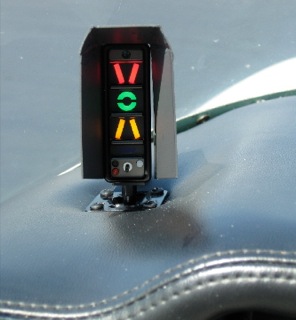
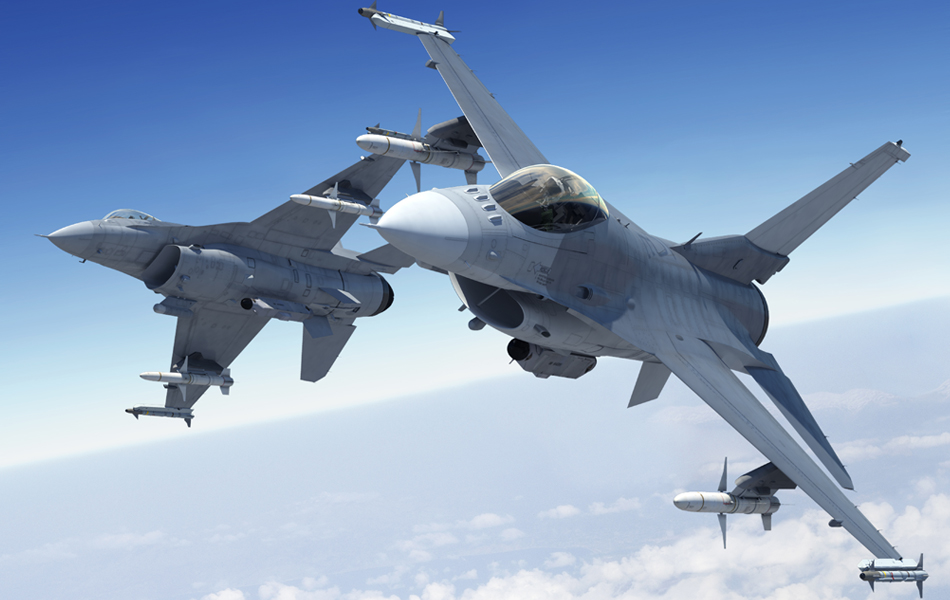
The AOA gauge on a fighter’s glare shield is a primary reference during hard maneuvering and for landing. The AOA for optimum maneuvering is 13 degrees, displayed as the green circle or “green donut” on the gauge. The red chevron on top represents a slow condition of 15 degrees or more and the yellow lower chevron represents 11 degrees or less.
For normal landing in the F-16C, the pilot slows to 220 kts and configures abeam the touchdown point while mentally computing the final approach airspeed of 136 kts plus 4 additional knots for each 1000 lbs of fuel. When rolling off the perch and flying the final turn, the pilot would usually only glance once at the airspeed once to ensure final turn airspeed of 180 kts while using the AOA sight gauge as the primary indicator of a best performance turn. As long as the AOA was green donut (13 degrees) or less, you would not stall. If on speed and 13 degrees wasn’t going to get you around the turn to line up with the runway, you knew you were going to overshoot. You never wanted to see the red chevron of 15 degrees or more as that meant you were too slow, pulling too hard, and in danger of building an un-recoverable sink rate!
Few GA aircraft are currently equipped with AOA indicators, though there are several after market devices available for retrofit. However, knowing the impact of AOA and how to manage it is vital to safe aviating, even without an AOA gauge. The bottom line is, as long as you don’t ask the wing to produce more angle of attack than it can handle, you won’t stall.
Practicing final turn stalls, to know what the wing feels like as you get too slow or pull too much on the controls, increasing AOA past the critical point, will keep you safe when you encounter that unexpected overshooting wind or you find yourself inadvertently on too tight of a downwind leg. Better to overshoot or take it around to try again, than to pull too hard and exceed critical AOA.
Mike Hostage is a retired USAF pilot with 37 years of experience, flying a wide variety of aircraft. An instructor pilot for more than half of his 4800 flight hours, Mike is currently qualified in a Cirrus SR-22T and regularly flies his two homebuilt sailplanes.
You are hand-flying an in-the-weather descent, power back, heading for the FAF. You start a 30 degree banked turn at your lead point to cross the FAF, when your passenger behind you gasps. Looking over your shoulder, you see he has spilled his drink into his lap…too bad for him! However, when you turn your…
I have the privilege of serving on the Malibu & M-Class Owners and Pilot’s Association Safety Committee. Along with 6 other Piper PA46 instructors, we were tasked with two things last year leading up to the MMOPA Convention in Colorado Springs last October. The first was to develop a Master Aviator Program (more on that in a later article). The second was to develop Operating Practices for the Piper PA46 fleet that we as instructors could all get on board with to teach the same thing, allowing everyone in the fleet to fly approaches and patterns the same way.
When I started instructing in the piston Piper PA46 line (the Malibu, Mirage, and Matrix), I was surprised to find that there were no recommendations anywhere that I could find for approach and pattern power settings and airspeeds. This led to some experimentation on my part trying to find out what works well for the airplane. I had originally been given good training in a Malibu, but hadn’t flown one for several years, so my numbers were a bit rusty.
I have been in the Cirrus world for a very long time. One thing I greatly appreciated from an instructing point of view about Cirrus was the abundance of guidance the factory gives instructors and pilots on how the airplane is supposed to be flown. All CSIPs and all Cirrus pilots should (theoretically) be teaching and flying the exact same way.
I was quite surprised that Piper didn’t put out similar information. I wasn’t as familiar with MMOPA at the time, but was surprised they didn’t have any information either.
I apparently wasn’t the only one with a desire to have a little bit more standardization.
So, without further ado, here are the MMOPA Operating Practices that the Safety Committee put together. If you are a new Piper PA46 pilot, these numbers are what you will expect to use when you do your Initial training. If you are a seasoned Piper PA46 pilot, you probably fly these numbers, or pretty close to them already.
These are tried and true power settings and speeds for the approach phase and landing phase. They work. That was the goal of the Safety Committee: put down in writing something repeatable to enhance safety. I believe we have accomplished that.
I have the privilege of serving on the Malibu & M-Class Owners and Pilot’s Association Safety Committee. Along with 6 other Piper PA46 instructors, we were tasked with two things last year leading up to the MMOPA Convention in Colorado Springs last October. The first was to develop a Master Aviator Program (more on that…
When it comes to turboprop engines, a hot start is a really bad thing. For you piston drivers out there thinking, “What’s the big deal, you are just starting a hot engine,” then here’s a little education for you.
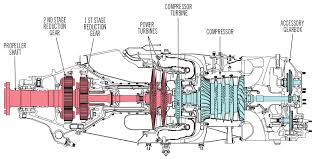
In a PT6 turboprop engine, there is a very important temperature gauge that a pilot monitors very closely during each and every start. It is called the Inter-Turbine Temperature gauge, or ITT. This temperature is a measurement of the exhaust gases between the compressor turbine and the power turbine (s). In the picture below, the probe is located where the blue and red colors meet.
In a turboprop engine, specifically the Pratt & Whitney PT-6 in all it’s different sizes and variations, there will always be a specific temperature that the pilot will want to keep the ITT below. This article will deal specifically with a Piper Meridian.
A Piper Meridian starts hotter than almost any other PT6 engine because of the way it’s air intake is designed. Unlike other turboprops, the Meridian has a permanently open inertial separator. This means that not all the intake air makes it to the engine during start because some of it goes out the inertial separator opening. So, coming to a Meridian from operating other turboprop engines can lead to a little bit of a surprise on the ITT temperature being higher than what a pilot is used to when starting.
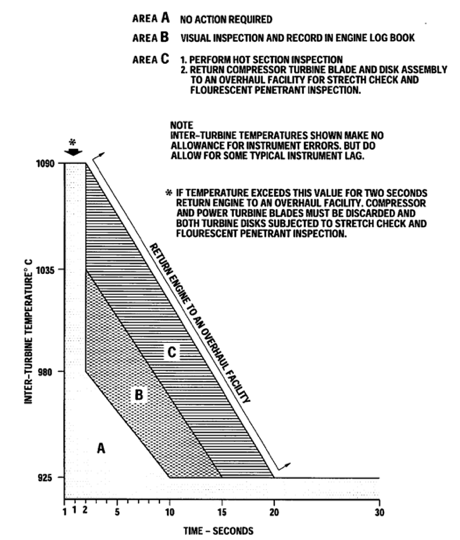
As a rule of thumb, when starting a Meridian, never let a start continue when the ITT hits 875 degrees. Based on the chart below, you are still in the safe zone at 875 and have about a 50 degree buffer before you have to start getting worried.
On cold starts with a good battery or a GPU, 875 is typically not an issue. Most starts when cold are going to be in the high 700s or low 800s. On a cold start, if you are seeing starts in the mid to upper 800s, try starting with a GPU and see if that lowers the start temperature. If it does, then that means your battery is weak and needs to be replaced. Another tell-tale sign of a weak batter is the Ng doesn’t spool up properly (meaning it settles around 12-13%) or takes a really long time to spool up. Also, never start on the battery with less than 24 volts.
When there are multiple flights in one day, the pilot has to take into consideration the warm engine prior to starting. If the ITT, prior to the start sequence, is above 150 degrees, it is time to do some motoring of the engine.
What is motoring? It is simply using the starter to turn the engine, which leads to air being sucked into the engine allowing the engine to cool off prior to start. The theory is, the cooler your engine prior to start, the cooler the ITT peaks at during start.
Here’s the steps on how to dry motor a Piper Meridian:
Battery on
Strobes on
Fuel Pumps and Ignition off
Throttle idle
Condition Lever feather/cutoff
Push the start button
Monitor the ITT temperature
Reaching 150 degrees, if less than 30 seconds have elapsed:
Fuel Pumps on
Ignition On
Condition Lever run
Reaching 150 degrees, if 30 seconds have elapsed:
Push Manual/Stop button to stop the start
Let starter rest for 30 seconds
The starter has a 30 second limit on the Meridian, followed by a 30 second rest period. You can do the sequence twice, then, after the 3rd start, there is a 30 minute rest period. Typically, if the ITT won’t cool down to 150 after the 3rd time, there is probably something wrong.
The most important thing a pilot can remember is never, ever push the condition lever forward if the ITT is above 150 degrees. You’ll be well on your way to avoiding hot starts that way.
When it comes to turboprop engines, a hot start is a really bad thing. For you piston drivers out there thinking, “What’s the big deal, you are just starting a hot engine,” then here’s a little education for you. In a PT6 turboprop engine, there is a very important temperature gauge that a pilot monitors…
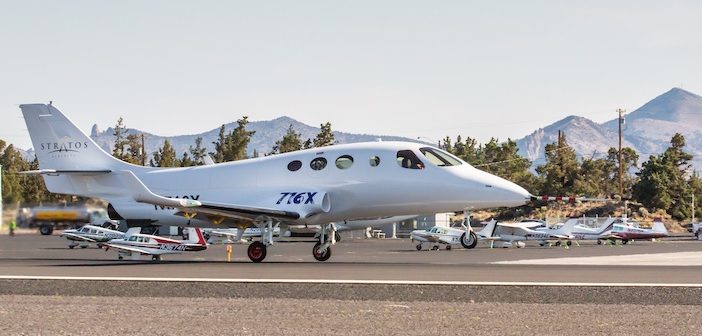
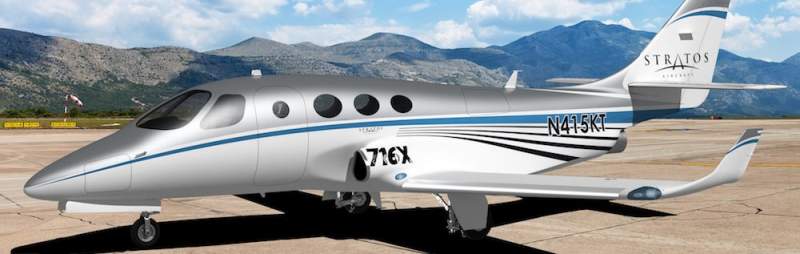
In July, Stratos Aircraft completed the first test flight of the single engine Stratos 716X personal jet. Stratos, based in Redmond, OR, is taking a page out of Epic Aircraft’s book in how the company is planning on bringing the Stratos 716X to market.
Epic Aircraft first released the Epic LT composite single engine turboprop in the early 2000s as an experimental. The first kit was completed and flying in 2005. Epic’s goal was to bring the airplane to market as a certified aircraft, a feat that took them almost 20 years to do, achieving full certification earlier this year.
Stratos Aircraft is hoping to learn a lot from their Bend, OR neighbors. The 716X is going to start off as a limited release experimental kit, while the company is working on achieving certification for the airplane. Once the plane is certified, it will be dubbed the Stratos 716. The 716X experimental kits will be assembled through a factory builder assist program (no garage built single engine jets here!). The kit will cost $2.5 million assembled, while the expected cost of the certified Stratos 716 will be $3.5 million.
Now, let’s talk about the airplane. 400 KTAS. One engine.
That’s right, you did hear correctly. The Stratos 716X is expected to cruise at 400 KTAS on only one engine. Compared to the Cirrus Vision Jet, that’s 100 knots faster. Think, “I’ll be relaxing at the hotel pool with a drink in hand when you are landing” type speeds. The fuel burn of the Pratt & Whitney JT15D-5 engine (3,000 lbs of thrust) is about 25 GPH more than the Vision Jet (the Stratos 716X will burn about 98 GPH of Jet A while the Vision Jet averages about 75 GPH of Jet A).
Comparing the two engines, the above numbers start to make sense. The Williams FJ33 engine on the Vision Jet only puts out 1,850 lbs of thrust, significantly less than the 3,000 lbs of thrust that the Stratos 716X Pratt & Whitney JT15D-5 puts out.
What does that mean to the pilot? In the Stratos 716X, it means less takeoff roll, better climb rate, faster cruise (as evidence by the 400 KTAS expected cruise speed), and a better payload. More power = more weight carrying capacity. And, the 716X is expected to have a service ceiling of 41,000 feet. I probably wouldn’t want to go that high single pilot with one engine, but I’d be very happy with that speed in the mid-30s.
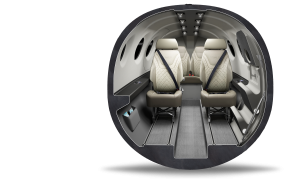
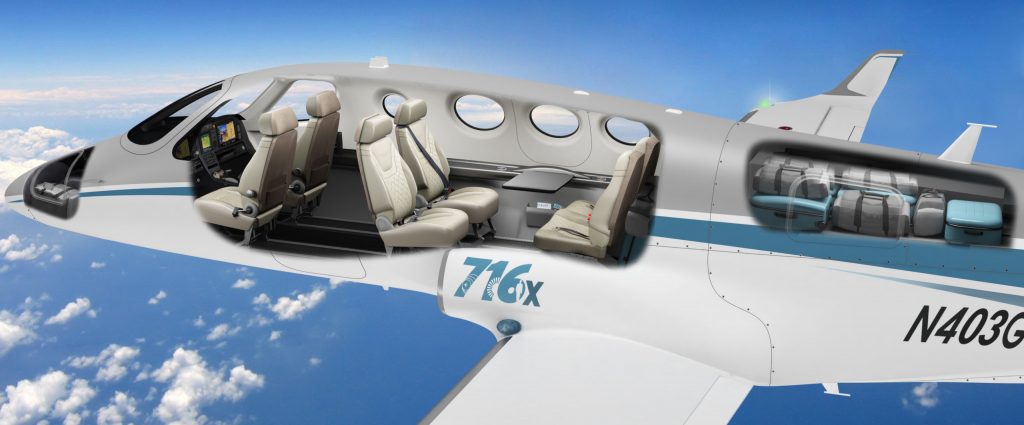
The cabin, based on the pictures I’ve seen, looks very comfortable. The Stratos 716X seats 6 and can be configured in several different ways. Baggage is no problem as Stratos Aircraft stretched the fuselage from their original 714 Proof of Concept aircraft, adding a very roomy baggage compartment above the engine compartment. The passenger compartment is as big as a Phenom 100, providing more leg and head room than the Vision Jet. The front seats have plenty of legroom too, as Stratos has opted for a side stick instead of a yoke.
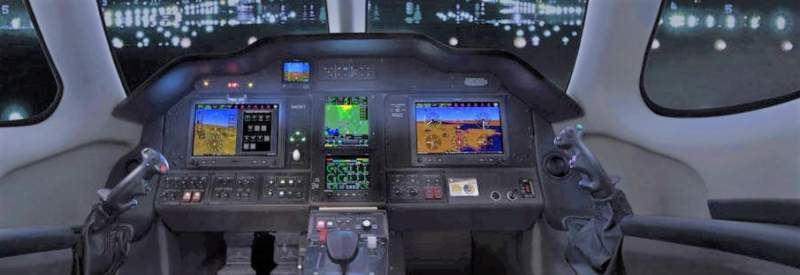
The avionics for the Stratos 716X are expected to be the Garmin G3X Touch for the panel which will be driven by a Garmin GTN 750 GPS. Autopilot will be integrated within the G3X. I would imagine that once the plane is certified, the panel will be switched to a Garmin G1000 NXi and a GFC 700 will be installed.
The genius of the design of the Stratos 716X is the aerodynamics of the engine placement. Instead of hanging the engine out in the slip stream and going with a drag inducing V-Tail like Cirrus did, Stratos took some notes from the myriad of single engine military fighter jets out there, placing the engine inside the fuselage. The fuselage is then built around the engine with two air scoops for intake directly in front of the wings. With two intakes instead of one, that leads to more air flow, which again, means more power. The Vision Jet has only one.
I’m going to keep tabs on the Stratos 716X (as I kept tabs on the Epic E1000). I’m hoping Stratos gets several flying soon (the company expects to do 3 kits a year till the airplane gets certified) and certification comes quickly after.
I got to stick my head in the mockup of the Stratos 716X when I went to Osh Kosh in 2018. I was very impressed and was excited to see the airplane was finally airborne this summer.
For more information about the Stratos 716X, check out the Stratos website.
Cirrus Vision Jet, meet your competition. In July, Stratos Aircraft completed the first test flight of the single engine Stratos 716X personal jet. Stratos, based in Redmond, OR, is taking a page out of Epic Aircraft’s book in how the company is planning on bringing the Stratos 716X to market. Epic Aircraft first released the…
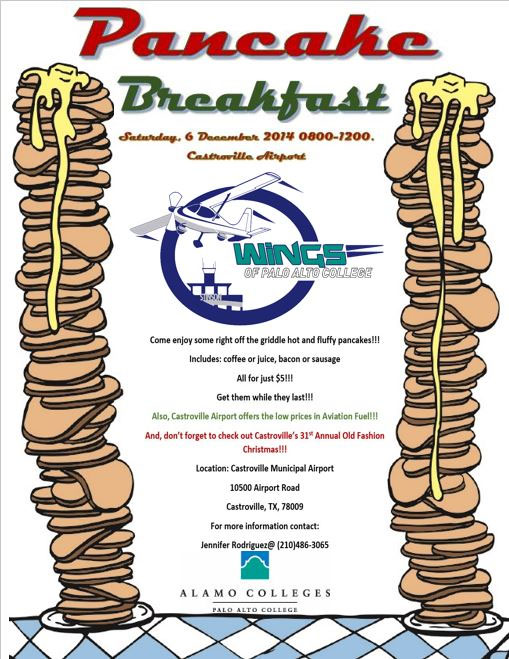
For those of you in the Hill Country looking to kick off the Christmas month right, head over to the Castroville Airport (KCVB) on Saturday, December 6th and get yourself a short stack of flapjacks. For just $5, you can get yourself a good hearty breakfast that includes coffee or juice and bacon or sausage. The eating starts at 0800 and goes until 1200, local time. Come with an empty belly and an empty gas tank as CVB currently has some of the lowest priced gas in South Texas, currently listed at $4.70/gallon.
There will be plenty of hangar flying, lots of airplanes to look at, and most importantly, lots of pancakes!
For those of you in the Hill Country looking to kick off the Christmas month right, head over to the Castroville Airport (KCVB) on Saturday, December 6th and get yourself a short stack of flapjacks. For just $5, you can get yourself a good hearty breakfast that includes coffee or juice and bacon or sausage….
From the time I started flying, I have always had the dream to learn how to fly a seaplane. As I learned in November, it’s actually learning to land a seaplane, and the veterans call them floatplanes.
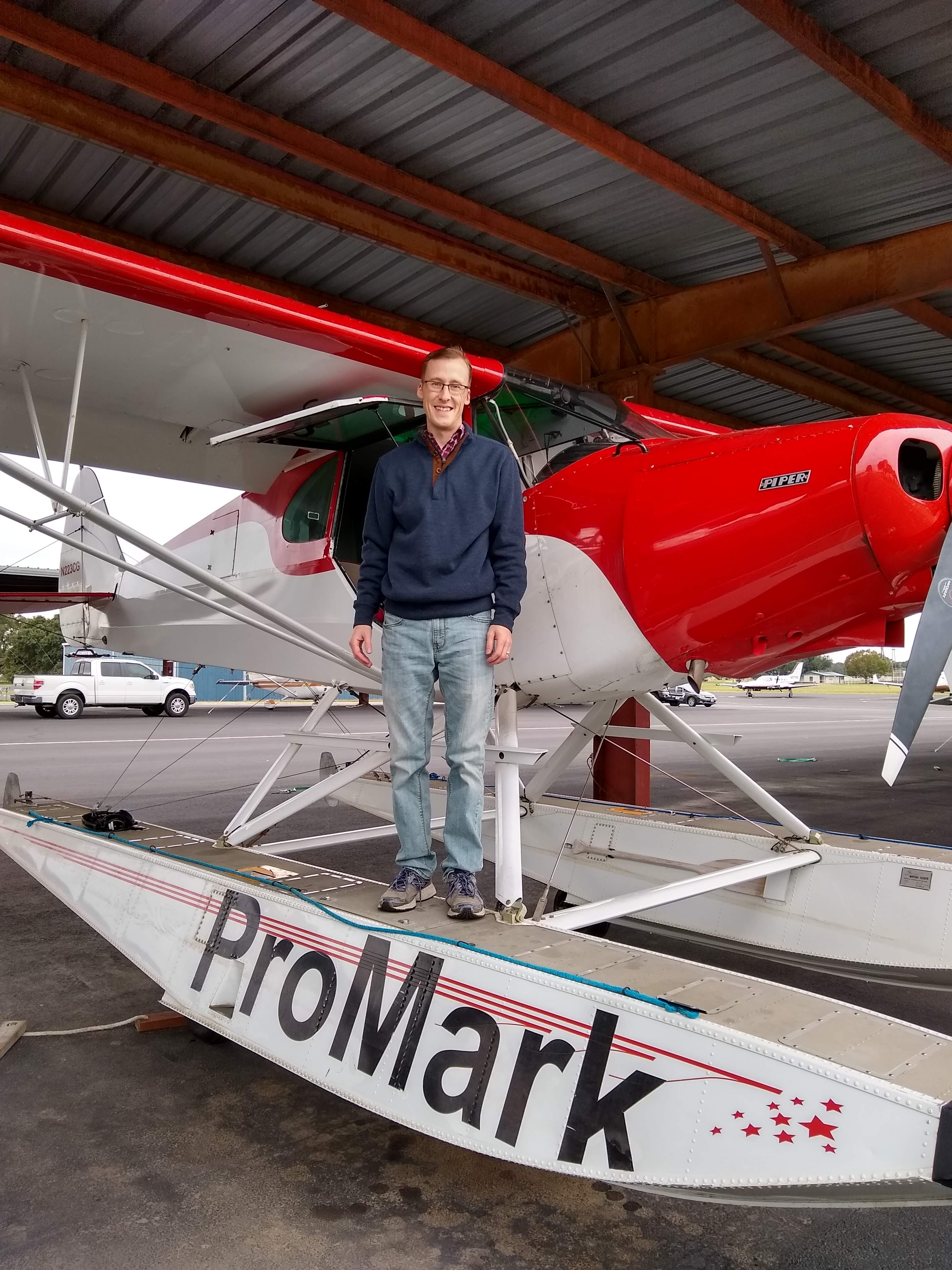
ProMark Aviation at the Burnet Airport (KBMQ) offers a weekend float plane course that is high on fun and low on stress. The school has a Piper PA12 Super Cruiser on amphibious floats (amphibs as I was corrected at one point. I mean, if you’re going to fly a seaplane, er, floatplane, you have to know the lingo) that will land and takeoff on water, but does little else with ease and grace. At 150 HP with those big floats and all the associated rigging hanging underneath the airplane, you are lucky to get to 500 feet before you get to your destination.
We weren’t working on setting any speed records. I was learning the lay of the water. I learned about the step, the keel, pumping the floats, how to read the water, currents, ducks (yes, ducks and birds are important to know about when you are flying low on the water), buoys, docking, and ditching. Step taxiing was fun as you are basically at 3/4 throttle screaming across the top of the water just below flying speed. It’s the best way to taxi a seaplane (truly, it is. You get more air in your engine, you can see better, and you are moving. Just don’t try and turn sharp).
Floatplanes also don’t have any shock absorbers, so the higher the wave, the more you get knocked around, so wind velocity and, in turn, wave height is very important.
A very important nuance of an amphibious floatplane compared to a straight floatplane (one that doesn’t have wheels that come out of the floats), is at one point, you want to make sure your gear is down for landing (runway landing) and at another, you want to make absolutely sure your gear is up for landing (water landing). If you land wheels down in the water, you will capsize, 100% of the time. Thankfully from my good instruction, I did not capsize.
Ken Wittekiend, my instructor, and I spent the majority of the weekend landing and taking off on Lake Buchanan (I was informed by locals it is pronounced “Buk-cannon”, not “Bue-cannon”), which is more open and therefore has more waves. We did one landing on Inks Lake so my kids could see me land, which they thought was the best thing since cheese sticks.
There is a check ride at the end of the training, but, as Ken reassured me, it’s the most fun check ride you’ll ever have. I still hate check rides, but that one I think I hated least of all.
I hope someday I can put my floatplane skills to practice, but for now, I can vouch that I now speak seaplane!
From the time I started flying, I have always had the dream to learn how to fly a seaplane. As I learned in November, it’s actually learning to land a seaplane, and the veterans call them floatplanes. ProMark Aviation at the Burnet Airport (KBMQ) offers a weekend float plane course that is high on fun…