Will Fly To Food: Texas Airport Diners

Looking for some good $100 Hamburger options in the state of Texas?  Here are some other good fly-in eateries around Texas.  These are ranked in no particular order because they are all just really good!  Most of these are located on the airport property, but a few are in town and worth the drive!

  • Lockhart BBQ (50R):  With 4 BBQ options in Lockhart (and City Market BBQ 10 minutes away in Luling), you can’t go wrong with a stop in Lockhart.  Just grab the keys for the giant suburban, and away you go. Most folks who stop off in Lockhart will give it a legitimate claim over Hard 8 in Stephenville.
  • Angelina County Airport Restaurant (KLFK):  This is pure East Texas eating here in Lufkin.  With greasy, tasty burgers and sandwiches, breakfast, and ladies who call you “Sugar” when taking your order, this is down home if I ever tasted it.  Lufkin and Brenham are currently neck and neck for the best Texas burger.
  • Black Walnut Cafe (KCXO):  This airport diner, located at the Galaxy FBO in Conroe on the north side of Houston, is top notch.  The food is excellent (I have eaten several different sandwiches and have not been disappointed) and you can’t beat the 3rd floor runway view from the patio.  Not a bad place to spend the lunch hour, though make sure you get there before the lunch hour.  It fills up quick.
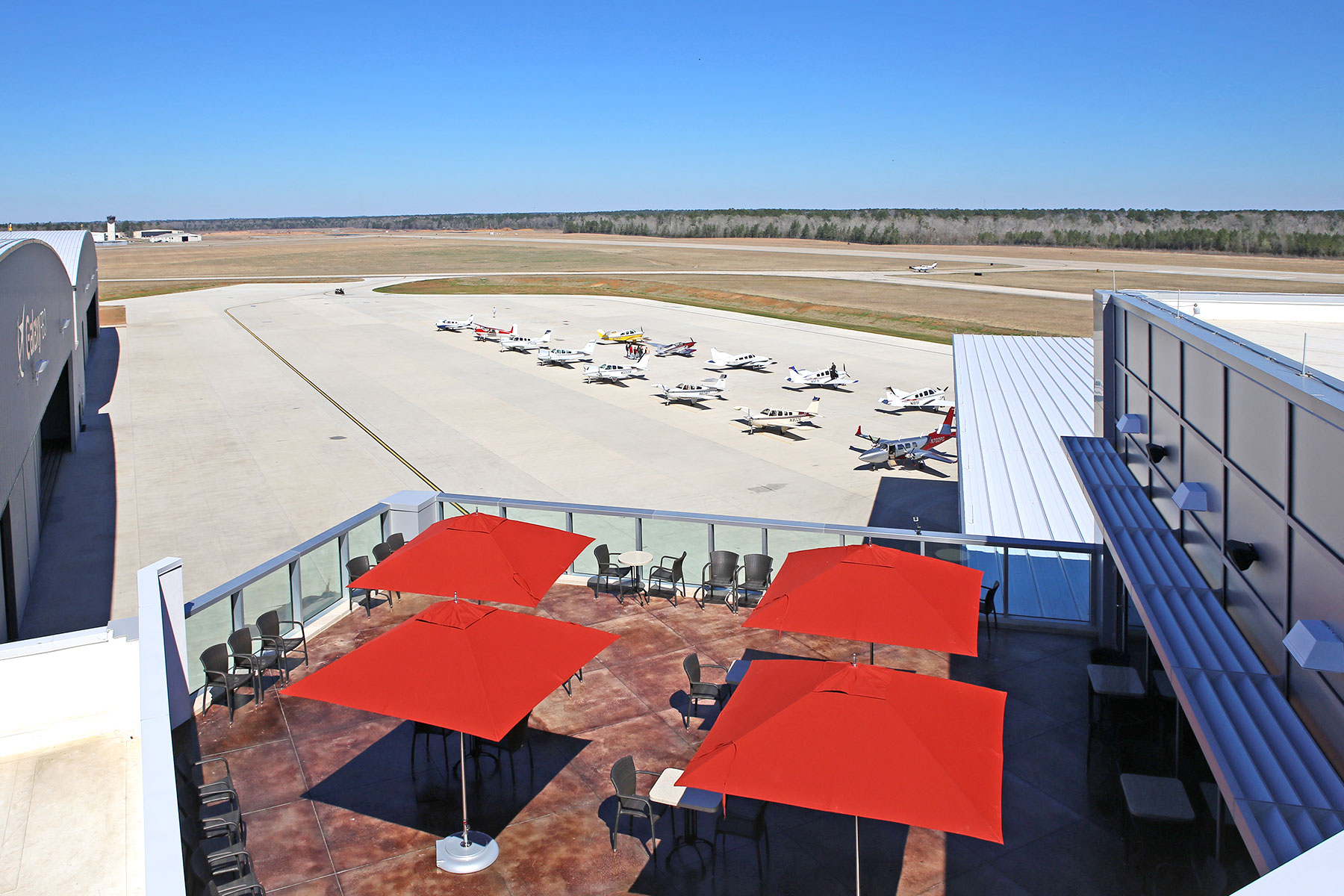
Black Walnut Cafe

  • Airport Diner (T82):  Right next to the Hangar Hotel, the Airport Diner in Fredericksburg brings back memories of the old soda fountains of the ’40s and ’50s.  With plates like the Warthog (their sausage sandwich with Fredericksburg made sausage) and the Whirly Bird (their chicken tenders wrap), the Airport Diner fully embraces the airport theme.  Better to stop for lunch on a weekday rather than a weekend as their isn’t a whole ton of seating.  Check your NOTAMs as the restaurant is closed on Mondays and Tuesdays.
  • Radial Engine Cafe (KGPM):  A good little stop in the Dallas area for a simple burger, fries, and a Coke. Don’t get the smaller 17/35 runway at GPM confused with the much larger 16/34 runway at GKY just to the west.  Approaching from the south, this can be easily done.
  • Clear Springs Restaurant (KBAZ):  Come for the onion rings, stay for the fish.  Clear Springs is just a 5 minute drive from the airport and there are always plenty of crew cars available.  You could probably make a whole meal out of the onion rings themselves, but the fish is top notch too.
  • Gate 12 (KCLL):  The College Station Airport now has the 12th Man!  Aggie Fans will appreciate the Gate 12 experience with all the Texas A&M decorations scattered throughout the restaurant.  Bring an appetite if you want to tackle the burgers.  They are huge!  Parking is only at the FBO.  Only military planes get to park in front of the restaurant.
  • Cooper’s BBQ (KAQO):  Llano, TX is known for BBQ.  Just fly in to the airport, get a car, and after a 10 minute drive, you can take your pick of any kind of BBQ under the sun.  Careful, as it’s easy to over order!
  • Hangar 6 Restaurant (KUVA):  The newest restaurant on the list, located on the ramp at the Uvalde Airport, Hangar 6 tips it’s hat to the military history of the Uvalde airport while serving really good food.  Taxi in and walk up to the quaint little joint.  They even have a playground for the kids!
  • Sky Restaurant (KVCT):  Not quite within walking distance, but just a short drive from the FBO, Sky Restaurant specializes on the seafood, but they also have good burgers and steaks.  VCT is popular amongst the Air Force and Navy trainers in the area, especially around lunch!
  • Runway Cafe (KLBX):  The best place I have found for seafood along the Texas Gulf Coast.  With a huge runway to land on and a beautiful FBO next door, this is my go to for Fried Shrimp when I’m in the Houston area.
  • Delta Charlie’s (KRBD):  With quite an extensive menu (and a full bar for those overnight trips), I will definitely make RBD one of my routine stops. Dallas Jet Center recently opened in the terminal, so fueling your stomach and your plane can all be done in one spot.
  • The Red Baron Restaurant (KDHT):  The Panhandle of Texas hides many surprises and the Red Baron restaurant in Dalhart, TX is no exception.  For those early morning flights, The Red Baron makes a solid breakfast and a mean cup of coffee.  Lunch satisfies even the hungriest pilot.  Dalhart has a very spiffy modern FBO to sleep away that burger and fries until your passengers show back up too.
  • Hogg’s BBQ (KDUX):  I came hungry and I left very happy.  Hogg’s makes some good West Texas BBQ.  Huge helpings and an aviation themed dining room makes for a good choice.  Restaurant is located just behind the terminal building.  I was there for dinner and it wasn’t too crowded, but I bet lunch is hoppin’!
  • Aviator’s Grill (KDWH):  Located in the Gill Aviation, FBO, Aviator’s Grill has a great selection of creative sandwiches.  Hooks can be a little tricky to navigate while taxiing, but just tell ground you are going to Gill, and they will direct you to lunch.
  • Bill’s Burgers (KBMQ):  A short drive from the airport in the Burnet FBO’s new courtesy van deposits you at Bill’s Burgers, the largest burger this side of the Mississippi.  Always a popular lunch spot, especially on weekends, hitting lunch early or late is a good plan.  Don’t get a full order of fries unless you want to share.  It’s huge!  Closed on Mondays.

In my book, these are the other great places to stop on a flight in Texas.  Always make sure to come hungry! I probably missed a few along the way, so please feel free to add others to the list!

Note:  Some of the above restaurants are either closed for COVID, or are only doing takeout.  Make sure you call before hand.  Google doesn’t always have updated information.

Similar Posts

  • ViBAN IFR Hood

    The first task I give my new instrument students before we start training is to find a view limiting device that they like.  There’s the hood that everyone hates (which has been used since the beginning of instrument training,though it isn’t that uncomfortable) or foggles, which usually end up becoming very uncomfortable very quickly.  The headset ends up pressing the sides of the foggles into the side of your head, leaving lumps and scars that hurt for days.

    Well, there is finally another solution that combines the hood and foggles.  Meet the ViBAN.

    ViBan

    ViBAN brags that it is the most comfortable IFR view limiting device out there.  I have a customer who has one and he loves it.  It’s easy to put reading glasses on underneath while still blocking the view of the exterior of the plane.  It doesn’t leave bruises against the side of your head, either.

    If you’re looking for something different for your IFR training, give ViBAN a try.

  • PIREP: IFR Clearances at Uncontrolled Airports

    There is great news coming for all IFR pilots who utilize the multitude of uncontrolled airports across the US.

    From the beginning of aviation time, the process of getting an IFR clearance at an uncontrolled airport has been arduous. For airports under Center controlled airspace, you had to dial the Clearance Delivery line, which ported you to Flight Service. Then you sat on hold till someone picked up, gave them your information, then sat on hold again while they called the Center. Finally, after what seemed like an eternity, the briefer came back with your clearance and departure instructions.

    On a busy day, this could take ten to fifteen minutes, which can be really annoying when a pilot is trying to take off and get somewhere.

    In my opinion, this also led to a lot of unsafe (and probably illegal) VFR departures when conditions were either clearly IFR or unsafe if buzzing around at low altitudes and high speeds in Class G airspace.

    RCO’s (Remote Communications Outlet, 2nd column, halfway down) and Clearance Delivery Frequencies are in place at some airports, but by and large, the above process was how you got your clearance.

    Departing from a TRACON controlled airport usually was easier and quicker. The TRACON has a direct line that is available for pilots to call to speak directly with a controller, but not all these phone numbers are published.

    As of June 20th, the FAA is implementing this at all uncontrolled airports. On the chart supplement for all IFR charts across the US (not including Alaska), the FAA will publish the Center phone numbers and remaining TRACON phone numbers for pilots to call directly to receive their IFR clearances and departure instructions, and to cancel their IFR flight plans (A lot of TRACONs already have their phone number published).

    Flight Service will no longer be taking IFR flight plan cancellations. Pilots will still be able to cancel with Center or TRACON in the air, but will now need to call the number on the chart supplement on the ground for cancellation.

    Now that the FAA is modernizing this process, hopefully more pilots will decide to call on the ground for their clearance on a MVFR or IFR day instead of taking off and trying to pick it up in the air.

    Finding the Chart Supplement on Foreflight

    Where is the Chart Supplement? I’m so glad you asked.

    Before iPads, everyone carried around the green book, officially known as the Airport/Facilities Directory, or A/FD. With the advent of Foreflight & Garmin Pilot & others, all the information in the A/FD is now easily accessible in each of the Apps.

    Foreflight may integrate the clearance delivery phone number for each airport into their airport information page, but in the meantime, here is how to find the Chart Supplement.

    On Foreflight, go to Documents along the bottom of the App. In the Catalog on the left, tap FAA. Chart Supplement will be about 1/3 of the way down the page. Tap that, then tap the region you need and it will download into your Documents Library.

    Once it is downloaded, check the Table of Contents for FAA Telephone Numbers and NWS. Go to that page and scroll through to find the Center or TRACON you are needing, then dial the number.

    Happy Flying!

  • Piper PA46 Partnership in San Antonio

    A Piper PA46 partnership is being formed in the San Antonio area. Two to three partners are being sought to purchase either a Piper PA46-310P Malibu or a ’90s model Piper PA46-350P Mirage.

    The Piper PA46 Malibu is the original Piper PA46 airframe. It is equipped with a Continental TSIO 520, 310HP engine (though many have been upgraded to the Continental TSIO 550C engine, which is a great upgrade), is complex, and pressurized (the best feature about the airplane!). The six seat airframe travels around 185-190 KTAS at FL200 on 16-17 GPH, giving an incredible range with 120 gallons of fuel.

    The Piper Mirage is what Piper designated the PA46 when it switch to the Lycoming TIO 540 350HP engine in 1989. The airframe remained the same, but the engine eeks out a few more KTAS at 22-25 GPH depending on how high the cruise altitude is.

    Both the Piper Malibu and the ’90s model Mirage are equipped with the KFC 150 autopilot. A lot of the Piper PA46 airframes still have a Garmin 530W/430W or dual 430Ws, but a large number have been upgraded to the Garmin GTN 750/650, while a few have opted for the Avidyne IFD 540/440 GPS units. There are a fair number still with steam gauges, while some have upgraded to Aspen units or the Garmin G500 or G500TXi.

    If you are located in the San Antonio area and interested in a 3-4 way partnership on a Piper PA46, please Contact Us. The purchase price will be between $300,000-$450,000, so only interested parties that can afford a budget of $100,000-$150,000 please.

    The plane will be based at Stinson Field (KSSF) or New Braunfels (KBAZ).

  • Fly Away Destination: Lajitas Golf Resort

    Talk about star treatment.  The Lajitas Golf Resort rolled out the red carpet for the 2019 Texas Top Aviation Lajitas Fly In.  I had been to Lajitas twice before; once in July when it was hot, miserable and bumpy.  The second time was the week before our Fly In.  Both times, everyone from the airport folks to the bus drivers to the front desk and restaurant staff were top notch.  It made for a very pleasurable experience.

    If you haven’t been out to Lajitas (or don’t even know where it is) and you’re a pilot (you don’t even have to play golf), you have missed a sure gem.  Lajitas is positioned on the southern tip of the Big Bend area of Texas, right on the Rio Grande river.  Lajitas has great lodging with several different room options from big to small, an excellent restaurant for 3 square a day (and even a bakery for sweets, coffee, and breakfast tacos in the mornings), and a 5 star golf course in Black Jack Crossing.

    Why is this all relevant to us aviators?  Lajitas has it’s own private airport, 89TE.  Complete with a 5,500 foot asphalt runway, VFR conditions most of the year, and reasonable fuel prices, Lajitas is the pilot’s gateway to the resort and the entire Big Bend area.  If you wait until the fall, a brand new, 7,000 foot concrete runway should be completed and an IFR approach should be available.  An AWOS is in the works too.

    The resort and airport are so far south, radar and radio coverage with Albuquerque Center is pretty poor below about 15,000 feet, and non-existent below 10,000 feet.  This isn’t a big concern as any airplanes in the area should be on 122.9 and the airport manager will make contact with you, give you a weather report, and assign a runway.

    Once you are on the ground, there will be a resort bus waiting to whisk you and all your friends to the resort for your getaway.

    The 2019 Texas Top Aviation Lajitas Fly In was a big hit.  We had 7 airplanes total:  5 Cirrus SR22s, 1 Piper Matrix, and 1 Citation M2.  There were 15 attendees total, including 13 golfers.  Everyone raved about the resort and the golf course.  The only hiccup in the weekend was the cold front that blasted through on Friday afternoon, kicking up a lot of dust.  Golfing on Saturday was windy too, but Sunday morning was absolutely perfect.

    Thanks again to the folks at Lajitas for the star treatment!

    Interested in participating in the next Texas Top Aviation Fly In?  Contact Us or Sign Up for Our Newsletter and we will make sure you find out about the next one so you don’t miss out!

  • A Proper Cross Country Flight Checklist (Part 2)

    This is Part 2 of the Proper Cross Country Flight Checklist article. To read Part 1, click here.

    Airplane Covers

    If you’re going to be leaving your airplane outside at your destination, make sure you have proper covers and plugs to protect it while you are gone. A friend of mine forgot to put his pitot cover on his airplane while it was parked outside and had his departure delayed because of a mud dauber which had moved in while the airplane sat on the ramp.

    Pitot-tube
    An example of a pitot tube blockage taken from www.student-pilots.com

    Tie-Down Ropes

    Depending on your destination airport/FBO, there may or may not be tie down ropes available on the ramp. It isn’t uncommon for there to be tie down loops, but no ropes. I generally try to carry a set of ropes in the airplane and even my own set of chocks. If you are going to a fly-in or landing at a private strip, steaks with tie down ropes can be very useful as well. Don’t forget to take your ropes and chocks with you when you leave, though. Ropes and chocks which are left unattended can cause problems for airport machinery (plows) and other airplanes.

    Paper and a Pen

    Back to basics! Don’t forget to bring a pen/ pencil and something to write on to keep track of clearances and frequencies.

    EAPIS/ Boarder Crossing Procedures

    If you are planning to fly across the U.S. Border, you will need to have filed the proper paperwork and make sure to bring along your passport/greencard. If you want to fly into Canada everyone on board the airplane is required to have a passport.

    Basic Tools

    You never know when you may need a screwdriver or some pliers. Having a small toolbox which you can throw in the airplane could be a life saver.

    GPS

    If you have a GPS, make sure that your data base is up to date.

    Camera

    Pretty self explanatory…but, don’t forget the camera charger!

    Currency

    Look through your pilot logbook and the airplane logbook and make sure that everything is up to date. If you need to get an IPC or a BFR done before you leave, give yourself some buffer time in case you have to reschedule.

    Other Considerations

    Sometimes it makes sense to go to a larger airport despite having to pay additional fees and higher gas prices. Often, if I am traveling at night or after regular business hours, it is worth the extra expense to know that there will be assistance available should I need it. It also isn’t always necessary to get a hotel…there are airports such as Noble County, Ohio (I10) that have beautiful campsites available on the airport. If you like camping, it can be a fun alternative to shelling out the cash for a hotel and rental car.
    Camping out next to the airplane can be a fun way to spend the night.

    Finally, I like to take the airplane out for a short flight and make sure that everything is working properly before I bring the family and get everything loaded up. (Plus, it’s a perfect excuse to go for a little joyride.) I’d much rather find out that the battery is dead or the plugs are fouled when I have time to fix the issues. If possible, do your test flight on a day when your maintenance shop is open so you can get any problems addressed immediately. If you haven’t done much cross country flying or if you are a little rusty, ask a flight instructor or another pilot to look over your planning. There is also nothing wrong with having an instructor or experienced friend come along on the first few trips until you become more comfortable doing it on your own.

    IMG_0455 (cropped)
    An approach into Farmer’s Cay in the Bahamas.

    In my opinion, cross country flying is one of the most rewarding things a pilot can do with their certificate. The view available from the window of a general aviation airplane is so different than the one you get out the window of a car or a commercial airliner. If you’re willing to invest the time and money, you’ll get a lot more out of your trip than a few hours in your logbook. So, what are you waiting for….haven’t you always wanted to go to Oshkosh?

    Andrew Robinson is a 135 Charter Pilot and flight instructor who lives with his wife and 2 daughters in Pennsylvania.  He flies Pilatus PC-12s and instructs in Beechcraft Bonanzas.

  • Flying Through Rain

    For the most part, flying through rain is a non-event. If the NexRad or Radar is showing light green or dark green, usually there aren’t that many bumps and your plane just gets a wash. Sometimes the visibility drops down a little bit making us IFR pilots have to transition to our instruments.

    It get’s a little more exciting when the precipitation on your screen turns to yellow. This means there is a lot more precipitation echoes either in the clouds or coming out of the clouds, meaning harder rain. I usually tend to stay away from yellow unless it’s absolutely necessary to go through it.

    I had a situation a few weeks ago where I deemed it necessary to fly through some yellow NexRad returns. I was flying a G1000 Columbia into Monroe, Louisiana, KMLU. The winds were mostly light, but slightly favoring runway 04, which was the runway in use. As I got closer, a decent size rain shower with mostly yellow returns was sitting over the final approach fix for runway 04 and slowly tracking to the northeast.

    I didn’t particularly want to spend the entire approach getting beat on with rain, so I decided to fly the RNAV 14 approach at MLU and circle to land on runway 04. The rain hadn’t quite reached the airport yet, so I decided that circling to 04 should be no problem.

    I started the RNAV 14 at the FLESH IAF. Since I was approaching from the west, I did not need to do the procedure turn, so I joined the Final Approach Course (FAC) after crossing FLESH.

    In the meantime, that rain shower was inching closer to the FAC for the RNAV 14. I wasn’t concerned about my safety if I flew through some of it and I didn’t have passengers on board who would get nervous, so I elected to continue. I wasn’t seeing any lightning coming out of the clouds, so it appeared to only be moderate rain.

    Just before I got to JIVEY, the FAF, I entered the clouds and the rain. About 20 seconds later, my altimeter and airspeed started bouncing around a lot. Now, based on all I’ve said so far, what would cause that, and what would you do?

    (Jeopardy theme song playing while contestants ponder questions)

    The answers? Due to the moderate precipitation, water had gotten into my static port and caused the unusual readings on my altimeter and airspeed indicators on the G1000.

    I had experienced this before, so I knew what to do. I reached down and turned the static source from primary to alternate, which starts taking static pressure from inside the cabin in the Columbia. Instantly, everything went normal.

    The other time I had experienced this was also in a Columbia, so I’m under the impression that the way the Columbia static ports are designed, they are a little bit more susceptible to water creeping into them than other airplanes.

    Moral of the story? If your pitot/static instruments start jumping around, the first thing you do is turn your alternate static source on.

13 Comments

  1. Two amazing spots in West Texas (both NW of Amarillo)
    KDHT – Dalhart – Red Baron Diner – daily 0630-1400 – awesome breakfast and burgers – park right where you eat!

    KDUX – Dumas/Moore County – Hoggs BBQ weekends 8-2100 and weekdays 11-2100. Breakfast all day! Best airport BBQ I’ve ever had! Restaurant is just 30 feet from parking and fuel. Great FBO where I spent the night due to bad weather once.

    Both are good flights to see the high desert

  2. is the diner at Amarillo still open? It used to be a short walk through the FBO and there you are.

  3. I second the comments about the Harris Creek Grocery at the Chevron across from KPWG. We live nearby and go there regularly for burgers. You wouldn’t likely go there without a recommendation, so here it is – trust us on this. If you like OR’s (and they have them in stock), order them.

  4. Thank you very much for assembling and sharing this list! Gives me a lot of ideas of where to go!

  5. Redbarn Café is walking distance from the FBO at Sulpher Springs (KSLR). Country Style cooking that is great for breakfast and lunch. They only take cash and you have to walk across Highway 19 but both are worth it for the food.

Leave a Reply

Your email address will not be published. Required fields are marked *