Looking for something different to do this Spring Break week?
Consider checking out the First Annual MODAERO NextGen Aviation Festival in Conroe, TX. It’s a fly in event, complete with camping opportunities, at the Lone Star Executive Airport, KCXO. The festival itself is being held right next door to the airport at the Lone Star Convention Center.
What’s the draw, do you ask? Not only are there going to be representatives from all the major aircraft manufacturer’s (along with tons of airplanes), there will be a multitude of speakers and live music. There are even drone races! The live music sets the event apart from the well known national fly in events like Osh Kosh and Sun N Fun. It’s a different type of Festival, geared toward the younger generation of pilots.
For more information or to register, check out MODAERO’s website. The festival runs from Wednesday through Saturday, March 16-19.
The FAA defines personal minimums “as an individual pilot’s set of procedures, rules, criteria, and guidelines for deciding whether and under what conditions to operate (or continue operating) in the National Airspace System.” Have you actually given thought as to why we choose the personal minimums we do? From the beginning of initial pilot training, weather minimums were established for day-to-day training and during solo flight. I didn’t realize it at first, but I later learned these limits were not just an insurance mandate, but these minimums were set at the time to safely operate an aircraft based on my “then” current experience.
So here’s the question: what are your personal minimums and WHY do YOU have them? Do you ever lower or raise your minimums? Are your minimums based solely on your overall experience level or do they take into account other variables such as advanced avionics? For pilots that fly multiple aircraft like I do, can and do your minimums change in regard to category or type of aircraft you are flying? It’s a judgment decision on how you chose your minimums. However, it’s important that time is taken before you strap into the cockpit for each flight to critically think about the different risk factors and variables which may affect your decision for the minimums you choose.
To guide us, let’s try briefly apply the FAA’s Personal Minimums Checklist to see how risk factors might shape what personal minimums or decisions we make for the day. Remember, just because you have been flying with a certain set of minimums one day, doesn’t mean you can’t adjust your minimums to a higher value given an ever-changing situation.
The acronym most pilots have heard is PAVE:
Pilot– We all should be familiar with the acronym IMSAFE associated with this. It addresses variables such as Illness, Medication, Stress, Alcohol, Fatigue, and Emotion. But how do you adjust your personal minimums using this guideline? Have you ever thought about raising your minimums for a training flight if you only got 4-6 hours of sleep, instead of 8? Or if you anticipate a hard IFR flight with a long day, maybe taking a safety pilot to mitigate the chance of a mistake if you’re forecasting having to shoot an approach to your weather planning minimums.
Aircraft– Personally, this is a really important factor for me when deciding what minimums to apply. I often spend a large majority of my time asking myself; is this aircraft properly equipped for the flight? This question goes beyond just looking at the logbook for a properly equipped and legal aircraft. A professional pilot should think further. Am I flying a traditional 6-pack “steam gauge” layout, non-slaved compass card, with a separate OBS gauge for course guidance? What if the aircraft doesn’t have an auto-pilot? What if I’m flying an aircraft equipped with a dual auto-pilot, dual GPS with an integrated glass cockpit? I can comfortably say my personal minimums change depending on the equipment I have available.
A pilot should also look at his/her recency with the aircraft. For example, if you are qualified to fly both airplanes and helicopters, maybe you should choose to have higher personal minimums in one particular airframe or if you haven’t flown that airframe within 30, 60 or 90 days. This is a very important factor for the owner/pilot.
EnVironment– Most of the time, when we think of environment, we ask ourselves, is the weather legal for me to take off and, more importantly, can I conduct this flight safely? Basic flight planning should have taught us to take into consideration crosswind limits, day versus night, and the type of airspace the flight is conducted in. Thought should also be given to how you set your personal minimums in regards to the particular type of environment you might rarely encounter. Flying an approach to your minimums in the flat plains of Texas during the day is one thing, but how would you adjust your weather minimums flying to a new airport, at night, with no moon illumination, in the mountains of Colorado? Could you reduce the risk and adjust your minimums in this scenario with two pilots?
External Pressures – What external pressures are affecting your flight? Passengers, the owner, “get-there-it is”, the desire to impress someone? Although external pressures should never be a factor when conducting a flight, they almost always play a role in your decision whether to conduct the flight or not. For example, a professional pilot gets hired to do a flight and the weather is below their personal minimums. The pilot could be tempted to lower their minimums by 100 feet to take the flight for a paying customer. This scenario plays out every day across the country whether it’s a professional pilot or owner/pilot. It would be foolish not to consider this type of pressure. Always make sure you have a plan if and when you encounter this situation. Planning your flight and having a plan to deal with these potential scenarios ahead of time ensures you stick to your minimums. It can be as simple as telling your passengers, or the owner, well ahead of your flight what your personal minimums are to accept the flight, and to ensure they, or you, have a back-up plan!
Most pilots will never break a hard limitation such as an airframe cross wind limitation, or engine limit, but the chances of breaking a personal minimum are realistic. Think about the last time you went on a diet and broke your plan because you were tempted by your friends or family during an outing. Self-imposed personal minimums can be hard to enforce and we need to acknowledge this as humans. Here are a few techniques that you can use to assist in making a decision using personal minimums and help reduce the influence of external pressures.
Step 1: Sit down with your CFI/CFII and fill out a personal minimums worksheet. Filling one out by yourself is a good start but having an outside objective view will help in making sure your personal minimums are realistic. Remember, it is easy to convince ourselves that we can do something even though we have set personal minimums. Talk with other pilots to see if you have set realistic expectations.
Step 2: Preflight planning must start a few days in advanced. It can be as easy as checking what the forecast might be and looking at the projected route, near-by alternate airports, and various approaches. This can be done quickly and will give you a heads up on whether the flight can be safely conducted or not. By alerting the passengers or owner early enough, alternate plans can be developed. An extra pilot can be added, the passengers can fly commercial, bring along a CFI, or cancel the trip altogether and seek alternate transportation. The main point is the decision was made well ahead of the flight when conditions didn’t look favorable. This helps in removing external pressures and ensures you don’t go below your personal minimums.
Step 3: Never be afraid to ask for a second opinion. Part 135 operators have set procedures for conducting flights which assist the pilots in making decisions. These set procedures help remove external pressures by allowing the pilot to say, “The rules don’t allow for this, or this is how we will conduct the flight!” However, under Part 91, the pilot has to take ownership for all phases of the flight. This is where talking it out with another pilot helps with mitigating external factors and the environment. Ideally, this person should have more experience and be able to talk through the situation. For instance, if I’m flying to a new destination, I often seek the advice from another pilot who’s familiar with the area. They may have key insights into weather patterns, preferred approaches, or hazards to avoid. In certain situations, asking for another pilot’s opinion might be what influences your go/no-go decision! You’ll be amazed how much you can learn just from talking to other pilots.
Step 4: Continue to build your experience and knowledge base. Building experience requires us to push our abilities, and sometimes this may be to the limit. However, this can be done in a controlled training environment or just going out and experiencing it. Get a new license, fly regularly with a CFI/CFII, and always try and take advantage of training opportunities. For example on your next flight from point A to point B, practice hand flying an approach, do a short field landing, a quick steep turn, etc. Quality flight time is always better than quantity. Continue to challenge yourself and try not to become complacent.
Personal minimums are a tool to assist in every pilot’s aeronautical decision making process. Use your personal minimums to guide your final go/no-go decision and remember to stick to the plan. I encourage you to review the FAA’s Risk Management Handbook (FAA-H-8083-2). Appendix B has Sample Risk Management Scenarios and reviewing them will give a better understanding how to apply the techniques discussed to your everyday flying.
Pedro Vargas-Lebron is a King Air 200 and uH-60 Blackhawk Instructor pilot with the Texas Army National Guard. Pedro is a CFI/CFII/MEI both in airplanes and helicopters with over 4000 hours of flight time, half as an instructor pilot.
The Cirrus Pilot Proficiency Program is once again returning to Houston, TX the first weekend in November. Henrickson Jet Center at the Houston Executive Airport (KTME) will be the host FBO this year. If you are a Cirrus owner in the South Central US, the Houston CPPP weekend is definitely worth your while.
What is it? The Houston CPPP is a combination ground and flight training weekend. With ground classes ranging from engine management, to loss of control prevention, to avionics best practices, an attendee will not lack a better Cirrus education by the time he or she leaves.
The flight training side of the weekend gives an attendee several options. A Houston CPPP attendee can do 1 or 2 flights with a highly qualified Cirrus Standardized Instructor Pilot (CSIP), one on Saturday and one on Sunday (if the 2 flight option is selected). The Cirrus Owner’s and Pilot’s Association (COPA) brings in exceptional instructors for each of the CPPP events, so the training is top notch. Folks who want to take in more ground school, but still want to fly a little bit have the option of just doing 1 flight, either Saturday or Sunday, in order to increase their Cirrus knowledge.
The Houston CPPP event will be November 2nd, 2018-November 4th, 2018, a Friday through a Sunday. The weekend kicks off with a welcome dinner Friday night, then ground sessions and flying on Saturday and Sunday, plus a dinner on Saturday night.
For those who want to challenge themselves, there are simulator sessions available with a challenging instrument approach that doesn’t quite meet up with the normal, ho-hum type of approach.
The Houston CPPP also provides a Partner in Command course for those right seaters out there wanting to learn more about what to do in an emergency situation.
Hank Gibson of Texas Top Aviation will be at the Houston CPPP as a flight instructor. For more information and to sign up, please click here.
Texas Top Aviation wants to express our heartfelt concerns and prayers for those affected by Hurricane Harvey along the Texas Gulf Coast and in Houston. We have several customers in Houston and hope and pray that they are all safe.
The Houston Hobby Airport after Hurricane Harvey’s Torrential downpour
If you would like to donate to the relief effort, there are several organizations that are accepting support. A few are below.
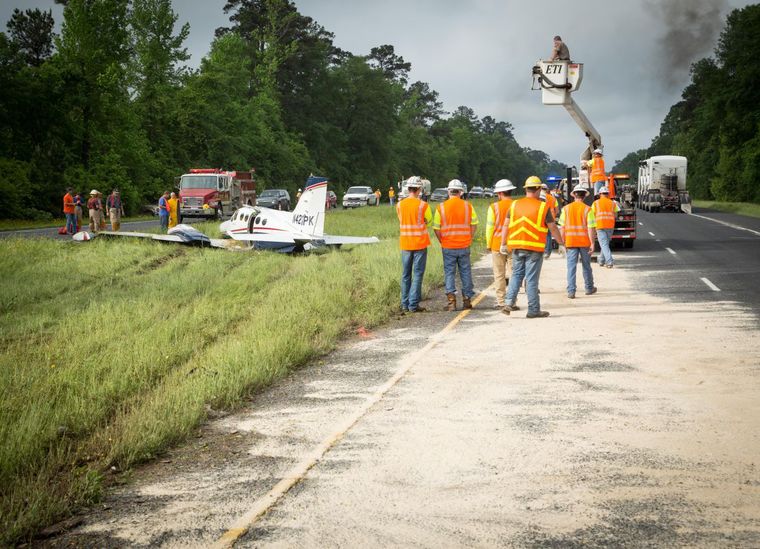
The AOPA’s Air Safety Foundation will be returning to Texas this coming week with their After the Crash: Surviving An Aircraft Accident seminar. Though aircraft accidents are rare to most pilots, they still happen. It is best to be prepared with the proper knowledge and supplies in case you are stranded in a remote area while awaiting help to arrive.
The seminar will cover the following items:
How and what to pack in a survival kit
Ways to help search parties find you
What to do first immediately after the off airport landing
How to survive will awaiting rescue
The seminar will be put on in Houston, San Antonio, and Austin on three consecutive nights, the 20th-22nd, so everyone will get a chance to attend. The location and times are below.
No signup is necessary, just show up and be ready to learn. The seminar does count for WINGs credit and there will be a sign in sheet at each event.
The AOPA Air Safety Foundation puts on numerous seminars throughout the country during the year covering a wide variety of topics relevant to general aviation pilots. The content is always interesting and the presenter always knowledgeable and entertaining. Hope to see you there!
Tuesday, January 20th
Wyndham Hotel, Houston West
14703 Park Row Blvd.
Houston, TX 77079
7:00pm-9:00pm
Wednesday, January 21st
Doubletree Hotel, San Antonio Airport
37 NE Loop 410
San Antonio, TX 78216
7:00pm-9:00pm
Thursday, January 22nd
Omni Hotel, Southpark
4140 Governor’s Row
Austin, TX 78744
7:00pm-9:00pm
For more information on the event and the locations, please click here.
You are at cruising altitude and your flight is going just as planned. All of that can change, sometimes without much warning, and you, the non-pilot, are now in charge. Would you know what to do?
This was a scary thought for me until I attended a seminar developed for the non-flyer at a Cirrus Owners Pilot Association (COPA) fly-in. Cirrus is the only small plane with a parachute as standard, so I thought all I had to do in an emergency was pull the chute. It’s a little more complicated than that!
I learned the vast majority of pilot incapacitation happens when the plane is at cruising altitude, so there is time to find a solution.
I was taught ten basic steps to follow to bring the plane safely to the ground.
First attempt to revive the pilot. If he is choking, it is possible to do a Heimlich maneuver from the side. This may dislodge whatever is blocking his airway and solve the problem. If he is experiencing hypoxia, turn off the heat, open all vents, and, if you have on board oxygen, use it. Also, if you can, get instructions on how to descend to a lower altitude. If the pilot is unconscious due to a heart attack or other medical emergency, there are still things you can do from the right seat.
Engage the autopilot if it isn’t already on and move the pilot off the controls. *
Ensure you are connected to the radio. If you hear ATC or other pilots, you are.
Send an electronic trouble message. Set the transponder to 7-7-0-0 to identify your plane to ATC. This will cause your plane to be highlighted on ATC radar screens.
ATC will most likely contact you asking what is your emergency. If this does not happen, you will need to transmit a Mayday call. All non-pilot passengers should know how to use the radio to get help, if they know nothing else.
With help from ATC, decide where you want to go.
Use the autopilot to fly in the direction suggested by ATC. I was taught that ultimately the choice of where to deploy the parachute is up to me because I am now the PIC, pilot in command.
Ensure that seat belts are secure and the emergency hammer is between your legs (so you have it to break a window to escape if needed).
Pull the parachute handle.
On the way down, shut down the engine and brace for impact.
After landing, move away from the plane, into the wind. Stay nearby and wait for help.
The seminar covered specific procedures to accomplish these basic steps, what to do if you don’t get a response from ATC, what to say in a Mayday transmission, how to fly a heading, how to check fuel levels, shut down the engine, etc. After the seminar, I felt much more comfortable about what to do if my pilot suddenly lost consciousness.
I was also told to practice what I had learned to avoid panicking in an emergency situation. There are so many things the person in the right seat can do under normal circumstances to practice. Learn how to set heading bugs, learn where the plane’s Electronic Locator Transmitter (ELT) is located and how to activate it. This will help rescuers locate the airplane. Learn how to assess your fuel levels. Practice making routine radio transmissions. Observe what your pilot does and ask questions if you don’t understand something.
Knowing what to do in an emergency situation will give you a sense of control over what will happen to you, your pilot, and any passengers on board your plane. If you have never considered taking a lesson or two for the non-pilot, find yourself an instructor, and learn what you need to know for your plane. Hopefully you will never have to use it, but if you do, you will be ready to be the PIC who lands the plane.
Anne and her husband Stephen are the proud owners of a Cirrus SR20. They plan to put the airplane to better use once Stephen retires. Anne has a background in desktop publishing and writing.
For a VFR or an IFR pilot, an unusual attitude can be one of the most dangerous situations to get into. That is one reason so many new autopilots are being developed with a level button. The concept behind the level button is if the pilot gets into a disorienting situation, press the level button and the autopilot comes on, holding the airplane in a straight and level pitch attitude.
What about all those planes without autopilots that have a level button? That’s who this article is for.
First off, what is an unusual attitude? The Airplane Flying Handbook on page 4-17 gives the following definition: “An unusual attitude is commonly referenced as an unintended or unexpected attitude in instrument flight.” The AFH also goes on to say that an unusual attitude in training has no defined bank and pitch parameters, but “for training purposes an instructor could place the airplane in a 30 degree bank with a nose up pitch attitude of 15 degrees and ask the student to recover and that would be considered an unusual attitude….”
We now have a basis from the FAA. VFR Pilots are now saying, “Oh, instrument flight, that doesn’t apply to us.” Not so fast. The Private Pilot ACS (and before it, the PTS) has a requirement for Basic Attitude Instrument Flying, including unusual attitude recoveries. Why? Because VFR pilots still inadvertently fly into IMC conditions and can get into an unusual attitude. Plus, a private, non-instrument rated pilot has a higher chance of not recovering from an unusual attitude since he isn’t used to relying on his instruments.
At each training event I do, whether it be private pilot training, a flight review, IFR training, transition training, or pretty much any kind of recurrent training, I like to do unusual attitude recoveries with my customers. It’s one of those things that the recovery procedure wanes over time since it isn’t routinely practiced solo (for good reason!).
I see people have the most trouble with the nose high unusual attitude recoveries. Let’s start with the recovery procedure, then I’ll discuss the common errors (notice that the nose high unusual attitude recovery procedure mirrors a stall recovery). Remember, this is in IFR conditions:
Breathe
Pitch Down to a level pitch attitude on the Attitude Indicator (or lower if the stall warning horn continues to go off)
Simultaneously add full power
Roll wings level
Flaps up and recover to a level pitch attitude if not there already
The order is important, especially the breathing part. What happens if a pilot goes straight into a recovery and doesn’t pause for a second or two to absorb what’s going on is the recovery isn’t executed properly.
Our brains see the wings banked and set off all kinds of alarms to roll the wings level first before doing anything else. Adding any kind of aileron input with the nose close to the critical angle of attack is a bad idea. You are adding adverse yaw (since you probably won’t be coordinated) and load factor which increases the stall speed. Then we all know that Stall + Yaw = Spin. That’s something that is best avoided in IMC.
We have to teach our brains to ignore the bank angle until the pitch and power come in. Once the airplane is far away from the critical angle of attack, then the bank can be rolled to neutral.
Let’s look at the nose low unusual attitude recovery. The order is still important on this one too:
Breathe
Power Reduce (to idle if necessary)
Roll Wings Level
Pitch up to a level pitch attitude
Add Power back to cruise
The theory with the nose low unusual attitude is your speed is accelerating. By reducing the power first, that helps reduce the load factor experienced when the pitch is increased. Same with rolling the wings level. Neutral bank is a lower load factor than some kind of a bank angle. We are trying to prevent overspeeding the airplane. The lower the load factor, the less of a chance we have to rip the wings off.
The most important step in either recovery procedure is to breathe first, allowing the brain to process exactly what is happening. That way, the proper recovery can be executed.