Thank you to everyone who made the 2022 Texas Top Aviation Fly In at the Hilton Santa Fe Buffalo Thunder Resort a success!
We had 22 attendees and 12 airplanes make it out to beautiful Santa Fe, New Mexico for the week.
After 2 days of very competitive golf, Chris Travland was our 2022 Texas Top Aviation Fly In Golf Tournament Champion.
While you are out in Santa Fe on your next trip, go check out the Rancho de Chimaya restaurant. It was excellent and a true New Mexican experience.
Mark your calendars for the 2023 Texas Top Aviation Dallas Fly In at the Westin Stonebriar Resort in Frisco, TX. McKinney National Airport (KTKI) will be our host airport. The event will be April 12th-April 14th, 2023. Hope to see you all there!
Looking for something different to do this Spring Break week?
Consider checking out the First Annual MODAERO NextGen Aviation Festival in Conroe, TX. It’s a fly in event, complete with camping opportunities, at the Lone Star Executive Airport, KCXO. The festival itself is being held right next door to the airport at the Lone Star Convention Center.
What’s the draw, do you ask? Not only are there going to be representatives from all the major aircraft manufacturer’s (along with tons of airplanes), there will be a multitude of speakers and live music. There are even drone races! The live music sets the event apart from the well known national fly in events like Osh Kosh and Sun N Fun. It’s a different type of Festival, geared toward the younger generation of pilots.
For more information or to register, check out MODAERO’s website. The festival runs from Wednesday through Saturday, March 16-19.
Looking for something different to do this Spring Break week? Consider checking out the First Annual MODAERO NextGen Aviation Festival in Conroe, TX. It’s a fly in event, complete with camping opportunities, at the Lone Star Executive Airport, KCXO. The festival itself is being held right next door to the airport at the Lone Star…
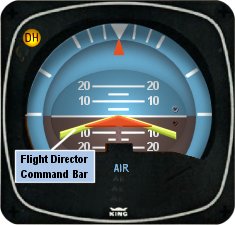
I’ve noticed that a lot of general aviation pilots tend to ignore the flight director on the attitude indicator. A lot of pilots don’t even know what it’s there for or how to use it. Talk to any airline pilot, though, and he or she will tell you how important the flight director actually is.
In most high performance airplanes, the flight director comes on when the autopilot comes on. Essentially, the autopilot is following the flight director, which tells the autopilot where to go. The flight director can also be used with the autopilot off, when hand flying an approach, for example. By turning the flight director on, it will show you where you need to fly to stay on course and on glide slope.
The flight director is most often controlled by the autopilot controller. The same buttons you use to put the autopilot in heading mode also tells the flight director to follow the heading bug when the autopilot is off. When you move the heading bug (or change course on the GPS, depending on which mode you have selected), the flight director will show you when you need to turn and when you need to stop turning. It directs your flight attitude, hence the name.
I recently discovered it’s a great backup when you have some instruments on the fritz. I went on a long flight in a steam gauge Piper Malibu and the attitude indicator started reading erratically. While flying straight and level, it would randomly indicate that I was in a 10 degree bank to the right, swing back and show wings level, then show a 3 degree turn left. This went on for a while. We were in VMC conditions, so legality wasn’t a problem, but it was kind of disorienting.
After a little while of this, the autopilot started acting up. It would start oscillating the pitch up and down, making it seem like we were going through a moguls course in the air. I ended up turning the autopilot off and hand flying the airplane.
This led to a conundrum, since my attitude indicator was unreliable. I could definitely look outside, since it was VMC, seeing when I was level and when I wasn’t. That would create a higher workload for me, which on a long flight like I was on, would lead to an increase in fatigue. The solution? The flight director!
I turned the autopilot off, but I left the flight director up. It wasn’t referencing the bank angle that the attitude indicator was showing since the KFC 150 goes off of the turn coordinator. So, if I just followed the attitude indicator, I could just keep scanning the instruments and relieve a little bit of my workload.
It actually worked really well. By just following the flight director, I was able to stay on course and on altitude with only minor attitude adjustments whenever we hit turbulence.
So, if you’re attitude indicator and autopilot decide to stop working on you, then bring up the flight director, push the same buttons you would if you were using the autopilot, and it works as a great backup.
I’ve noticed that a lot of general aviation pilots tend to ignore the flight director on the attitude indicator. A lot of pilots don’t even know what it’s there for or how to use it. Talk to any airline pilot, though, and he or she will tell you how important the flight director actually is….
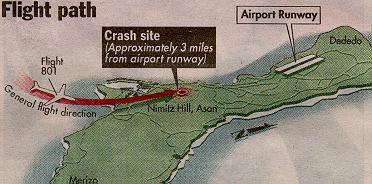
I ran across the story about the Korean Air flight that crashed in Guam in the late ’90s the other day. It was a 747 that hit the side of hill about 3 miles short of the runway, killing most of the people on board. The flight was at night (arrival time was about 1:30am) and the pilot’s lost sight of the runway on a visual approach due to inadvertent IMC entry. They didn’t execute a missed approach soon enough, got too low, and crashed.
These were experienced pilots, mind you, who had flown into that airport a number of times. They were experienced enough to know when to execute a go around. There were several other factors that led up to the crash, but, ultimately, they lost sight of the runway due to inadvertent IMC entry.
To all the VFR pilots out there, what do you do if you accidentally fly into a cloud? It’s a lot easier to encounter inadvertent IMC at night, simply because you can’t see the clouds in front of you. It is no less dangerous during the day, either.
So, we’re going back to the basics today. What really is the best course of action for a VFR pilot when flying into a cloud? One option (and in my opinion, the best option) is to turn around. Immediately start scanning your instruments, execute a shallow banked 180 degree turn while maintaining altitude, and fly out of the cloud you just flew into. If you have an autopilot, turn it on immediately and let it do the turn.
What if you were descending or climbing when you encountered the inadvertent IMC? In this case, just reverse whatever you were just doing. If you were descending, climb. If you were climbing, descend. Caution is needed, though, as climbing or descending when flying on instruments for an inexperienced IFR pilot could lead to a greater chance of disorientation.
One thing that could assist in spotting those clouds at night is turning the cockpit lights down. This will allow you to see outside a little bit better and start to notice when those ground lights are disappearing.
Most VFR pilots only do instrument flying on flight reviews. That doesn’t lead to a very high level of proficiency, so go out and grab your instructor and tell him to put you under the hood once a month. You’ll be a better pilot overall for it.
IFR pilots, taking a note from the Korean Air flight; if you lose sight of the runway on a visual approach, especially at night, go missed and ask for the instrument approach procedure. Don’t try and duck down below the clouds as there may be a hill or a mountain directly below you.
I ran across the story about the Korean Air flight that crashed in Guam in the late ’90s the other day. It was a 747 that hit the side of hill about 3 miles short of the runway, killing most of the people on board. The flight was at night (arrival time was about 1:30am)…
There was a bill introduced in Congress recently to take control of Air Traffic Control away from the FAA and give it to a private, for profit, corporation. The initial reaction of pilots is “Ahhh! User fees!” which we are all adamantly opposed to. There are a myriad of reasons why this is a bad idea (the “Flying” article makes a comparison to giving NASA to Richard Branson and Jeff Bezos) and we as pilots should be against it.
There was a bill introduced in Congress recently to take control of Air Traffic Control away from the FAA and give it to a private, for profit, corporation. The initial reaction of pilots is “Ahhh! User fees!” which we are all adamantly opposed to. There are a myriad of reasons why this is a bad…
If you’ve ever been to Nantucket Airport during the summer, you’ll understand when I say that it is a crazy place. During the summer months, especially on weekends, the airport is visited by an endless parade of airplanes ranging from the smallest GA airplanes to the biggest private jets.
One sunny Sunday afternoon I was standing in line at the front desk of the Nantucket FBO when the ramp door opened and a very grumpy and entitled man walked in. The man marched right up to the front desk and barked a fuel order at the girl working there, which she mistakenly read back wrong. After yelling at her for her wrongdoing, he announced that he had flown in to go to the restaurant and stormed off to drown his sorrows in fish and chips. Although he was a jerk, his attitude got me thinking about FBO’s and everything that the people who work at them do for us pilots.
For anyone who may not know, FBO stands for Fixed Base Operator. FBO’s can be found at airports everywhere and their business is to provide services such as fuel, hangar space, and tie downs. Bigger FBO’s can offer more services including rental cars, food, maintenance, flight instruction, etc. FBO workers have the ability to make life really good or really miserable for pilots, and, it seems to me, we pilots have the same power over them. Based on my personal experiences and the experiences of some friends who have worked at airports around the country, here are some things to think about next time you taxi onto an FBO ramp.
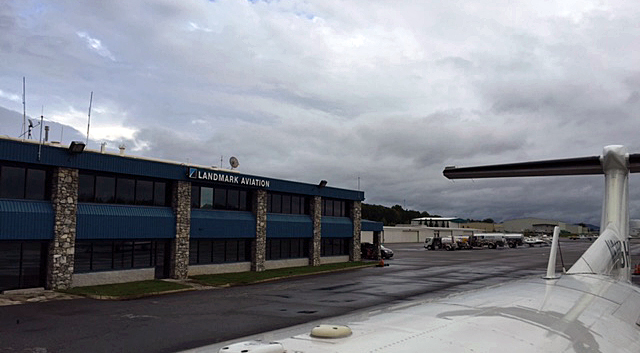
Landmark Aviation has the best pens
I’ve divided this article into two sections:
FBO Etiquette: What can we as pilots do to make life easier for the workers at the FBOs
FBO Pilot Perks: Ways that FBOs can help make a pilot’s life better (besides basic services like fueling)
FBO Etiquette
Be Polite
Everyone I talked to about their time working at an FBO said that simply by being friendly and polite is one of the biggest ways we can help. Most of the people that work at the FBOs love aviation and likely are working there to be around the industry in hopes of eventually being more involved. The girl working the desk at Nantucket didn’t deserve to be yelled at just for reading a tail number back wrong; don’t forget that “please” and “thank you” are still magic words.
Call Ahead
Whether you are flying to the airport, or you left your airplane at the FBO and you need them to pull it out or fuel it, calling ahead is greatly appreciated. Most FBO’s have a radio at the front desk and have their frequency listed online and in foreflight. Call ahead and tell them that you’re coming, when you’ll be arriving, and what you’ll need when you get there (gas, rental car, taxi..etc). That way they wont feel rushed and you may get what you’re looking for more expediently upon arrival.
Fuel orders
If your fuel order is difficult or confusing (example: 6.54 gallons in the right side and 4.32 in the left) you may be better off just to do it yourself at the self serve. One of the guys I talked to said that he would have pilots ask for extremely specific numbers and then stand there watching, ready to pounce when it wasn’t fueled exactly right. Its also worth noting that fuelers do make mistakes. Its highly recommended to watch and make sure that the correct truck (Jet A or 100LL) is the one pulling up to dispense your gas. Make sure you check that the fuel caps are properly installed before departing.
Look outside
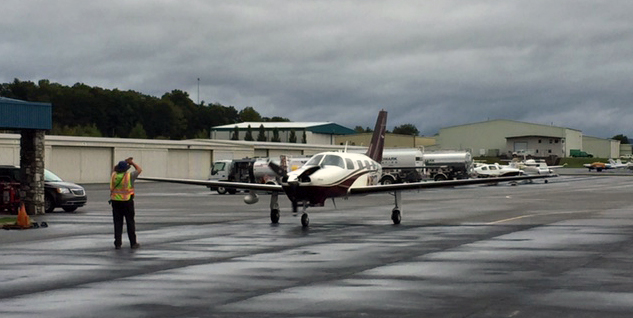
A lineman motions for the pilot to stop.
Taxiing onto the ramp is not the right time to be doing your after landing and shutdown checklists. Wait until the airplane is stopped before taking your eyes off the person marshaling you to your parking spot. I’ve been told that it isn’t uncommon for a pilot to be looking inside while taxiing and it makes the linemen very nervous as they are motioning to the pilot to stop (For those unfamiliar, with lineman hand signals, here’s a helpful link).
Brakes
Unless you have talked to them and get the okay, don’t leave the parking brake on when leaving your airplane at an FBO. Often the lineman will direct you to park upfront to make loading and unloading easy, but if you’re going to stay for a long period, the airplane will need to be towed and parked out of the way. Leaving the parking brake on can make serious headaches for the people trying to organize the ramp after you leave.
Lights
Don’t blind the poor guy parking you by leaving all your landing, taxi, and recognition lights on as you’re pulling into your spot at night. Likewise, when you are ready to leave your parking space, its courteous to signal the person waiting in front of your airplane by flashing one of your lights at them so they know you are ready to be directed off of the ramp.
FBO Pilot Perks
Good parking
This one is pretty basic. I’ve heard through the grapevine that you may get parked in the boondocks as punishment for being rude to the FBO staff. However, if asked, much of the time they can pull your airplane right up front and may even let you pull a vehicle onto the ramp to load people and bags more easily.
Cheaper hotel rooms/ rental cars
Some FBO’s have special rates with hotel and rental car companies around in the area. Although it varies from place to place, you may be surprised with the amount you can save on these travel essentials. I had a flight last week where I called and was given a quote of 185 dollars for a rental car…after telling them that I was parking at the local FBO, I got the special price of 125. Check with the FBO you will be stopping at for any of their current offerings.
Fuel discounts
Sometimes the price of fuel or the minimum uptake to waive the fees can be negotiated. Sometimes, the fees may be forgotten entirely. If you are unable to take the minimum amount of fuel to waive the landing or ramp charges, tell them what you can take and you may be pleasantly surprised with the response. Its not uncommon with our Bonanza that even though the “minimum” may be 20, I can waive the fees by up-taking 10 or 12 gallons instead.
Points/ Rewards cards
Some FBO’s offer incentives to pilots for buying gas. Many of the rewards programs are free to sign up for and will pay the fuel purchaser cash based on how much fuel they buy over a specified time period. I am a member of the Avtrip program which rewards fuel purchases at Avfuel airports with points that are redeemable for money. Avtrip is just one example of an FBO fuel rewards program; if you fly regularly, it may be worth looking into whether or not there is a fuel rewards program you can take advantage of.
Crew Cars
Most FBO’s have cars designated for use by the pilots. They are extremely nice for going to get lunch or taking care of whatever short errands you may need to run around town. Most crew cars are limited to about 1-2 hours of use, but they can often be loaned out longer based on the discretion of the people working the desk. On a few occasions, I’ve had the cars loaned to me for longer, even over night, by the nice people at the FBO (They always appreciate pilots splashing a few gallons of auto gas into the cars while they are out, too).
FBOs and the services that they provide are invaluable to pilots, both commercial and private. If we as pilots are willing to work with the linemen and service reps we can make both our lives and their lives easier. Remember to be polite and don’t be afraid to ask if you need something….that’s what they’re there for!
Andrew Robinson is a 135 Charter Pilot and flight instructor who lives with his wife and 2 daughters in Pennsylvania. He flies Pilatus PC-12s and instructs in Beechcraft Bonanzas.
If you’ve ever been to Nantucket Airport during the summer, you’ll understand when I say that it is a crazy place. During the summer months, especially on weekends, the airport is visited by an endless parade of airplanes ranging from the smallest GA airplanes to the biggest private jets. One sunny Sunday afternoon I was…
You just bought your Cirrus SR22. You do some flying, and soon find yourself with a brake temp sticker that isn’t white anymore. You remember from your transition training that any color other than white is a no go. You now ponder…. I don’t remember getting on the brakes hard, or riding the brakes while taxiing, but sure enough they aren’t white anymore. You now start thinking that all the horrible rumors of Cirrus brakes are true. They overheat so fast!
I would like to share some little-known facts about the Cirrus factory equipped braking system. Following the procedures below can help make the brakes last a little longer. There is also a very popular STC that allows upgraded brakes to be installed on all SR series aircraft. More to come on that.
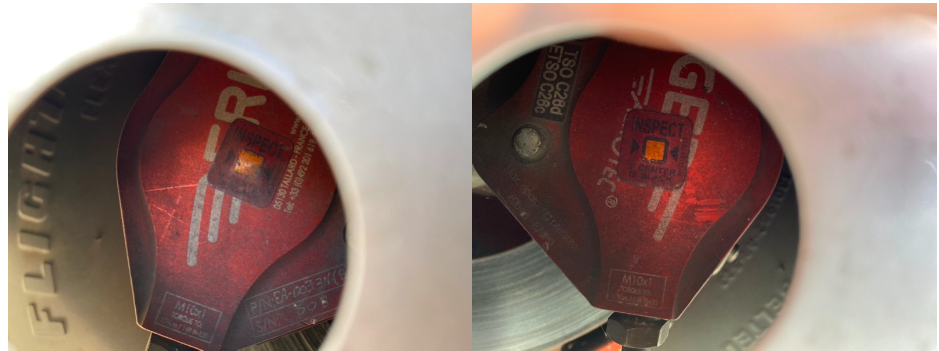
Notice the Top Yellow sticker is far darker than the Bottom. The Yellow temperature indicator turns at 300 Degrees, while the bottom Blue indicator turns at 330 Degrees. This is an indication to the pilot that if the bottom sticker has turned colors, that the braking system has exceeded 330 degrees and is in need of servicing.
Above is a photograph of an SR22 G1 braking system with turned brake temp stickers. The first things you may notice is that there are in fact two brake temperature stickers. We can only see the bottom blue sticker from the inspection port on the wheel pants. The other is higher on the caliper; in order to see it, the wheel pant must be removed. This isn’t common knowledge because there is no mention of this additional indicator in the POH.
Now you may be asking yourself, what can I do to extend the service life of my factory equipped Cirrus brakes? Here are some tips. First, always taxi at 1000 RPM and use the rudder as much as you can while only tapping the brakes. This is not fool proof, since sometimes, depending on the grade, you will have no choice but to utilize brake tapping to keep the aircraft going straight. Taxiing is not typically where the brakes get overheated, though, but this is still a good practice to follow.
What we tend to see is that the Cleveland brakes are generally overheated on landing. We always recommend to make sure your final approach speed is not excessive, land in the first 1/3 of the runway, and let the aircraft rollout to a smooth stop. What tends to happen is that the aircraft is too fast, and the pilot tries to exit at a certain taxi way, or brakes hard and continues to ride the brakes after landing during taxi. If you do your best to avoid these habits, it will serve you well.
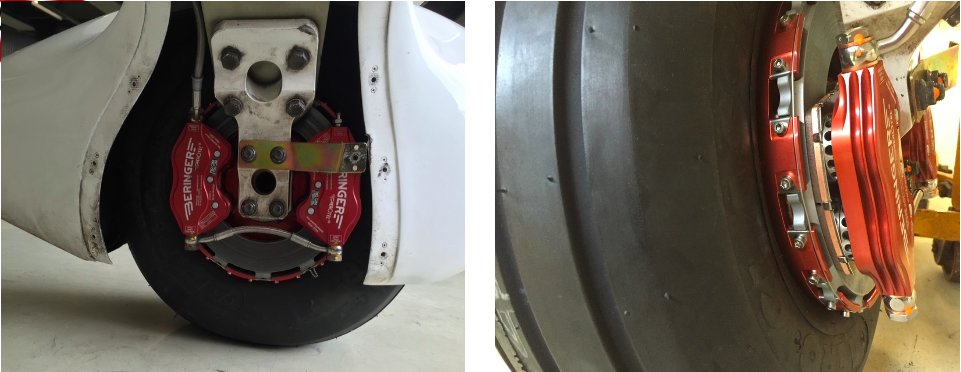
This braking system remained unchanged all the way until the 2016 G5 Cirrus SR series. Starting in 2016, the factory equipped G5 and G6 Cirrus SR series all now come standard with a single piston hydraulic braking system from Beringer. The Cirrus Beringer brakes far exceed the braking power and durability of the old system. The new system is more robust, withstands heat better, and is is very well built. There is also an option for an upgraded dual caliper system to increase durability and stopping power. A braking system STC for the older Cirrus G1 through early G5 models was created to upgrade those airplanes to the better stopping power and cooling of the Cirrus Beringer brakes.
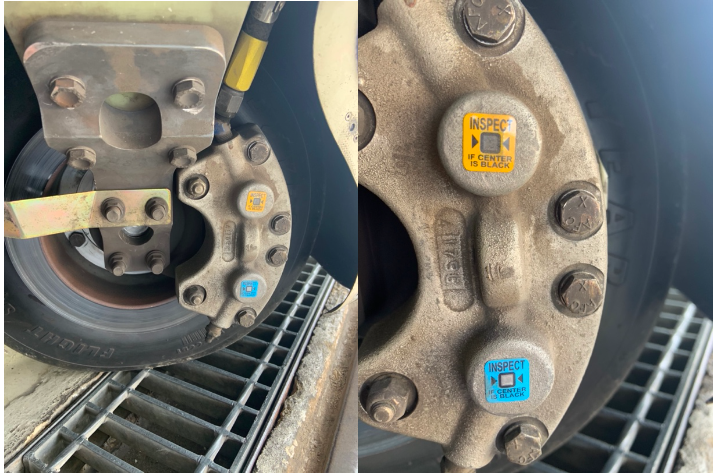
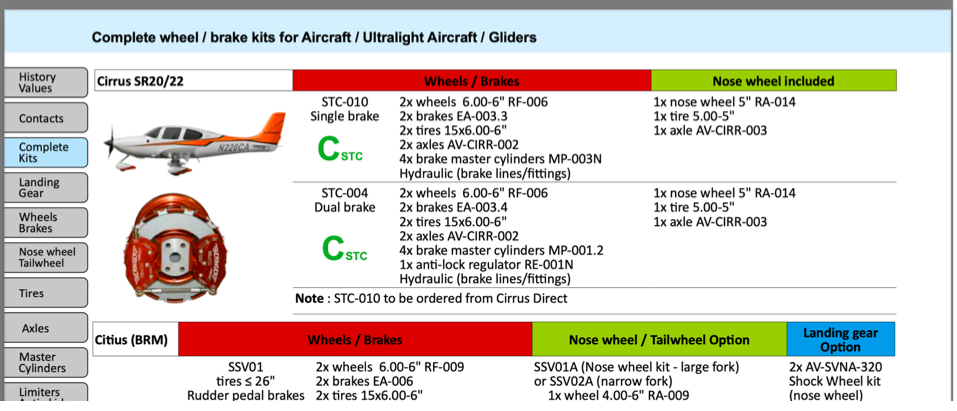
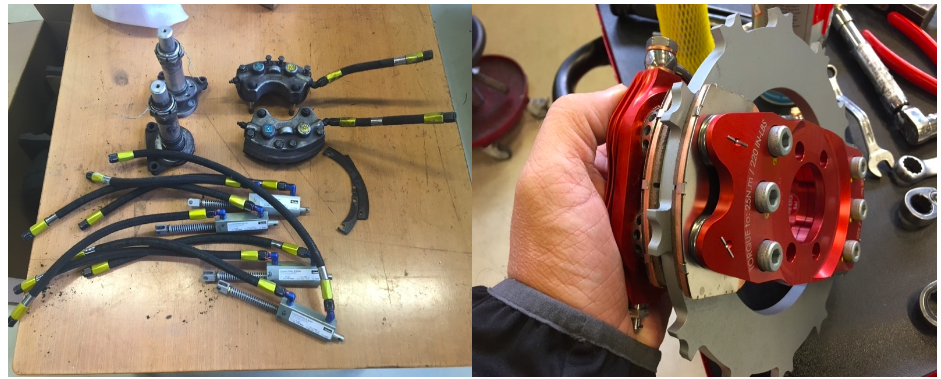
Seen above is a page from a Beringer catalog highlighting the Cirrus SR series STC kits. Your local Cirrus service center will be able to quote prices for the kits. We have over 1000Hrs spent behind Beringer equipped Cirrus aircraft and the difference is quite apparent. The pilot has better control of the aircraft, no spongy pedal, and the confidence to get the plane stopped without possibly overheating the braking system. This, in our opinion, is one of the best upgrades you can do to your Cirrus.Above is what an STC upgraded braking kit from Beringer looks like, as well as the new temperature indicator for the pre/post flight inspection. Notice the black spot on the left hand picture. These brakes have been overheated.
One other difference for a pilot to note is that once upgraded to the Cirrus Beringer brakes, there is only one temperature indicator and it changes color at a whopping 450 Degrees Fahrenheit! Needless to say, it can handle some heat! The new temperature indicator is now Orange in color and turns grey/black when overheated.
On the left are the original Cirrus factory brakes. On the right is the caliper to the new Beringer brakes for a Cirrus.Dual Caliper Cirrus Beringer Brakes
The Cirrus Beringer brakes upgrade is quite a step up in the world of slowing down. However, this doesn’t mean that they are completely issue free. There is one little-known problem with Beringer brakes that is not that big of a deal and can be fixed with relative ease.
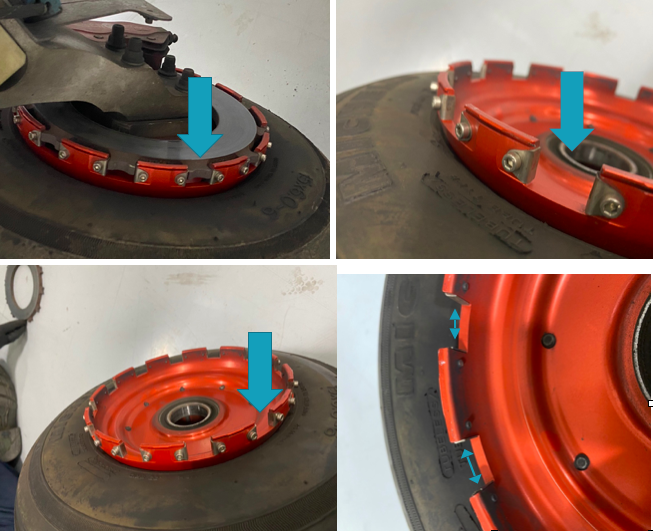
The rotor on the Beringer braking systems is “free floating,” meaning it is not necessarily “fixed” in position when secured down to the spindle. It is “keyed” into the wheel rim with the male and female side interlocking.
The brakes occasionally will get noisy, causing a “knocking” noise when brakes are applied. This noise is caused by the small metal tabs that tighten up the space between the wheel and the brake rotor. This is so the small tabs wear with use instead of the aluminum rim that they are fixed to. So, if your Beringers are making a knocking noise when brakes applied, this is most likely your culprit.
These gaps above are the “keyed” position where the rotor finds home in the rim. Without these tabs that wear with use, we would be replacing the rim more often than the much cheaper replaceable tabs.
It is highly recommended to upgrade your original Cirrus factory brakes to the new Beringer braking system. You will deal with less maintenance, less chance of a brake overheat, and less confusion on whether or not your brakes are airworthy. For more info, you can check out the Cirrus website for the single or dual caliper Beringer brakes.
Zach Anderson is a Cirrus Standardized Instructor Pilot (CSIP) for Texas Top Aviation. Zach comes from a auto mechanic background and is very familiar with the ins and outs of maintenance. He started working for Texas Top Aviation in December 2020.
You just bought your Cirrus SR22. You do some flying, and soon find yourself with a brake temp sticker that isn’t white anymore. You remember from your transition training that any color other than white is a no go. You now ponder…. I don’t remember getting on the brakes hard, or riding the brakes while…




 Most VFR pilots only do instrument flying on flight reviews. That doesn’t lead to a very high level of proficiency, so go out and grab your instructor and tell him to put you under the hood once a month. You’ll be a better pilot overall for it.