Earlier this week, Mooney announced they would be following competitors Piper (with their Archer DX) and Redbird (with their retrofitted 172 known as the Redhawk) into the training market with the Mooney M10 T and Mooney M10 J. Mooney, which hasn’t manufactured a primary trainer since the Mooney M10 Cadet in 1970, is planning on putting Jet A burning Continental Engines in the new aircraft. The mockup was unveiled at Airshow China.
The Mooney M10 T is a 3 seat, fixed gear trainer sporting a Continental CD-135 engine. At 135 HP, the initial design data claims the Mooney M10 T will be able to cruise at 140 KTAS at 75% power, allowing the Jet A engine to burn between 4-5 gallons per hour while holding 42 gallons of fuel. As with other Jet A piston powered airplanes, the Mooney M10 T will have a Fully Automated Digital Engine Control (or FADEC) system. This leaves just a single power lever in the cockpit, allowing the pilot to set a percent power and the FADEC computer will set the manifold pressure, prop speed, and mixture.
The Mooney M10 J has a slightly bigger engine, the 155 HP Continental CD-155. It also is equipped with retractable gear. Initially, Mooney is predicting 160 KTAS at 75% power for the Mooney M10 J. The airplane will come as a two-seater, but will have a third seat as an option. Mooney says that the Mooney M10 J will allow pilots to make an easy transition to the bigger and faster M20J that has been popular for many years amongst “Mooniacs.”
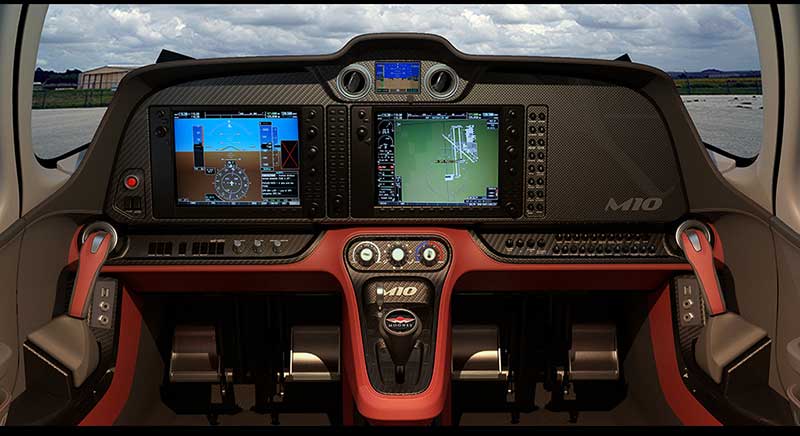
In a new direction for Mooney, the Mooney M10 T Mooney M10 J will both be composite airplanes with side sticks, instead of the traditional sheet metal exterior with a yoke as Mooney aircraft have been in the past. Also venturing from the more powerful Mooney aircraft is the fact that the Mooney M10 T and Mooney M10 J will have two doors. Remaining, though, is the swept tail that Mooney aircraft are known for. Both airplanes will be equipped with Garmin G1000 panels, while the Mooney M10 J will also have the GFC 700 autopilot, marketing more toward aircraft owners rather than students.
The only downside that I read about was the time between replacements for the engines. For the CD-135 engine in the Mooney M10 T, time between replacement is 1,500 hours, whereas the CD-155 only has a 1,200 hour replacement time.
Mooney expects certification and deliveries to begin for the Mooney M10 T and Mooney M10 J in 2017.
Information courtesy of AOPA and Mooney International. Images courtesy of Mooney International.
For a VFR or an IFR pilot, an unusual attitude can be one of the most dangerous situations to get into. That is one reason so many new autopilots are being developed with a level button. The concept behind the level button is if the pilot gets into a disorienting situation, press the level button and the autopilot comes on, holding the airplane in a straight and level pitch attitude.
What about all those planes without autopilots that have a level button? That’s who this article is for.
First off, what is an unusual attitude? The Airplane Flying Handbook on page 4-17 gives the following definition: “An unusual attitude is commonly referenced as an unintended or unexpected attitude in instrument flight.” The AFH also goes on to say that an unusual attitude in training has no defined bank and pitch parameters, but “for training purposes an instructor could place the airplane in a 30 degree bank with a nose up pitch attitude of 15 degrees and ask the student to recover and that would be considered an unusual attitude….”
We now have a basis from the FAA. VFR Pilots are now saying, “Oh, instrument flight, that doesn’t apply to us.” Not so fast. The Private Pilot ACS (and before it, the PTS) has a requirement for Basic Attitude Instrument Flying, including unusual attitude recoveries. Why? Because VFR pilots still inadvertently fly into IMC conditions and can get into an unusual attitude. Plus, a private, non-instrument rated pilot has a higher chance of not recovering from an unusual attitude since he isn’t used to relying on his instruments.
At each training event I do, whether it be private pilot training, a flight review, IFR training, transition training, or pretty much any kind of recurrent training, I like to do unusual attitude recoveries with my customers. It’s one of those things that the recovery procedure wanes over time since it isn’t routinely practiced solo (for good reason!).
I see people have the most trouble with the nose high unusual attitude recoveries. Let’s start with the recovery procedure, then I’ll discuss the common errors (notice that the nose high unusual attitude recovery procedure mirrors a stall recovery). Remember, this is in IFR conditions:
Breathe
Pitch Down to a level pitch attitude on the Attitude Indicator (or lower if the stall warning horn continues to go off)
Simultaneously add full power
Roll wings level
Flaps up and recover to a level pitch attitude if not there already
The order is important, especially the breathing part. What happens if a pilot goes straight into a recovery and doesn’t pause for a second or two to absorb what’s going on is the recovery isn’t executed properly.
Our brains see the wings banked and set off all kinds of alarms to roll the wings level first before doing anything else. Adding any kind of aileron input with the nose close to the critical angle of attack is a bad idea. You are adding adverse yaw (since you probably won’t be coordinated) and load factor which increases the stall speed. Then we all know that Stall + Yaw = Spin. That’s something that is best avoided in IMC.
We have to teach our brains to ignore the bank angle until the pitch and power come in. Once the airplane is far away from the critical angle of attack, then the bank can be rolled to neutral.
Let’s look at the nose low unusual attitude recovery. The order is still important on this one too:
Breathe
Power Reduce (to idle if necessary)
Roll Wings Level
Pitch up to a level pitch attitude
Add Power back to cruise
The theory with the nose low unusual attitude is your speed is accelerating. By reducing the power first, that helps reduce the load factor experienced when the pitch is increased. Same with rolling the wings level. Neutral bank is a lower load factor than some kind of a bank angle. We are trying to prevent overspeeding the airplane. The lower the load factor, the less of a chance we have to rip the wings off.
The most important step in either recovery procedure is to breathe first, allowing the brain to process exactly what is happening. That way, the proper recovery can be executed.
For a VFR or an IFR pilot, an unusual attitude can be one of the most dangerous situations to get into. That is one reason so many new autopilots are being developed with a level button. The concept behind the level button is if the pilot gets into a disorienting situation, press the level button…
I recently purchased the new, wireless, Lightspeed Tango headset. I’m a little OCD, so when a headset wire is banging against my shoulder while I’m trying to tune a radio or point something out, it’s a little annoying. A headset without the wires caught my eye.
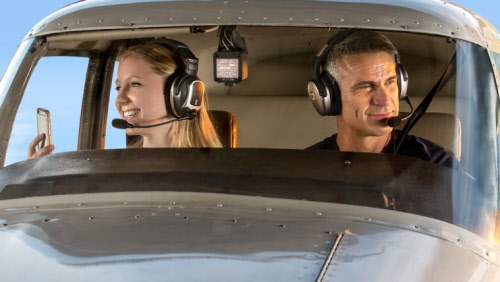
As I’ve stated before in a previous article, I really like Lightspeed headsets. They are more comfortable than Bose, and a little bit more affordable too. The noise canceling quality is very high in the different Lightspeed models. I personally believe it got even better with the Lightspeed Tango.
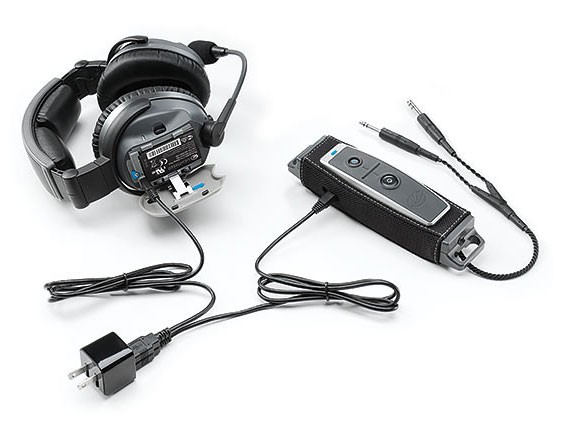
Let’s talk about the obvious first. Not having a wire connecting you to the headset jacks is really nice. You’re not tethered to anything, so your head is free to move anywhere without getting yanked back in place. Lightspeed developed a new technology, called Lightspeed Link, which bypasses Bluetooth or Wifi and connects the Panel Interface to the headset wirelessly.
The Link technology works pretty well. The only problem I have noticed is in certain airplanes, I occasionally lose one ear, but after I wiggle the input wires around, the deaf ear comes back up. It may be a loose connector in the plane itself.
The really nice thing about the Lightspeed Tango is the fact that it doesn’t need AA batteries anymore. Lightspeed put rechargeable lithium ion batteries in both the Panel Interface and the headset. You get 12 hours of battery life out of both, far surpassing any length of time you would want to be in an airplane. If the battery dies, there is a handy aux cable that can connect the Panel Interface directly to the headset (the ion batteries recharge with the included wall charger and USB cables in 2 hours).
Though the Lightspeed Tango is slightly heavier than the Zulu 2 due to the Link hardware and the lithium ion battery, it is still extremely comfortable. The ear cups actually fit better over my ears and give me a better seal with glasses on then the Zulu 2 did. As with all Lightspeed products, there is no squeezing of my head and the cushions on top of the headset sit very comfortably on top of my head.
The Bluetooth is much simpler to use than the Zulu 2 and definitely simpler than the Bose A20. Sound quality is very good for phone calls and music. The volume control on the headset itself is set to make smaller adjustments so you don’t have to deal with wide swings in volume.
Overall, I’m a big fan of the Lightspeed Tango. I am recommending them to all the pilots I talk to. Rolling in at $400 cheaper than the Bose, you can’t go wrong.
I recently purchased the new, wireless, Lightspeed Tango headset. I’m a little OCD, so when a headset wire is banging against my shoulder while I’m trying to tune a radio or point something out, it’s a little annoying. A headset without the wires caught my eye. As I’ve stated before in a previous article, I…
If you’ve ever been to Nantucket Airport during the summer, you’ll understand when I say that it is a crazy place. During the summer months, especially on weekends, the airport is visited by an endless parade of airplanes ranging from the smallest GA airplanes to the biggest private jets.
One sunny Sunday afternoon I was standing in line at the front desk of the Nantucket FBO when the ramp door opened and a very grumpy and entitled man walked in. The man marched right up to the front desk and barked a fuel order at the girl working there, which she mistakenly read back wrong. After yelling at her for her wrongdoing, he announced that he had flown in to go to the restaurant and stormed off to drown his sorrows in fish and chips. Although he was a jerk, his attitude got me thinking about FBO’s and everything that the people who work at them do for us pilots.
For anyone who may not know, FBO stands for Fixed Base Operator. FBO’s can be found at airports everywhere and their business is to provide services such as fuel, hangar space, and tie downs. Bigger FBO’s can offer more services including rental cars, food, maintenance, flight instruction, etc. FBO workers have the ability to make life really good or really miserable for pilots, and, it seems to me, we pilots have the same power over them. Based on my personal experiences and the experiences of some friends who have worked at airports around the country, here are some things to think about next time you taxi onto an FBO ramp.
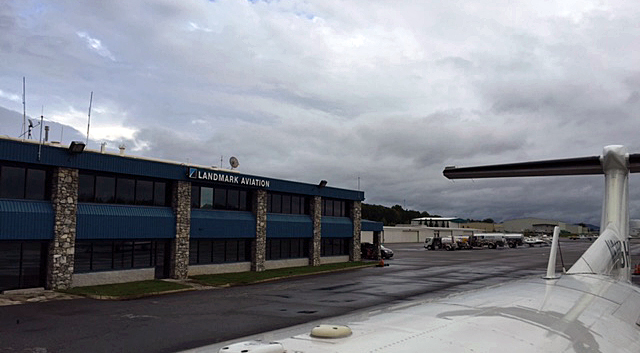
Landmark Aviation has the best pens
I’ve divided this article into two sections:
FBO Etiquette: What can we as pilots do to make life easier for the workers at the FBOs
FBO Pilot Perks: Ways that FBOs can help make a pilot’s life better (besides basic services like fueling)
FBO Etiquette
Be Polite
Everyone I talked to about their time working at an FBO said that simply by being friendly and polite is one of the biggest ways we can help. Most of the people that work at the FBOs love aviation and likely are working there to be around the industry in hopes of eventually being more involved. The girl working the desk at Nantucket didn’t deserve to be yelled at just for reading a tail number back wrong; don’t forget that “please” and “thank you” are still magic words.
Call Ahead
Whether you are flying to the airport, or you left your airplane at the FBO and you need them to pull it out or fuel it, calling ahead is greatly appreciated. Most FBO’s have a radio at the front desk and have their frequency listed online and in foreflight. Call ahead and tell them that you’re coming, when you’ll be arriving, and what you’ll need when you get there (gas, rental car, taxi..etc). That way they wont feel rushed and you may get what you’re looking for more expediently upon arrival.
Fuel orders
If your fuel order is difficult or confusing (example: 6.54 gallons in the right side and 4.32 in the left) you may be better off just to do it yourself at the self serve. One of the guys I talked to said that he would have pilots ask for extremely specific numbers and then stand there watching, ready to pounce when it wasn’t fueled exactly right. Its also worth noting that fuelers do make mistakes. Its highly recommended to watch and make sure that the correct truck (Jet A or 100LL) is the one pulling up to dispense your gas. Make sure you check that the fuel caps are properly installed before departing.
Look outside
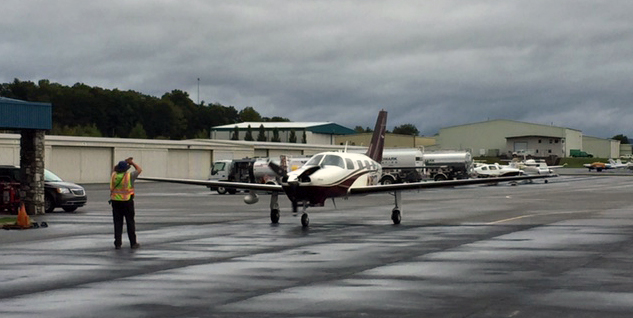
A lineman motions for the pilot to stop.
Taxiing onto the ramp is not the right time to be doing your after landing and shutdown checklists. Wait until the airplane is stopped before taking your eyes off the person marshaling you to your parking spot. I’ve been told that it isn’t uncommon for a pilot to be looking inside while taxiing and it makes the linemen very nervous as they are motioning to the pilot to stop (For those unfamiliar, with lineman hand signals, here’s a helpful link).
Brakes
Unless you have talked to them and get the okay, don’t leave the parking brake on when leaving your airplane at an FBO. Often the lineman will direct you to park upfront to make loading and unloading easy, but if you’re going to stay for a long period, the airplane will need to be towed and parked out of the way. Leaving the parking brake on can make serious headaches for the people trying to organize the ramp after you leave.
Lights
Don’t blind the poor guy parking you by leaving all your landing, taxi, and recognition lights on as you’re pulling into your spot at night. Likewise, when you are ready to leave your parking space, its courteous to signal the person waiting in front of your airplane by flashing one of your lights at them so they know you are ready to be directed off of the ramp.
FBO Pilot Perks
Good parking
This one is pretty basic. I’ve heard through the grapevine that you may get parked in the boondocks as punishment for being rude to the FBO staff. However, if asked, much of the time they can pull your airplane right up front and may even let you pull a vehicle onto the ramp to load people and bags more easily.
Cheaper hotel rooms/ rental cars
Some FBO’s have special rates with hotel and rental car companies around in the area. Although it varies from place to place, you may be surprised with the amount you can save on these travel essentials. I had a flight last week where I called and was given a quote of 185 dollars for a rental car…after telling them that I was parking at the local FBO, I got the special price of 125. Check with the FBO you will be stopping at for any of their current offerings.
Fuel discounts
Sometimes the price of fuel or the minimum uptake to waive the fees can be negotiated. Sometimes, the fees may be forgotten entirely. If you are unable to take the minimum amount of fuel to waive the landing or ramp charges, tell them what you can take and you may be pleasantly surprised with the response. Its not uncommon with our Bonanza that even though the “minimum” may be 20, I can waive the fees by up-taking 10 or 12 gallons instead.
Points/ Rewards cards
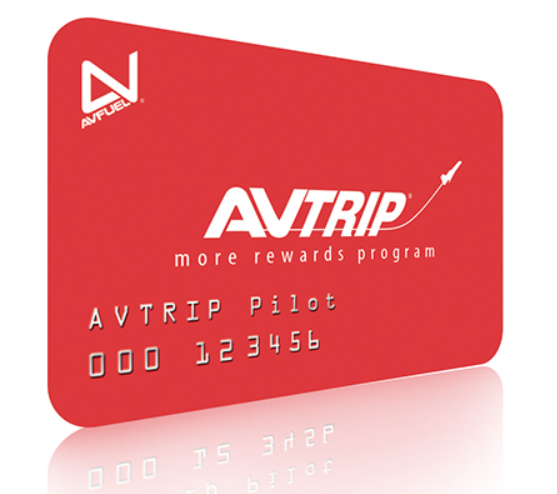
Some FBO’s offer incentives to pilots for buying gas. Many of the rewards programs are free to sign up for and will pay the fuel purchaser cash based on how much fuel they buy over a specified time period. I am a member of the Avtrip program which rewards fuel purchases at Avfuel airports with points that are redeemable for money. Avtrip is just one example of an FBO fuel rewards program; if you fly regularly, it may be worth looking into whether or not there is a fuel rewards program you can take advantage of.
Crew Cars
Most FBO’s have cars designated for use by the pilots. They are extremely nice for going to get lunch or taking care of whatever short errands you may need to run around town. Most crew cars are limited to about 1-2 hours of use, but they can often be loaned out longer based on the discretion of the people working the desk. On a few occasions, I’ve had the cars loaned to me for longer, even over night, by the nice people at the FBO (They always appreciate pilots splashing a few gallons of auto gas into the cars while they are out, too).
FBOs and the services that they provide are invaluable to pilots, both commercial and private. If we as pilots are willing to work with the linemen and service reps we can make both our lives and their lives easier. Remember to be polite and don’t be afraid to ask if you need something….that’s what they’re there for!
Andrew Robinson is a 135 Charter Pilot and flight instructor who lives with his wife and 2 daughters in Pennsylvania. He flies Pilatus PC-12s and instructs in Beechcraft Bonanzas.
If you’ve ever been to Nantucket Airport during the summer, you’ll understand when I say that it is a crazy place. During the summer months, especially on weekends, the airport is visited by an endless parade of airplanes ranging from the smallest GA airplanes to the biggest private jets. One sunny Sunday afternoon I was…
A couple of months ago, I had a life-threatening experience while flying. Thankfully, with my flight training, along with a lot of luck, I am here to talk about it.
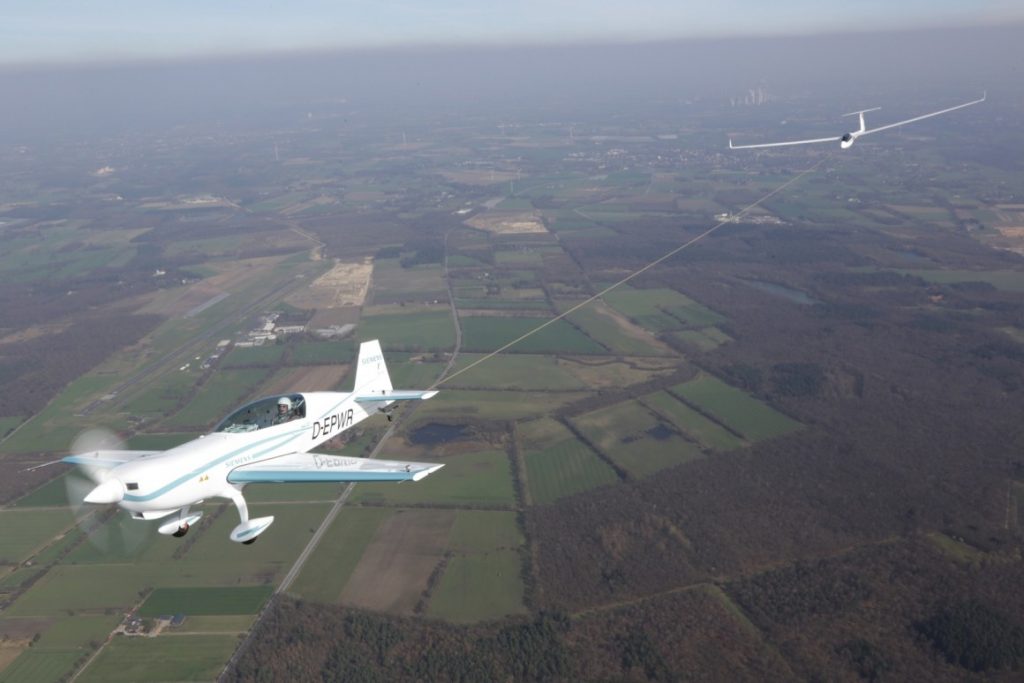
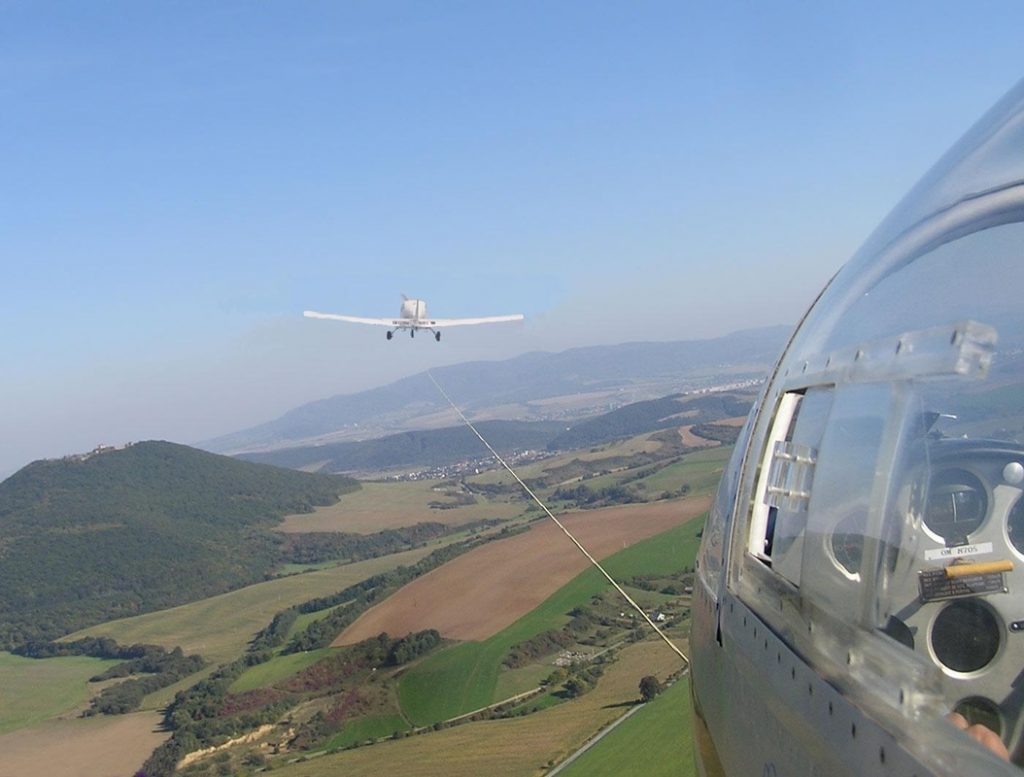
One of my many piloting jobs is as a glider tow pilot. For those not familiar with gliding, since a glider doesn’t have an engine, every time a glider pilot goes and flies, it’s a team effort. A powered airplane (anything from a Super Cub to a turbine powered Air Tractor) is attached to the glider via a tow rope, which is about 200 feet long. Once the glider pilot gives the go ahead over the airport’s CTAF, then the tow plane begins it’s takeoff roll, pulling the glider along behind it.
The glider becomes airborne prior to the tow plane, then the tow plane will circle the airport environment till it get’s to the pre-determined altitude to release the glider. Some tows are pattern tows and some are higher (not usually above 3,000 AGL), depending on the request from the glider pilot. Once the altitude is reached, the glider pilot pulls a handle in the glider to release the tow rope, then begins his glide. The rope stays attached to the tail of the tow plane, which in turn descends back down to the runway and lands. The tow plane also has a tow rope release handle in case of emergency.
On this particular tow, the plan was to tow the glider up to 3,000 AGL. Upon reaching 2,500 AGL, the glider pilot called me on the radio and stated that his rear canopy had opened up. I looked over my shoulder and sure enough, the rear canopy was fully opened while he was still in level flight behind me. I asked him if he wanted me to tow him closer to the field, but he didn’t reply.
Now, as an experienced tow pilot, I know a glider canopy popping open should not be an emergency situation. It’s definitely abnormal, but would be similar to a door or window popping open in a powered airplane. Not a big deal. If too much force from the relative wind is applied to the canopy, it would snap off; however, a glider can easily land without a rear canopy.
About 5 seconds after I radioed the pilot (and received no reply), I felt my tail instantaneously lift up into a completely vertical position, which caused my nose to go straight down. The next thing I knew, a whole lot of earth suddenly filled my windscreen and I was in what’s known as a graveyard spiral.
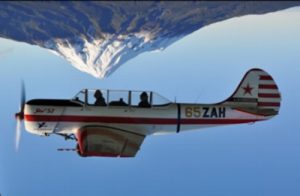
A graveyard spiral (as defined from the Airplane Flying Handbook pg 4-23), “is a descending turn during which airspeed and G-load can increase rapidly….the airplane is flying very tight circles, in a nearly vertical attitude and will be accelerating since it isn’t stalled.” It’s also known as a spiral dive.
Back to the story. At this point, I tried to reach for the glider release handle. Unfortunately, due to the shoulder straps holding me against the seat, plus the g’s, and also the quart of oil and tow bar that flew forward and hit me in the back of the head, I couldn’t reach it. I was semi-upside down at a certain point, which dislodged the oil and tow bar from the floor of the baggage compartment. They sailed over the seat and nearly gave me a concussion.
At this point, 2,500 feet above the ground, I had a choice to either fight for my life at a very low altitude or to sit back and become part of a big explosion.
I decided to fight for my life.
As I was spiraling to the ground, I felt the tow rope snap. Up to this point, I had still been attached to the glider. The rope snapping was a good thing, as my airplane was now under my control, not attached to, and being affected by, a glider (more on that later). I now had a lifeline, no pun intended.
After I felt the rope snap, my instincts and training kicked in. I initiated the spin recovery procedure using the PARE acronym. This task was difficult to do as I had a lot of debris flying from the rear of the plane to the front, blocking my view out of the windshield. There was also debris around my feet, hampering my ability to use the rudder pedals. The spiral finally stopped and I recovered approximately 500 feet above the tree tops. It took my heart a lot longer to stop spinning.
After barely regaining my emotions, I tried to evaluate the condition of the plane. Were all the pieces of the plane still there, was the engine damaged, did my control surfaces still work?
Once I advanced the throttle and saw an increase in my engine RPM, I started an immediate climb to give me altitude to get back to the airport. I had engine power but I wasn’t sure how long it would last if I had damage. Now, what they don’t teach you during spin training is that when this happens unexpectedly, you will become very disorientated. You have just been spiraling unexpectedly and your equilibrium will be out of whack. As I leveled out just over the tree tops, I was too low to visually see any landmarks, nor could I see the airport. Once I was able to climb, I was able to orient myself and figure out where the airport was.
I had to be very careful getting back to the airport and landing without radio communication, since my radio was knocked out with all of the FOD from the baggage area. Thankfully, the landing was uneventful. After I landed, I saw the glider limp in over the trees. The rear canopy was totally gone, while the front canopy and other parts of the glider had suffered major damage. Miraculously, my airplane wasn’t damaged, except for the wire from the radio which came loose during the spiral.
So, how did all this happen, you ask? Well, the glider pilot made 2 huge mistakes. First, in gliding, the moment the glider pilot loses visual sight of the tow plane, you are supposed to release the tow rope. He did not do that and almost killed both of us.
Second, as pilots we are taught to always fly the airplane first. Everything else, no matter what it is, always comes after flying the airplane. As I stated previously, the loose canopy is not an emergency situation, but since the glider pilot did not aviate first and was distracted, it was almost a fatal day for 2 people and 2 airframes.
So, what caused this chain of events? By getting distracted by the open canopy, the glider pilot inadvertently pulled back on the stick while trying to close the canopy. Then, by not releasing the glider from the tow plane, the glider pilot climbed rapidly with an excessive rate of climb while still being attached to me. The rapid climb is what pulled my tail up, causing my nose to drop and put me into the spiral. The tow rope snapping set into motion my recovery, since up till that point, I literally had no control. An extremely high lift wing was attached to my tail, pulling it up, and there was absolutely nothing I could do about it.
We all spend time practicing and demonstrating emergency maneuvers during our flight training and during flight reviews. Many times you might think, I’ll never need to use this stuff. Thankfully, some of the procedures I learned in the past kicked in at a time of need, even though my heart was beating out of my chest.
At some point in every pilot’s career, some type of spin training or Upset Recovery Training would be highly recommended. Then, when things go wrong, remember to always aviate first, then handle all the other things that need to be handled.
Interested in spin training or Upset Recovery Training (UPRT)? Check out the list of Malibu & M-Class Owner’s and Pilot’s Association (MMOPA) approved UPRT vendors and schedule UPRT training today.
by Lance Stick & Hank Gibson A couple of months ago, I had a life-threatening experience while flying. Thankfully, with my flight training, along with a lot of luck, I am here to talk about it. One of my many piloting jobs is as a glider tow pilot. For those not familiar with gliding, since…
Texas Top Aviation wants to express our heartfelt concerns and prayers for those affected by Hurricane Harvey along the Texas Gulf Coast and in Houston. We have several customers in Houston and hope and pray that they are all safe.
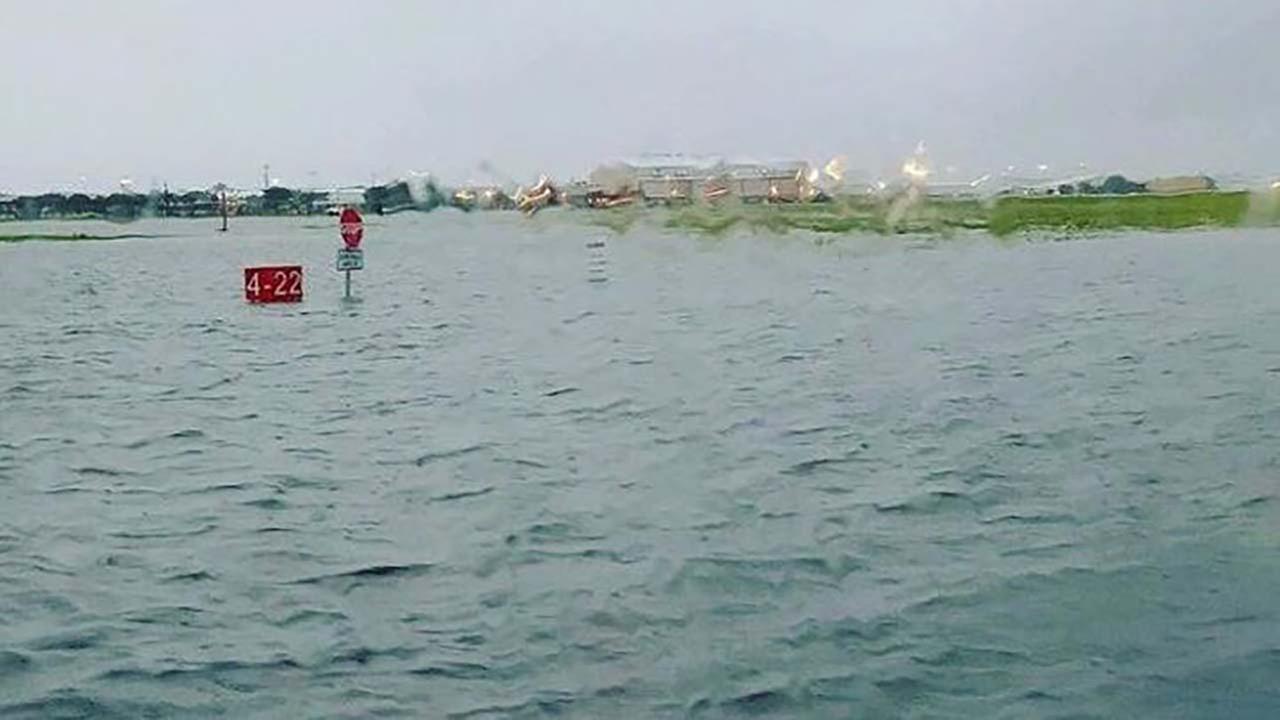
The Houston Hobby Airport after Hurricane Harvey’s Torrential downpour
If you would like to donate to the relief effort, there are several organizations that are accepting support. A few are below.
Texas Top Aviation wants to express our heartfelt concerns and prayers for those affected by Hurricane Harvey along the Texas Gulf Coast and in Houston. We have several customers in Houston and hope and pray that they are all safe. If you would like to donate to the relief effort, there are several organizations that…
The Cirrus Pilot Proficiency Program (CPPP) will be coming to the Galaxy FBO at the Lone Star Executive Airport in Conroe, TX again this year. The dates of the event will be October 14th-16th.
Wondering what the CPPP program is?
“CPPP offers a weekend event for Cirrus owners and their partners that focuses on Cirrus-specific knowledge and flying proficiency. We bring some of the most experienced flight instructors who regularly teach in all kinds of Cirrus airplanes flown for all kinds of missions. We have prepared an extensive syllabus of ground courses that complement the transition training and delve into areas of greatest need for Cirrus pilots.” (from CirrusPilots.org)
The weekend starts off with a group dinner on Friday night. The Saturday morning ground session focuses on General Aviation Safety with special focus on the Cirrus accident statistics. Normal and emergency procedures are also reviewed.
In the afternoon on Saturday, the attendees are split into two groups. The first group has a myriad of options for ground sessions covering all topics related to Cirrus aircraft and operations. The second group flies, then they switch for the second 3 hour session. Sunday brings the same split, with more courses offered and more flying.
While the Cirrus pilots are flying and learning more about their airplanes, CPPP offers a Partner in Command course for flying partners on Saturday. This allows flying partners to be more comfortable in the airplane and teaches them what to do if something were to happen to the pilot.
All in all, attending a CPPP will improve both Cirrus knowledge and Cirrus flying skills. It’s highly recommended for all Cirrus pilots.
To register for the CPPP event in Conroe, check out the CPPP website.
The Cirrus Pilot Proficiency Program (CPPP) will be coming to the Galaxy FBO at the Lone Star Executive Airport in Conroe, TX again this year. The dates of the event will be October 14th-16th. Wondering what the CPPP program is? “CPPP offers a weekend event for Cirrus owners and their partners that focuses on Cirrus-specific…