Checking The Stall Warning Horn

When a pilot first glances at the title of this article, the first thought that probably goes through that pilot’s head is, well that’s easy.

And it is, if you are flying a high wing Cessna. On other airplanes, there are a few tricks to checking the stall warning horn. If you get them wrong, you’re liable to get a bill from your maintenance shop for an hour of labor for a problem they couldn’t duplicate.

Cirrus SR22

Let’s start with the Cirrus. On the pre-FIKI Cirrus aircraft, there was a small little hole in the wing that contained a diaphragm. That diaphragm sensed a change in airflow at a certain angle of attack just below the critical angle of attack and set off the stall warning horn. Unfortunately, the only way to check that is to suck on the hole during pre-flight.

I don’t. I verify the hole is clear and that’s about it.

On the FIKI Cirrus aircraft, there is actually a stall warning vane. It looks like a high wing Cessna vane, but if you turn the batteries on and try and get it to come on during your light and pitot heat check, nada.

Here’s the trick, and the checklist doesn’t do a good job of describing this.

  • Turn on the Avionics Master
  • Turn on the speaker
  • Put the flaps to full
  • Then move the stall warning vane and you’ll hear the horn
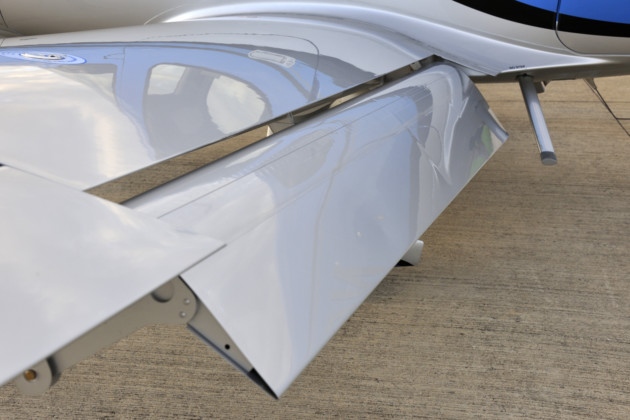
The speaker and the Avionics Master are so you can actually hear the horn (if you had the headset on while you were doing this, the speaker would be unnecessary). The flaps have to be full because the pitch attitude for the critical angle of attack is lower with the flaps down, so the horn goes off when at a different angle. You then don’t have to use as much force to push the vane.

Piper PA46

The early -310P Malibus are pretty simple and straight forward. Move the vane, get the horn.

In the -350P, you can’t get the horn to come on by moving the vane. So, Piper put a stall test button that’s hidden underneath the upper left side of the instrument panel. Push that to test the horn. On the G1000 PA46, it is located directly above the PFD. On the Avidyne, it’s below and to the left of the pilot’s yoke.


Testing the stall warning horn is a very important part of pre-flight. A pilot needs to know if the aircraft is close to a stall. The advent of Angle of Attack indicators in small, GA aircraft, have added a greater awareness to the angle of attack during all phases of flight to avoid those stall spins.

If the stall warning horn goes off or the AOA shows yellow, lower that nose immediately.

Similar Posts

  • Cirrus CAPS Pull in Arkansas

    Cirrus CAPS pull #55 took place at the beginning of November over Fayatteville, AR.  From initial reports, it appears a clamp broke on the oil cooler, causing a loss of oil pressure.  It does not appear that the engine immediately quit, but an annunciator alerted the pilot that the engine was losing oil pressure.  At this point, it appears the pilot elected to do an emergency descent to an airport below him, but ended up not timing it right, missing the airport and pulling the parachute.

    As an experienced Cirrus flight instructor, there appears to be some suspect decision making in handling this operation.  I teach in a Cirrus that if an oil light comes on, given that a pilot has some altitude to work with, it is a better option to physically shut the engine down, leaving control of the situation in the pilot’s hands.  This way, the pilot knows when the engine is stopping and is prepared for it, instead of the engine acting erratically and causing problems on the descent.

    After checking the engine gauges and shutting the engine down, a pilot should establish best glide first, not nose down and descend at a high rate trying to make an airport.  Best glide gives the pilot many more options and a lot more altitude to work with, further allowing him/her to plan how to make an airport directly underneath the airplane.

    To pontificate, it seems that if the pilot had adjusted the plane to best glide, instead of performing an emergency descent, there is the possibility that Drake Field would have been reachable, the chute would not have been needed, and the driver of the truck would not have had to visit the hospital.  Hindsight is 20-20, but this may be an overall training and decision making issue that may need further emphasis.

    The initial NTSB report as well as a link to the CBS story is below.

    http://www.cbsnews.com/live/video/pilot-forced-to-deploy-emergency-parachute-in-arkansas/

    NTSB Identification: CEN16LA026
    14 CFR Part 91: General Aviation
    Accident occurred Tuesday, November 03, 2015 in Fayetteville, AR
    Aircraft: CIRRUS DESIGN CORP SR22T, registration: N857SW
    Injuries: 3 Minor, 1 Uninjured.
    This is preliminary information, subject to change, and may contain errors. Any errors in this report will be corrected when the final report has been completed. NTSB investigators may not have traveled in support of this investigation and used data provided by various sources to prepare this aircraft accident report.
    On November 3, 2015, at 0950 central standard time, a Cirrus SR22T airplane, N857SW, descended under the canopy of the cirrus airframe parachute system (CAPS) and landed on a road in Fayetteville, Arkansas. The pilot, pilot rated passenger and one person on the ground received minor injuries. One passenger in the back right seat was uninjured. The airplane was substantially damaged. The airplane was registered to WG Aviation LLC, Rogers, Arkansas, and operated by a private individual under the provisions of 14 Code of Federal Regulations Part 91 as a personal flight. Visual meteorological conditions prevailed at the time of the accident and an instrument flight rules (IFR) flight plan was filed. The flight departed from the Bentonville Municipal Airport (VBT), Bentonville, Arkansas, at 0934 and was en route to the Waco Regional Airport (ACT), Waco, Texas.

    According to the pilot, after departure from ACT he leveled off around 10,000 ft mean sea level (MSL) and was in “VFR on top” conditions. The pilot noticed that the crew alerting system (CAS) flashed a yellow caution light for oil pressure; the engine was still producing power. The pilot notified air traffic control (ATC) of the issue and received vectors to the nearest airport, Drake Field Airport (FYV), Fayetteville, Arkansas. The pilot descended and maneuvered toward FYV as the CAS indicated a red warning light for oil pressure, which had dropped below 10 psi. The engine was producing inconsistent power as the airplane descended to 3,300 ft and FYV was still not in sight due to cloud coverage. The pilot was unable to maintain altitude and the airplane’s stall warning horned sounded. The pilot deployed the Cirrus airframe parachute system (CAPS) and descended to the ground. During the landing the airplane collided with a truck and then came to rest on a four lane road.

    At 0953, the weather observation at FYV reported wind from 190 at 9 knots, gusting to 17 knots, 10 miles visibility, clear sky, temperature 61° F, dew point 57° F, and altimeter setting 30.11 inches of mercury.

    An initial postaccident examination was conducted on November 4, 2015, in Fayetteville. Engine oil was observed on the underside of the fuselage. The oil cooler cross fitting was broken and oil was observed in the engine compartment.

    The airplane’s recoverable data module and three data cards were removed and sent to the NTSB Vehicle Recorders Laboratory for download.

    The airplane has been retained for further examination.

  • Air Traffic Control Privatization

    There was a bill introduced in Congress recently to take control of Air Traffic Control away from the FAA and give it to a private, for profit, corporation.  The initial reaction of pilots is “Ahhh!  User fees!” which we are all adamantly opposed to.  There are a myriad of reasons why this is a bad idea (the “Flying” article makes a comparison to giving NASA to Richard Branson and Jeff Bezos) and we as pilots should be against it.

    Read the “Flying” Magazine full article here.

    Air Traffic Control

  • Direct to the FAF

    A common practice when ATC is setting an aircraft up for a visual approach is giving a clearance direct to the Final Approach Fix (FAF) for the approach for that runway.  The theory is, the pilot will fly to the FAF, then he’ll pick up the airport and fly visually in.  It is a handy way of setting the pilot up for a 5 mile straight in visual approach.

    For anyone who flies with a Garmin GPS, whether is be a 430, a G1000, or a GTN 750, you have probably discovered a little nuance with going direct to the FAF.  Once an approach is loaded into the flight plan, whether is is loaded via vectors or via an IAF, all the waypoints on the approach go into the flight plan.  If the FAF is selected in the flight plan and the direct to command is given, the plane turns to the FAF and flies direct to it.

    The fun starts once the plane gets to the FAF.  The Garmin doesn’t sequence to the next waypoint.  It just keeps the FAF as the active waypoint and the airplane just continues on the course it had to get to the FAF. This has probably caused some stress and frustration as the pilot is expecting the airplane to turn inbound (if the autopilot is engaged), but then it keeps flying, usually away from the runway.

    How to fix this?  If a Garmin GPS is closely inspected once the direct to the FAF command is selected, the pilot will notice that the GPS goes into Suspend mode.  The Garmin programers thought this was a good idea to do.  

    How to get it to sequence properly?  Well, once the FAF is the active waypoint and the airplane is flying direct to it, simply unsuspend the GPS, then the airplane will turn inbound on the final approach course and track inbound and the glide slope will pop up.  On the 430 or 530, just press the OBS key.  On the G1000, press SUSP.  On the GTN 750, tap UNSUSP on the bottom of the unit.

    Hopefully, this will lead to reduced frustration on what otherwise should be a simple approach to an airport.

  • Aviation News: The Formation of ONE Aviation

    Earlier this month, Eclipse Aerospace and Kestrel Aircraft merged to form ONE Aviation.  Most pilots are familiar with Eclipse, who makes the Eclipse 550 jet, but not many have heard of Kestrel Aircraft.

    Kestrel K350

    Kestrel Aircraft is run by Alan Klapmeier, co-founder of Cirrus Aircraft and brother to Dale Klapmeier, who still runs Cirrus.  Klapmeier joined Kestrel in 2010 and brought innovation to the K350 Turboprop design that Kestrel was developing.  Kestrel has been lacking in investors to further their project, but the merger will help a lot in getting more funding.  Klapmeier assumed the CEO role for ONE Aviation.

    Eclipse 550

    The merger will also help bring more innovations to the Eclipse 550.  The original Eclipse Jet was a miserable failure and the company went into bankruptcy in 2009. The Eclipse Jet came back to market in 2013 as the Eclipse 550 with many much needed improvements, including making GPS a standard amenity.

    Klapmeier and his genius will lead ONE Aviation in good directions.  The K350 will come to market a lot sooner as more investors will be drawn to the company, while the Eclipse 550 will continue to see new and innovative developments.

  • MMOPA Spring Safety Standdown

    MMOPA will be hosting it’s second Safety Standdown event at many locations across the country for Piper PA46 owners and pilots. The first iteration of MMOPA Safety Standdown in the fall of 2019 was a big hit. Each event was very well attended by MMOPA members.

    What is Safety Standdown you ask? Safety Standdown was put together as a mid-year training event as part of the MMOPA Master Aviator program. It’s goal is to allow PA46 owners and pilots to fly in to a location at a reasonable time (the event starts at 10am local time), received some good quality ground training over relevant safety topics by highly experienced PA46 instructors, have a free lunch, then depart mid-afternoon to arrive back home before dark.

    The event is free to all attendees. Lunch will be provided at each location. This event is not exclusive to MMOPA members, either. Any PA46 owner or pilot, or just anyone interested in the PA46 world, are invited to attend.

    Texas Top Aviation is hosting the South Central Region Spring Safety Standdown at the Henrickson Jet Center at the Austin Executive Airport (KEDC). Hank Gibson and Pedro Vargas-Lebron will be presenting on the following topics:

    • MMOPA Operational Practices review and importance of stabilized approaches
    • Crosswind Takeoffs and Landings
    • High Density Altitude Operations
    • A discussion of thunderstorms, resources in the cockpit for weather avoidance, and accidents that have occurred involving thunderstorms

    The MMOPA Spring Safety Standdown will take place on Saturday, April 18th, 2020. Registration is required for the event. The link for registration can be found here.

    Come on out for some high quality training and free BBQ with 50 of your closest PA46 buddies!

Leave a Reply

Your email address will not be published. Required fields are marked *