Night Flying

Ah, fall is finally here.  In Texas, it arrived about a month late, but showed up with a vengeance.  A strong cold front caused a 40 degree temperature drop in 12 hours earlier this week, bringing rain, lower freezing levels, and lots of wind.

Fall means cooler temps, but fall also means less light.  The sun begins to set sooner, plus the fall back time change in November cause darkness to spring upon an unaware pilot.

Before getting in to too many night landings tips, just a friendly reminder, passengers can only be carried at night if the PIC has completed 3 takeoffs and landings to a full stop in the last 90 days during the time period of 1 hour after sunset to 1 hour before sunrise.

Lots of us have been landing long before sunset for most of the past couple of months, so those night flying skills might be a little rusty.  The best way to remedy night flying rustiness?  Call an instructor and go get some practice.

In the meantime, here are some tips as to what to expect for your next night flying experience.

  1. Your Eyes Are Very Important.  This may seem like an obvious statement, but night vision can be affected by many things.  Before you takeoff, you want to make sure you can see in the dark.  The FAA recommends no bright lights 30 minutes prior to takeoff.  They also recommend using oxygen at night as this greatly improves night vision, even at low altitudes.  Use off center viewing to help spot traffic or other objects in the air.  Finally, when preflighting, use a red flashlight as much as possible, but if you do have to use a white light, close one eye to keep one eye from being blinded.
  2. Utilize Approach Lights on Landing.  Night landings are very different then day landings.  It is very difficult to get the proper depth perception, not too mention see obstacles below you on your final approach to a runway.  PAPI’s, VASI’s, and instrument approach glide slope’s become very important.  If you are VFR only pilot, if your airport has a PAPI or a VASI, keep 2 white and 2 red (or 1 white and 1 red) lights.  If you see 3 red (or 2 red), climb.  If you see 4 red, definitely climb.  If you are an IFR pilot, I highly recommend always flying an approach at night.  What if your airport doesn’t have a PAPI, VASI, or approach with a glide slope?  You might not want to utilize it at night.  One side note on VFR flight: Clouds are nearly invisible at night.  If you do fly into a cloud (a clue is your strobe lights start reflecting back at you), don’t panic.  If you have an autopilot, turn it on and execute a 180 degree level turn.  If you don’t have an autopilot, start scanning your instruments, keep your attitude indicator blue side up, and make a shallow 180 degree while maintaining altitude.  Then call ATC, advise them what happened, and ask for help.  One more note:  I highly recommend that if a pilot finds that he/she will fly at night at lot, get an instrument rating and fly IFR at night.  It’s much safer.
  3. Practice Landings Before Carrying Passengers.  The tendency when landing at night is to level off too high before flaring, causing the airplane to bleed off speed and energy too high above the runway.  This can lead to a stall, a hard landing, and/or too high of a pitch attitude at touch down causing a tail strike. A good tip is start your level off when you can see the tire marks on the runway.  Make sure you practice night landings, preferably with an experienced instructor who is night current and proficient, before carrying any passengers on board, even if you are night current, but haven’t landed at night in a while.
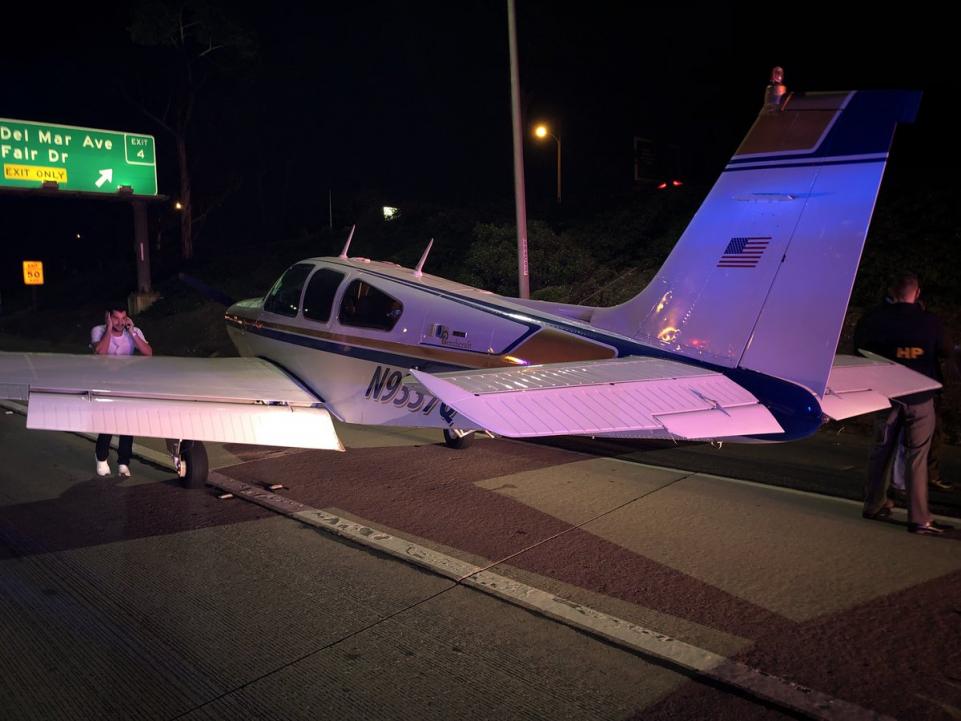
  4. Night Emergencies.  For engine failures at night, you are very limited on options.  Unless you have a Cirrus equipped with a CAPS parachute system, you really have two options if an airport isn’t within gliding distance.  Find a wide, lighted road that appears to be lightly trafficked.  A word of caution, though:  be careful of light poles, fences, concrete medians, cars, and buildings.  The LA freeway would not be a good option (though there are exceptions to this rule as is evidenced by the picture below).  The second option is find a dark spot and pray it’s a field (or the Hudson River).  As you get closer, you can turn your landing light on to see what the ground looks like.  If it looks good, keep the light on and continue.  If you don’t like what you see, turn your landing light off and continue….
Flying at night can be the best time of day to fly.  It’s usually smoother, cooler, and you get to see all the city lights.  It is a very different environment, however, so make sure to get some training before darkness settles in on your next trip.

Similar Posts

  • Garmin VNV

    The Garmin G1000/Perspective combined with the Garmin GFC 700 Autopilot can be a great tool in descent planning.  When you want to end up at pattern altitude a certain distance from the airport or you get a clearance to cross a fix at a certain altitude, Garmin VNV is a great tool.  Here’s how to use it.

    VFR Garmin VNV Use

    Let’s say you want to end up at pattern altitude 3nm from your destination, but you don’t want to descend down into the bumps before you have to.  Here’s how to set it up:

    • Go to the Flight Plan page on the MFD
    • Press the ATK OFST soft key on the bottom of the MFD.  It stands for Along Track Offset, which, in laymen’s terms, means you are setting a point along your track a certain distance from your destination.  In this case, it will be 3nm
    • Input the distance using either the keypad or the small FMS knob and press enter
    • Select the altitude you want to be at (in this case pattern altitude) and press enter
    • You will see a point 3nm before you destination appear on your magenta line and a Top Of Descent (TOD) appear where you need to start your descent
    • 1 minute before the Top Of Descent, an indicator will appear next to your altimeter
    • To have the GFC 700 Autopilot fly the descent for you, you have to do two things
      • Set the Altitude bug for the desired altitude
      • Press VNV on the autopilot
    • All you have to do now is manage power

    IFR Garmin VNV Use

    Let’s say you are told to cross a fix at a specific altitude.  Here’s how to use Garmin VNV to plan it out.

    • Go to the Flight Plan page on the MFD
    • Turn the cursor on and highlight the altitude blank next to the fix in the flight plan
    • Input the desired altitude
    • You will see a Top Of Descent (TOD) point appear along your course where you need to start your descent
    • 1 minute before the Top Of Descent, an indicator will appear next to your altimeter
    • To have the GFC 700 Autopilot fly the descent for you, you have to do two things
      • Set the Altitude bug for the desired altitude
      • Press VNV on the autopilot
    • All you have to do now is manage power
  • New Houston Airspace Procedures

    If you are based in Houston, or heading into or out of the Houston airspace under IFR, have you updated your charts?  If not, you may hear a clearance stating: “N67889, cleared to Amarillo via the BORRN 1 Departure, CRGER Transition, Direct.  Climb via the departure, expect 8000 in 10 minutes.  Departure frequency 123.8, Squawk 3365.”  You manage to get the clearance written down, but have completely messed up the spelling of both BORRN and CRGER, so you have no idea where the intersections are.  After stumbling through a readback, you ask ground to spell the fixes for you.

    Then, more bad news.  You haven’t updated your GPS cards yet, so the departure isn’t in your 430.  It’s an RNAV only departure, so you can’t fly it based on the NAV Radio.  You were planning on updating your iPad when you got to Amarillo, so you don’t have the departure on there, either.

    This has probably already happened to a few people today already.

    Houston airspace got a major overhaul today.  There are 20 new DPs and 29 new STARs guiding IFR traffic into and out of Houston airspace (including one named the DOOBI 1 Arrival, named after the Dooby Brothers band).

    The FAA’s goal in all these changes, according to AOPA, is to “bring fuel efficiencies, time efficiencies, and reduce carbon emissions” (from Benet J. Wilson’s May 15th article on AOPA.com).  The FAA issued a NOTAM today valid until June 6th describing what routes for pilots to file.  The NOTAM also contains contingency plans for pilots flying without updated charts (like our example above).

    Pilots should expect these wide scale procedure additions and changes to start showing up in other Class B airspace across the country.  As always, make sure those charts are updated, GPS databases are current, and you do some studying of your route before you file your flight plan.

  • Fly Away Destination: Lajitas Golf Resort

    Talk about star treatment.  The Lajitas Golf Resort rolled out the red carpet for the 2019 Texas Top Aviation Lajitas Fly In.  I had been to Lajitas twice before; once in July when it was hot, miserable and bumpy.  The second time was the week before our Fly In.  Both times, everyone from the airport folks to the bus drivers to the front desk and restaurant staff were top notch.  It made for a very pleasurable experience.

    If you haven’t been out to Lajitas (or don’t even know where it is) and you’re a pilot (you don’t even have to play golf), you have missed a sure gem.  Lajitas is positioned on the southern tip of the Big Bend area of Texas, right on the Rio Grande river.  Lajitas has great lodging with several different room options from big to small, an excellent restaurant for 3 square a day (and even a bakery for sweets, coffee, and breakfast tacos in the mornings), and a 5 star golf course in Black Jack Crossing.

    Why is this all relevant to us aviators?  Lajitas has it’s own private airport, 89TE.  Complete with a 5,500 foot asphalt runway, VFR conditions most of the year, and reasonable fuel prices, Lajitas is the pilot’s gateway to the resort and the entire Big Bend area.  If you wait until the fall, a brand new, 7,000 foot concrete runway should be completed and an IFR approach should be available.  An AWOS is in the works too.

    The resort and airport are so far south, radar and radio coverage with Albuquerque Center is pretty poor below about 15,000 feet, and non-existent below 10,000 feet.  This isn’t a big concern as any airplanes in the area should be on 122.9 and the airport manager will make contact with you, give you a weather report, and assign a runway.

    Once you are on the ground, there will be a resort bus waiting to whisk you and all your friends to the resort for your getaway.

    The 2019 Texas Top Aviation Lajitas Fly In was a big hit.  We had 7 airplanes total:  5 Cirrus SR22s, 1 Piper Matrix, and 1 Citation M2.  There were 15 attendees total, including 13 golfers.  Everyone raved about the resort and the golf course.  The only hiccup in the weekend was the cold front that blasted through on Friday afternoon, kicking up a lot of dust.  Golfing on Saturday was windy too, but Sunday morning was absolutely perfect.

    Thanks again to the folks at Lajitas for the star treatment!

    Interested in participating in the next Texas Top Aviation Fly In?  Contact Us or Sign Up for Our Newsletter and we will make sure you find out about the next one so you don’t miss out!

  • Learning From Other’s Mistakes:  An Overview of the 2024 Piper PA-46 Accidents

    The Piper PA-46 series, which includes models like the piston engine Piper Malibu and Piper Mirage, and the turboprops Piper Meridian, M500, and M600, is a popular choice for private pilots and business aviation. Known for its impressive speed, range, and pressurization, the PA-46 is a very capable single pilot aircraft. However, like all high-performance aircraft, it presents its own set of challenges and risks, especially when pilot error or adverse conditions come into play.

    The 2024 PMOPA (Piper M-Class Owner’s and Pilot’s Association) Convention was the first weekend in November and one of the sessions every year is the PA-46 Safety Review.  Sadly, in 2024, the accidents involving various PA-46 models pointed out several areas related to decision making that all pilots need to put be aware of. These accidents highlight critical issues in weather awareness, pilot training, and decision-making, and they provide valuable lessons for other pilots in any type of aircraft.

    Overview of the 2024 Piper PA-46 Accidents

    The Piper PA-46 is generally regarded as a reliable and capable aircraft, but the safe outcome of a flight often times depends on the pilot’s decision making.  There always can be mechanical malfunctions, but those still require good pilot decision making to be able to walk away from the accident.

    In 2024, multiple accidents occurred involving different variants of the PA-46, with many of the accidents occurring during critical phases of flight like takeoff or landing. Some of the key factors contributing to these accidents included:

    1. Weather Challenges: In several cases, adverse weather conditions, such as low visibility, thunderstorms, or high winds, contributed to accidents. Despite most PA-46’s being equipped with NexRad and weather radar, pilots sometimes underestimated or misjudged the weather risks.
    2. Pilot Decision-Making: A recurring theme in these accidents was pilot error—specifically, poor decision-making when faced with challenging conditions. In some cases, pilots continued flights despite deteriorating weather or failed to react appropriately to emergency situations.
    3. Mechanical Failures: As with every airplane, systems fail on a Piper PA-46.  Several accidents were due to engine power loss.  Proper training teaches pilots how to have the right mindset and skills to handle those engine power loss situations, taking a bad situation and having the best possible outcome due to good decision making and gliding skills.

    Three Key Lessons for Pilots

    The Piper PA-46 accidents of 2024 serve as valuable reminders about the importance of pilot preparation, decision-making, and risk management. Here are three critical lessons pilots can take away from these accidents:

    1. Prioritize Pre-Flight Weather Planning

    Poor weather conditions were a significant factor in some of the crashes in 2024. Pilots of high-performance aircraft must place a strong emphasis on weather pre-flight planning, especially when flying into regions prone to rapidly changing weather or severe conditions and across frontal systems. Pilots should:

    • Stay up-to-date with weather briefings before and during the flight, including calls to Flight Service Station if there is serious weather along the route.
    • Be proactive in altering flight plans or delaying departures when weather conditions become unfavorable.
    • Utilize onboard weather radar and other tools to monitor changing conditions in real time and avoid nasty looking weather systems.  ADS-B and XM Weather are delayed information.  They are not meant to be used to find holes through storm systems.
    • Finally, don’t try to shoot through holes!  They are called sucker holes for a reason.

    2. Master Emergency Procedures

    Pilots of all aircraft, not just PA-46 models, need to practice engine-out procedures multiple times a year with an instructor, not just at recurrent training.  The goal is to make emergency procedures second nature which creates the right mindset to handle the emergency, creating a much better outcome. Training should focus on:

    • Engine-out procedures immediately after takeoff, climbing out at low altitude, and at cruise.
    • Performance with the propeller feathered and unfeathered, recognizing how the feathered prop increases glide range.
    • Practicing forced landings and other emergency scenarios regularly to build confidence and competence.

    3. Always Plan for an Emergency Landing

    It is very important to know your options in the event of an emergency. When flying over mountainous or remote areas, pilots should always have a contingency plan for where to land if something goes wrong.  An emergency engine out brief should be a part of every pre-takeoff briefing to put the pilot in the right mindset. Pilots should:

    • Brief an engine failure on the runway, low altitude, and at an altitude that allows for a safe return to the airport in the event of an engine failure as part of every pre-takeoff briefing.
    • Study the flight route in detail and identify suitable emergency landing sites along the way, especially when flying in areas with limited options.
    • Consider the terrain, weather conditions, and available options in the event of an engine failure or other emergency.
    • Use terrain awareness and other onboard tools to help identify suitable landing areas in real-time, including the ForeFlight Glide Advisor.

    Conclusion

    The Piper PA-46 series, while a capable and reliable aircraft, demands a high level of skill and preparation from its pilots. The accidents in 2024 serve as a sobering reminder of the critical importance of weather awareness, emergency training, and proper flight planning. By learning from these accidents, pilots can make better decisions, have the right mindset, and reduce the risk of similar accidents in the future.

    By prioritizing weather awareness, mastering emergency procedures, and always having a contingency plan for forced landings, pilots of the Piper PA-46 can improve their ability to handle the challenges posed by these high-performance aircraft. These lessons are not just for PA-46 pilots, but for all pilots striving to fly safely and confidently.

  • PIREP: Austin Bergstrom Recovering After Flood Damage

    The massive storms that rolled through the Austin Bergstrom and San Antonio areas last Friday not only put a dent in the landscape, they put a dent in the skies too.

    The Austin Bergstrom (KAUS) control tower suffered significant flood damage Friday.  6 inches of rainfall in an hour caused water to come pouring into the first floor of the tower, flooding the radar room and knocking out the power.  This led to transmission outages for the tower, ground control, clearance delivery and the ATIS.  Similar to the Chicago Center fire last year (though this was a much smaller section of airspace), the area normally controlled by Austin Approach was replaced by a big, gaping radar hole.

    By 8:45am on Friday morning, the Austin Bergstrom airport actually closed.  One runway eventually opened back up Friday afternoon, but massive delays and cancellations had already taken place.  All the ILS approaches were down and Houston Center had taken over the airspace normally occupied by Austin Approach control.

    Austin Temprorary Tower

    A temporary, emergency tower vehicle was brought in by the FAA (it’s essentially an RV with communications and a giant window) by the end of the weekend.  All arrivals and departures were restricted to 17L and 35R.

    Due to the radar outage, I heard there was as much as a 4 hour delay even for planes coming into Austin Bergstrom from Dallas, and that was in VMC conditions on Sunday and Monday.  Tuesday and Wednesday brought IMC conditions which only enhanced the delays.

    The latest news is that Austin Approach will be opening back up, but in a satellite base in San Antonio.  The Austin controllers will be using the SAT radar room and will be receiving their radar picture via satellite.  The approach frequencies should be up and running today or tomorrow.  The Austin Bergstrom tower is up and running and most of the ILS approaches are operational at this point.

    In the meantime, expect delays going in and out of Austin.  If you don’t have to get to AUS, EDC, or GTU, you’re better off delaying a day or two until Austin Approach is back up and running.

  • VFR Flight Plans in the Modern Age

    Raise your hand if, after you have officially become a pilot by passing your private pilot check ride, you consistently file VFR flight plans with Flight Service.

    Anybody?

    Okay, let’s revise the question.  Raise your hand if you have filed VFR flight plans at least 5 times in the last year.

    Okay, one or two hands go up.

    That’s it?

    To be perfectly honest, I have filed VFR Flight Plans twice (I think) in the last year.  The only reason I did was because I was flying in an area that had poor radar/radio communications and I wanted someone to know where I was (I was ferrying an airplane through southern Oregon and northern Nevada which is mountainous and is hard to get coverage into at lower altitudes).  I was so unaccustomed to doing it that I nearly forgot to call and close my flight plan.

    FlightPlanForm

    This is a common complaint amongst pilots concerning VFR flight plans.  It’s extremely easy to get to your destination, hop in the car and completely forget to close your VFR flight plans.  Thankfully, now a days, the Flight Service Station will typically call the number you put in your VFR flight plans (your cell phone number most of the time) to make sure you are on the ground before initiating search and rescue services.

    Another complaint is that it is cumbersome to call the Flight Service Station after departing to open the VFR flight plans.  This is especially true in a busy airspace area or if the pilot is getting a VFR Flight Following and talking to ATC on a different frequency.

    I still think it is a great idea to file and utilize VFR flight plans.  If you don’t show up at your destination, someone will come looking for you which could mean the difference between getting stranded after an off airport landing and getting a warm cup of coffee at the end of the day.  Even if the you get flight following from ATC, it’s still good to file a flight plan.

    Lockheed Martin, who runs all the Flight Service Stations across the US, heard these complaints from pilots and decided to come into the modern age and make it easier to open and close flight plans.  They developed EasyActivate and EasyClose.

    These services are very simple.  Just go to Lockheed Martin’s Flight Service Station website, set up a new account, then file VFR flight plans to see the services in action.

    File your VFR flight plans first, through calling the FSS or on your favorite iPad app.  Then, for EasyActivate, you’ll receive an email 30 minutes prior to your ETD with a link in it.  Simply click/tap on the link and your flight plan is activated.  No having to call FSS in the air, no having to try to get them on the ground.  Just tap the link and you’re good to go.

    For EasyClose, you’ll receive an email 30 minutes prior to your ETA at your destination.  When you get on the ground, you’ll see the email in your phone or iPad and you just tap the link and your flight plan is closed.  Since we all have our phones and iPads with us constantly, there will be no more forgetting to close the flight plan and getting that angry call from the FSS.

    Sign up is quick and easy.  All Lockheed Martin needs is your email address, last name and phone number. They’ll send you the password to set up your account.  Log in (they will have you change your password immediately), then just click on EasyActivate/EasyClose up at the top.  You have to register the email address you want (you can also put in a phone number to receive a text message, and you can put multiple email addresses and phone numbers if you’d like), then you are all set to go.

Leave a Reply

Your email address will not be published. Required fields are marked *