Where the Airplane Market Is Headed in Q4 2026
Four things moved this market between July and the end of September, and each one changes the arithmetic on what your airplane is worth today. Inventory is thinner than it was a year ago and has stopped draining. Asking values have split. The Fed raised rates and has penciled in one more increase for December. And the FAA ended single-pilot operation in the legacy Citations. Here is the short version, and what I would do about it before December 31.
The short version
- Turboprop inventory is running about 12% under last year, and the field stopped shrinking in September.
- Piston asking values are still giving back. Turbine asking values have turned up.
- The federal funds rate is 3.75–4.00%, with one more quarter-point increase projected for December.
- The FAA rescinded the legacy Citation single-pilot exemptions on September 29, with no wind-down.
- Accepted offer to closing runs 30 to 45 days. To close before December 31 you need an offer accepted by about November 15 — which means listing by October 31.
Inventory is thin, and it stopped draining
In September, used single-engine piston inventory in the U.S. and Canada was down 12.2% against last year. Turboprops were down 12.0% worldwide. Jets were down 23.6%, with the large-cabin end off 39.8%. The field your airplane competes against is smaller than it was a year ago.
The monthly direction is the other half. Piston inventory was flat in September, turboprops rose 3.5% and jets rose 5.1% — the second month running that inventory added rather than drained. So the field is thin by the standard of a year ago, and it is no longer getting thinner.
Asking values have split
The three categories stopped moving together. Piston singles fell 0.74% on the month and are down 2.36% against last year. Turboprops rose 0.22% on the month and are up 0.57% on the year. Jets rose 2.02% on the month and are up 0.71%, led by the super-mids at plus 5.29%.
Asking prices are not values, and I will keep saying that. What they give you is the leading edge — VREF and the closed comps follow a quarter or two behind. Right now that edge says the turbine market has turned the corner and the piston market has not.
Rates went up, and may go again in December
On September 16 the Federal Open Market Committee raised the federal funds rate a quarter point, to 3.75–4.00% — the first increase since 2023, on a unanimous vote. The Committee’s own projections point to one more quarter-point increase in December. A financed buyer’s payment is higher than it was in the spring, and his offer reflects it.
The FAA ended single-pilot flying in the legacy Citations
On September 28 the FAA published a policy change rescinding the training-provider exemptions that let a single pilot fly the transport-category Citations. Effective September 29, no wind-down. Thirteen of the fourteen exemption holders reviewed were rescinded or denied renewal.
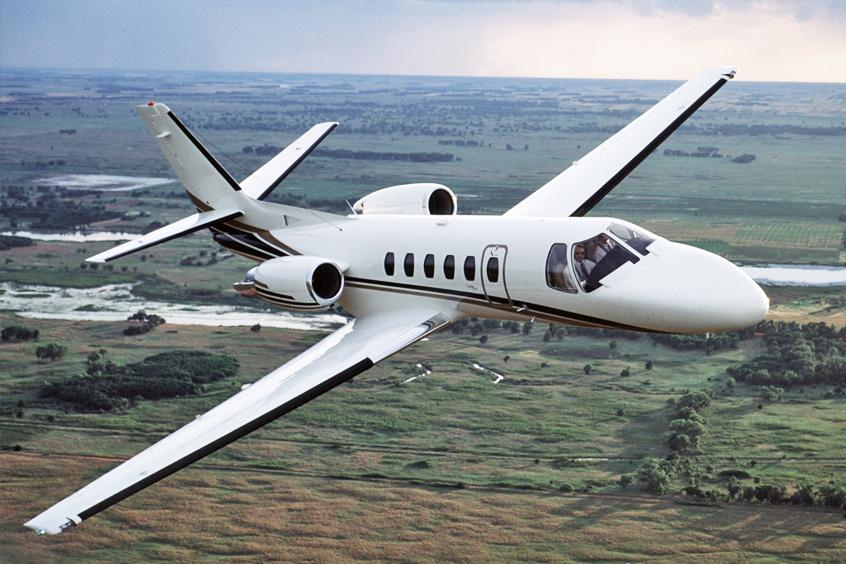
It catches the two-crew airframes: the 500, 550, S550, 552, 560, 550 Bravo, 560 Encore and Encore+. It does not touch the 501, the 551, the CJ/525 family, the Mustang, or any turboprop.
A large share of those airplanes are owner-flown. That owner now hires a second pilot for every leg, or he stops flying. NBAA and Citation Jet Pilots asked for a 90-day pause on September 29. No answer yet.
Why single-engine turboprops gain from it
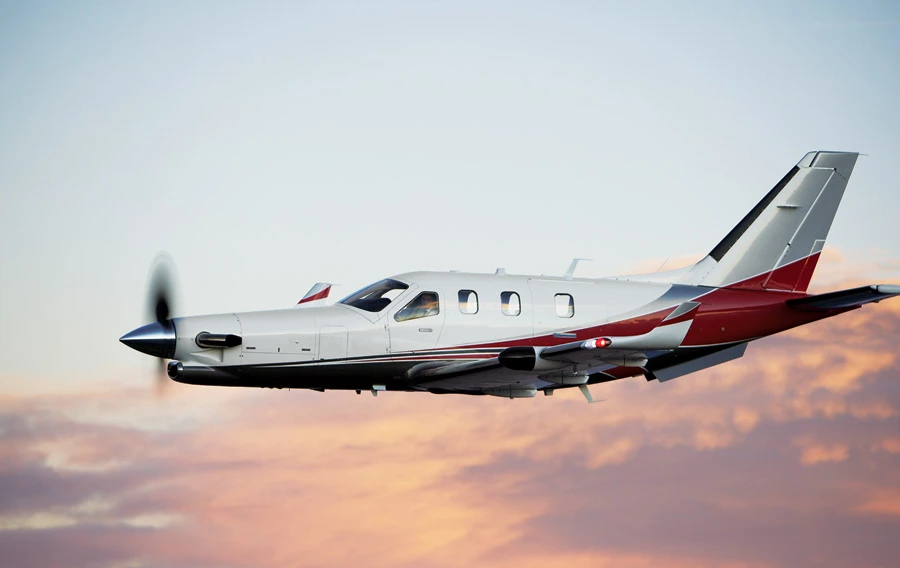
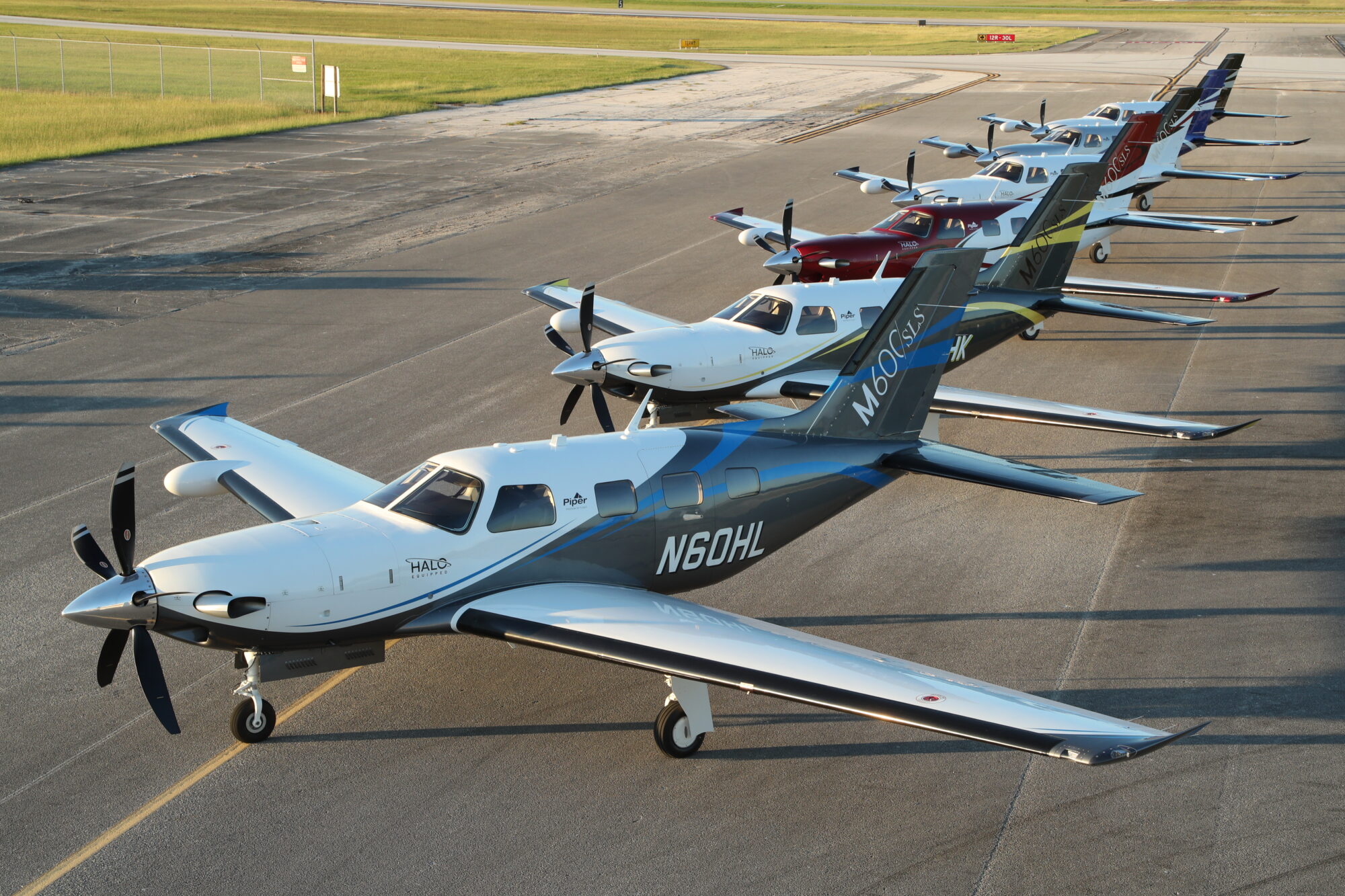
The demand moves, it does not disappear. The owner-pilot still wants to fly himself, and what he can legally fly is a short list: the CJ family, the Vision Jet, and the single-pilot turbines — TBM, M500, M600, M700, PC-12, JetProp. Those are legal single-pilot by type certificate, not by exemption.
The budgets line up. A clean legacy Citation’s price buys a strong TBM or a good PC-12, so these buyers arrive at the top of the turboprop market, where supply is thinnest and inventory is already 12% under last year.
Expect it in the leading indicators first — inquiries, showings, days on market — with price following a quarter or two behind.
The number that should drive your decision
Our airplanes went from listing to closing in a median of 98 days last year. This year that median is 178 days, an 81% increase. Buyers take longer, financing takes longer, pre-buys are more thorough.
At that pace an airplane listed today closes in March, not December. The year-end buyer is the exception — he is working to a December 31 placed-in-service deadline and moves far faster than the median.
Work the calendar backwards from that deadline. From an accepted offer, 30 to 45 days covers scheduling the prebuy, the inspection itself, the acceptance window and then escrow and title. To close before December 31 the offer has to be accepted by about November 15. To have an offer in hand by then, the airplane needs to be in front of buyers by the end of October. That is the whole reason for the date.
Our closings this year came in a median of 4.8% under the ask the airplane carried when it sold, and 7.1% under its original list price. We reduce the ask; we do not haggle.
On the fence about selling? List by October 31
If you own a Meridian, M500, M600, JetProp, TBM, Epic, PC-12 or Vision Jet and you have been going back and forth, here is the case for the next three weeks.
The buyers are shopping now. The displaced Citation owner-pilots are working through their options this quarter, and what they can legally fly is close to that list. An October listing puts your airplane in front of them while the field is thin. A March listing puts it in the spring wave, beside every other owner who had the same idea over the winter.
We took a full-price offer on one of our single-engine turboprops after a week on the market.
The call is yours. The calendar is the part that is not negotiable.
Similar Posts
Cirrus Braking Systems: A Hot Topic
You just bought your Cirrus SR22. You do some flying, and soon find yourself with a brake temp sticker that isn’t white anymore. You remember from your transition training that any color other than white is a no go. You now ponder…. I don’t remember getting on the brakes hard, or riding the brakes while taxiing, but sure enough they aren’t white anymore. You now start thinking that all the horrible rumors of Cirrus brakes are true. They overheat so fast!
I would like to share some little-known facts about the Cirrus factory equipped braking system. Following the procedures below can help make the brakes last a little longer. There is also a very popular STC that allows upgraded brakes to be installed on all SR series aircraft. More to come on that.
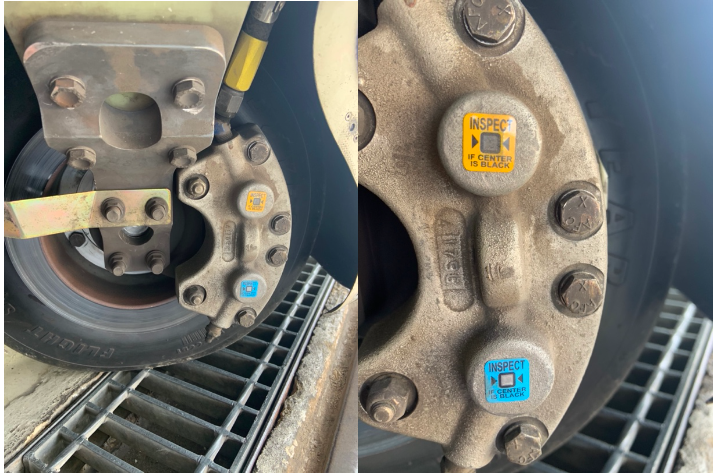
Notice the Top Yellow sticker is far darker than the Bottom. The Yellow temperature indicator turns at 300 Degrees, while the bottom Blue indicator turns at 330 Degrees. This is an indication to the pilot that if the bottom sticker has turned colors, that the braking system has exceeded 330 degrees and is in need of servicing. Above is a photograph of an SR22 G1 braking system with turned brake temp stickers. The first things you may notice is that there are in fact two brake temperature stickers. We can only see the bottom blue sticker from the inspection port on the wheel pants. The other is higher on the caliper; in order to see it, the wheel pant must be removed. This isn’t common knowledge because there is no mention of this additional indicator in the POH.
Now you may be asking yourself, what can I do to extend the service life of my factory equipped Cirrus brakes? Here are some tips. First, always taxi at 1000 RPM and use the rudder as much as you can while only tapping the brakes. This is not fool proof, since sometimes, depending on the grade, you will have no choice but to utilize brake tapping to keep the aircraft going straight. Taxiing is not typically where the brakes get overheated, though, but this is still a good practice to follow.
What we tend to see is that the Cleveland brakes are generally overheated on landing. We always recommend to make sure your final approach speed is not excessive, land in the first 1/3 of the runway, and let the aircraft rollout to a smooth stop. What tends to happen is that the aircraft is too fast, and the pilot tries to exit at a certain taxi way, or brakes hard and continues to ride the brakes after landing during taxi. If you do your best to avoid these habits, it will serve you well.
This braking system remained unchanged all the way until the 2016 G5 Cirrus SR series. Starting in 2016, the factory equipped G5 and G6 Cirrus SR series all now come standard with a single piston hydraulic braking system from Beringer. The Cirrus Beringer brakes far exceed the braking power and durability of the old system. The new system is more robust, withstands heat better, and is is very well built. There is also an option for an upgraded dual caliper system to increase durability and stopping power. A braking system STC for the older Cirrus G1 through early G5 models was created to upgrade those airplanes to the better stopping power and cooling of the Cirrus Beringer brakes.
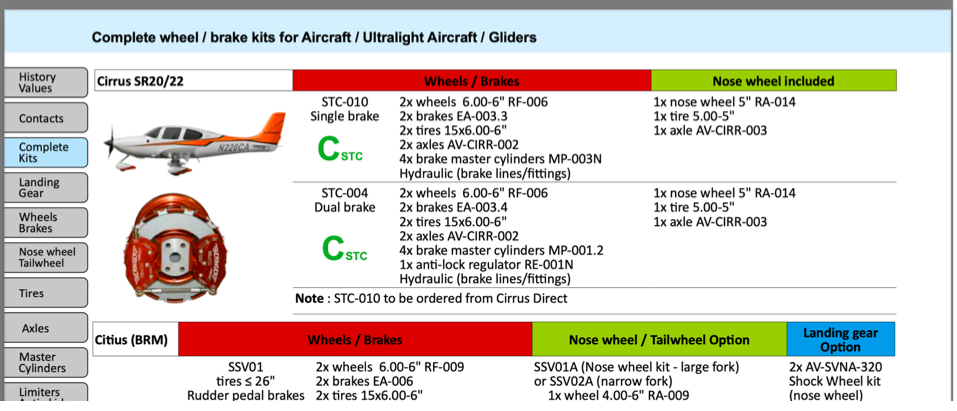
Seen above is a page from a Beringer catalog highlighting the Cirrus SR series STC kits. Your local Cirrus service center will be able to quote prices for the kits. We have over 1000Hrs spent behind Beringer equipped Cirrus aircraft and the difference is quite apparent. The pilot has better control of the aircraft, no spongy pedal, and the confidence to get the plane stopped without possibly overheating the braking system. This, in our opinion, is one of the best upgrades you can do to your Cirrus. 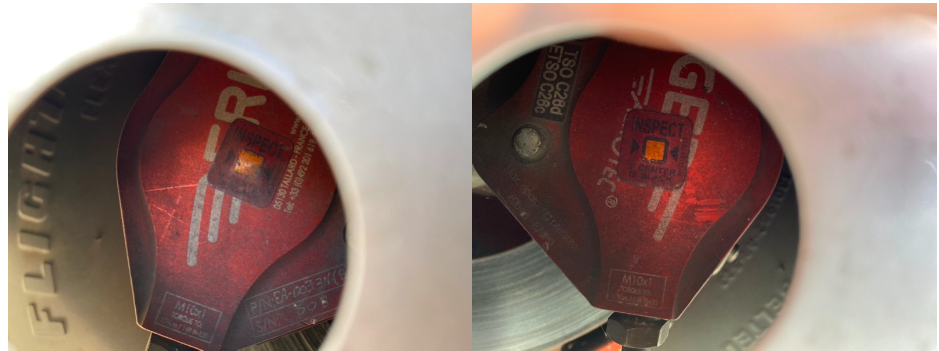
Above is what an STC upgraded braking kit from Beringer looks like, as well as the new temperature indicator for the pre/post flight inspection. Notice the black spot on the left hand picture. These brakes have been overheated. One other difference for a pilot to note is that once upgraded to the Cirrus Beringer brakes, there is only one temperature indicator and it changes color at a whopping 450 Degrees Fahrenheit! Needless to say, it can handle some heat! The new temperature indicator is now Orange in color and turns grey/black when overheated.
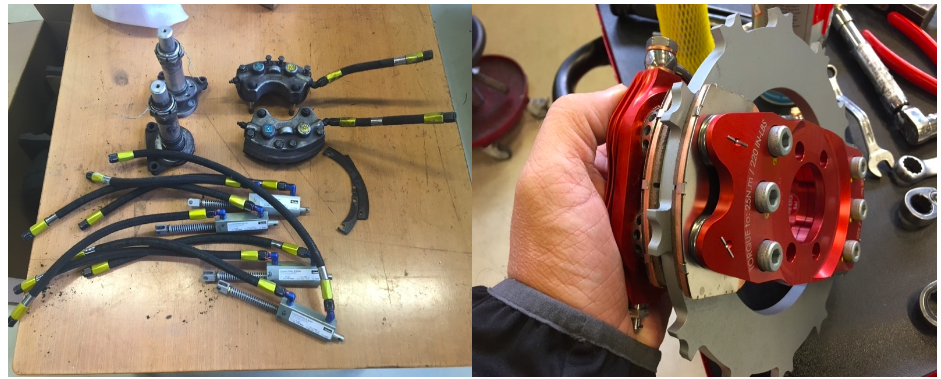
On the left are the original Cirrus factory brakes. On the right is the caliper to the new Beringer brakes for a Cirrus. 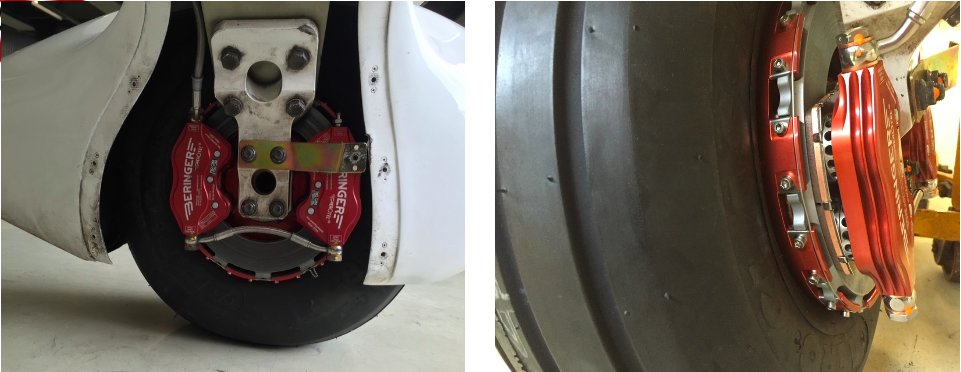
Dual Caliper Cirrus Beringer Brakes The Cirrus Beringer brakes upgrade is quite a step up in the world of slowing down. However, this doesn’t mean that they are completely issue free. There is one little-known problem with Beringer brakes that is not that big of a deal and can be fixed with relative ease.
The rotor on the Beringer braking systems is “free floating,” meaning it is not necessarily “fixed” in position when secured down to the spindle. It is “keyed” into the wheel rim with the male and female side interlocking.
The brakes occasionally will get noisy, causing a “knocking” noise when brakes are applied. This noise is caused by the small metal tabs that tighten up the space between the wheel and the brake rotor. This is so the small tabs wear with use instead of the aluminum rim that they are fixed to. So, if your Beringers are making a knocking noise when brakes applied, this is most likely your culprit.
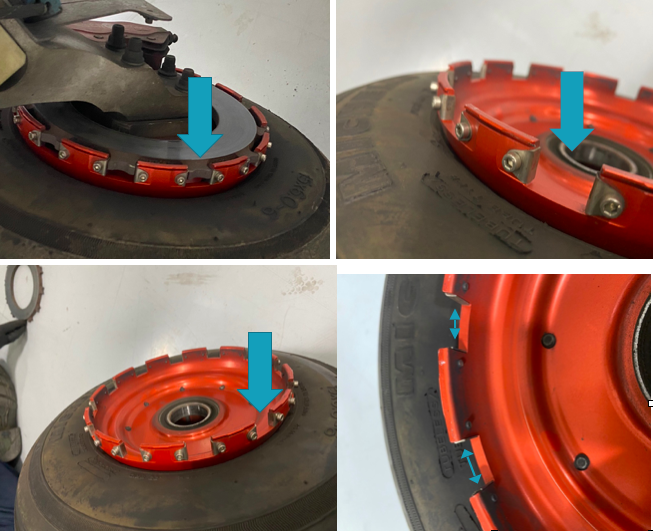
These gaps above are the “keyed” position where the rotor finds home in the rim. Without these tabs that wear with use, we would be replacing the rim more often than the much cheaper replaceable tabs. It is highly recommended to upgrade your original Cirrus factory brakes to the new Beringer braking system. You will deal with less maintenance, less chance of a brake overheat, and less confusion on whether or not your brakes are airworthy. For more info, you can check out the Cirrus website for the single or dual caliper Beringer brakes.
Zach Anderson is a Cirrus Standardized Instructor Pilot (CSIP) for Texas Top Aviation. Zach comes from a auto mechanic background and is very familiar with the ins and outs of maintenance. He started working for Texas Top Aviation in December 2020.
Cirrus Electrical System Health
As all Cirrus pilots know, SR20s and SR22s have 2 batteries in the Cirrus electrical system (technically, they have 3, as Battery 2 is made up of 2 12 volt batteries in series with each other). Battery 1 provides power to the starter and is a backup for the entire Cirrus electrical system, while Battery 2 provides backup for the Essential Bus items.
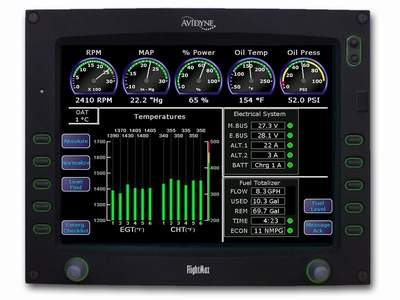
If you look on the engine page of either an Avidyne or a Garmin Cirrus, there is a section showing the Cirrus electrical system health. With the engine running, you have voltmeters showing the voltage from Alternator 1 and Alternator 2, ammeters showing the amperage output from Alt 1 and Alt 2, and an ammeter showing the charging rate of Battery 1. There is no indication for Battery 2.
This brings up a question. How does the pilot know that Battery 2 has any kind of a charge? What happens if the whole Cirrus electrical system goes caput and all that’s left is Battery 2? Will Battery 2 have juice then?
The answer is actually rather simple. As part of the pre-flight inspection, the first step in the cabin inspection is to turn the Battery 2 switch on, then check the Essential bus volt meter. The checklist says the voltmeter should be reading between 23-25 volts. This tells you how much voltage Battery 2 currently has. The next step (after ensuring the flap lights are out) is the turn Battery 1 on. Battery 1 then powers the Main Bus and Essential Bus. The voltage showing on the Main Bus shows how much voltage Battery 1 currently has.
Easy enough right? Now you can impress friends and family alike with your Cirrus electrical knowledge!
The Importance of Transition Training
In September, the FAASTeam at the San Antonio FSDO put a special emphasis on transition training (AOPA put out a free course last year covering general transition training topics). A lot of pilots don’t understand the need for transition training or what it even entails.
Transition training deals mainly with piston engine aircraft, regardless of whether the airplane is a single or twin. The FAA doesn’t have any special requirements for changing from one piston engine airplane to another, as long as the pilot has the appropriate endorsements (high performance, complex, high altitude, etc.) and is rated in that category and class.
Transition training is promoted mostly by insurance companies. An insurance company looks at a pilots experience when deciding to insure him or her in a new airplane. If the pilot has only flown Cherokees and Comanches and is now upgrading to a Malibu, then the insurance company is going to require some transition training with a knowledgable instructor.
What is transition training? It is when an appropriate rated pilot needs to learn how to fly a different airplane. These are referred to commonly as checkouts, but with more complicated airplanes, the training is actually very in depth.
Using the example above, Pilot A just sold his Comanche 260 and bought a 1987 Malibu. Pilot A says, “A Malibu is a complex, high performance, single engine piston, which is what I had in my Comanche. I can fly that, no problem.” In reality, a Malibu has a lot of differences.
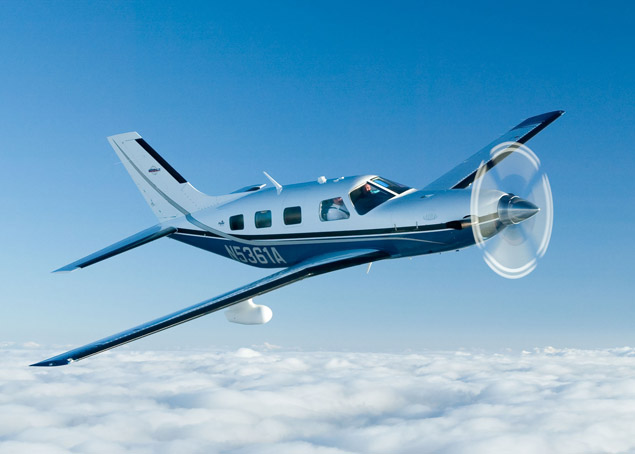
First, there are more systems in a Malibu. You have pressurization, air conditioning, emergency oxygen, turbo charging, and possibly radar. Not to mention you are dealing with a Continental engine instead of a Lycoming. And, is it a factory TSIO 520 or a converted 550? 2, 3, or 4 blade prop? Glass panel or steam gauges? What kind of autopilot? Plus, it’s a much heavier airplane so it’s going to fly different, have different rotation and landing speeds and handle differently in stalls. What’s the sight picture supposed to be on final approach? What are the emergency procedures?
Overwhelmed yet?
An experienced, insurance approved instructor and training program is a necessity when getting into new airplanes. It makes for safe pilots and safer skies.
Texas Top Aviation offers Cirrus Transition Training as well as Bonanza Transition Training and Columbia/Corvalis Transition Training. We are working on an insurance approved Piper PA 46 piston transition course as well (Malibu and Mirage) and will have the course approved by the end of 2016. Contact us today to schedule your transition training.
Avidyne IFD 440 Receives Certification
Avidyne’s plug and play replacement for the Garmin 430, the Avidyne IFD 440, finally received certification from the FAA last week. The touch screen GPS unit is being marketed as a simple swap out for the Garmin 430. This release follows up Avidyne’s release last year of the IFD 540, also a plug and play replacement, but for the Garmin 530.
The features and touch screen of the GPS units sound quite nifty, but it will be hard for Avidyne to compete with the GTN 750 and 650 from Garmin. The unit prices for the IFD 540 and 440 will be less (and installation is simpler), but we will see how the company does.

The STC allows for installation in 1,000 makes and models of aircraft, according to the company, so there are a lot of possibilities for installs.
In conjunction, Avidyne also released a new version of it’s software for both GPS units. According to Avidyne, this will unlock multiple features that enhances the capabilities of both units.
To read more on the IFD 440 and it’s bigger brother, the IFD 540, check out Avidyne’s website.
Conroe, TX CPPP
The Cirrus Pilot Proficiency Program (CPPP) will be coming to the Galaxy FBO at the Lone Star Executive Airport in Conroe, TX again this year. The dates of the event will be October 14th-16th.
Wondering what the CPPP program is?
“CPPP offers a weekend event for Cirrus owners and their partners that focuses on Cirrus-specific knowledge and flying proficiency. We bring some of the most experienced flight instructors who regularly teach in all kinds of Cirrus airplanes flown for all kinds of missions. We have prepared an extensive syllabus of ground courses that complement the transition training and delve into areas of greatest need for Cirrus pilots.” (from CirrusPilots.org)
The weekend starts off with a group dinner on Friday night. The Saturday morning ground session focuses on General Aviation Safety with special focus on the Cirrus accident statistics. Normal and emergency procedures are also reviewed.
In the afternoon on Saturday, the attendees are split into two groups. The first group has a myriad of options for ground sessions covering all topics related to Cirrus aircraft and operations. The second group flies, then they switch for the second 3 hour session. Sunday brings the same split, with more courses offered and more flying.
While the Cirrus pilots are flying and learning more about their airplanes, CPPP offers a Partner in Command course for flying partners on Saturday. This allows flying partners to be more comfortable in the airplane and teaches them what to do if something were to happen to the pilot.
All in all, attending a CPPP will improve both Cirrus knowledge and Cirrus flying skills. It’s highly recommended for all Cirrus pilots.
To register for the CPPP event in Conroe, check out the CPPP website.
US Aircraft Expo Returns to Addison
The 2022 Fly In Season kicks off March 4th-5th with the US Aircraft Expo at the Addison, TX Airport (KADS). Cutter Aviation at KADS will be the host for the event. All the major and minor aviation manufacturers will have static aircraft displays. Come see all the new Cirrus innovations, the Piper M600, and the Diamond DA62. All the latest and greatest technology will be available for your viewing enjoyment.

If you are planning on flying in, the FBOs at ADS are Million Air and Atlantic.
The event will run from 10am-3pm on both days, March 4th and March 5th.
For more info, check out the US Aircraft Expo website.
Don’t forget to check out other big fly in events in 2022: Sun N Fun, the Texas Top Aviation Fly In at Santa Fe, and Osh Kosh!