| |

Stratos 716X

Cirrus Vision Jet, meet your competition.

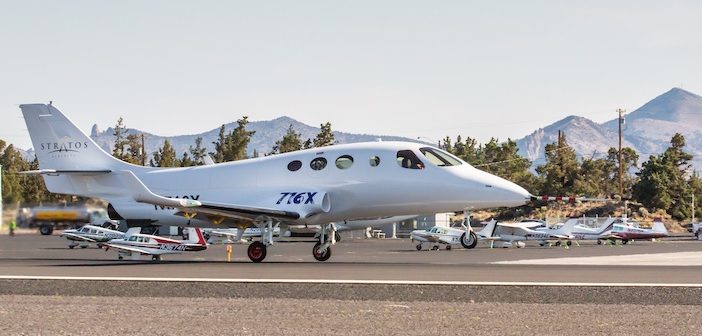
In July, Stratos Aircraft completed the first test flight of the single engine Stratos 716X personal jet. Stratos, based in Redmond, OR, is taking a page out of Epic Aircraft’s book in how the company is planning on bringing the Stratos 716X to market.
Epic Aircraft first released the Epic LT composite single engine turboprop in the early 2000s as an experimental. The first kit was completed and flying in 2005. Epic’s goal was to bring the airplane to market as a certified aircraft, a feat that took them almost 20 years to do, achieving full certification earlier this year.

Stratos Aircraft is hoping to learn a lot from their Bend, OR neighbors. The 716X is going to start off as a limited release experimental kit, while the company is working on achieving certification for the airplane. Once the plane is certified, it will be dubbed the Stratos 716. The 716X experimental kits will be assembled through a factory builder assist program (no garage built single engine jets here!). The kit will cost $2.5 million assembled, while the expected cost of the certified Stratos 716 will be $3.5 million.

Now, let’s talk about the airplane. 400 KTAS. One engine.

That’s right, you did hear correctly. The Stratos 716X is expected to cruise at 400 KTAS on only one engine. Compared to the Cirrus Vision Jet, that’s 100 knots faster. Think, “I’ll be relaxing at the hotel pool with a drink in hand when you are landing” type speeds. The fuel burn of the Pratt & Whitney JT15D-5 engine (3,000 lbs of thrust) is about 25 GPH more than the Vision Jet (the Stratos 716X will burn about 98 GPH of Jet A while the Vision Jet averages about 75 GPH of Jet A).

Comparing the two engines, the above numbers start to make sense. The Williams FJ33 engine on the Vision Jet only puts out 1,850 lbs of thrust, significantly less than the 3,000 lbs of thrust that the Stratos 716X Pratt & Whitney JT15D-5 puts out.

What does that mean to the pilot? In the Stratos 716X, it means less takeoff roll, better climb rate, faster cruise (as evidence by the 400 KTAS expected cruise speed), and a better payload. More power = more weight carrying capacity. And, the 716X is expected to have a service ceiling of 41,000 feet. I probably wouldn’t want to go that high single pilot with one engine, but I’d be very happy with that speed in the mid-30s.
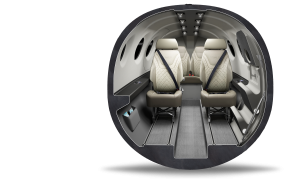
The cabin, based on the pictures I’ve seen, looks very comfortable. The Stratos 716X seats 6 and can be configured in several different ways. Baggage is no problem as Stratos Aircraft stretched the fuselage from their original 714 Proof of Concept aircraft, adding a very roomy baggage compartment above the engine compartment. The passenger compartment is as big as a Phenom 100, providing more leg and head room than the Vision Jet. The front seats have plenty of legroom too, as Stratos has opted for a side stick instead of a yoke.
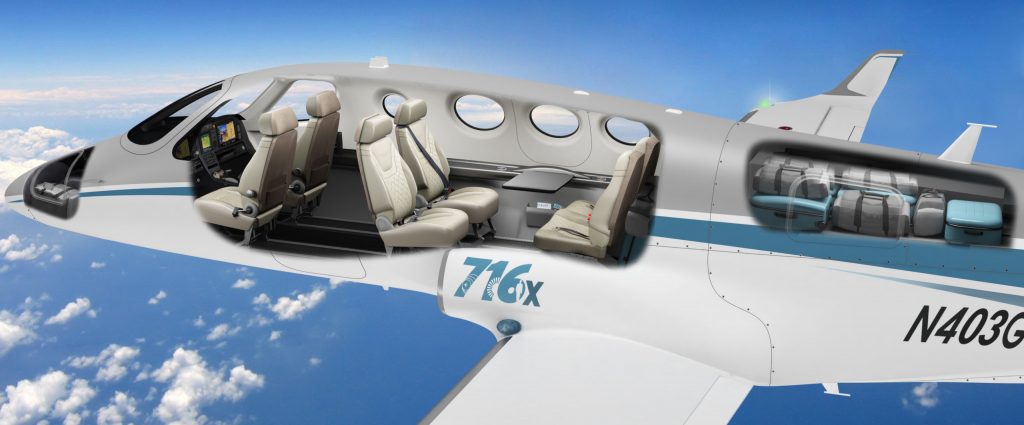
The avionics for the Stratos 716X are expected to be the Garmin G3X Touch for the panel which will be driven by a Garmin GTN 750 GPS. Autopilot will be integrated within the G3X. I would imagine that once the plane is certified, the panel will be switched to a Garmin G1000 NXi and a GFC 700 will be installed.

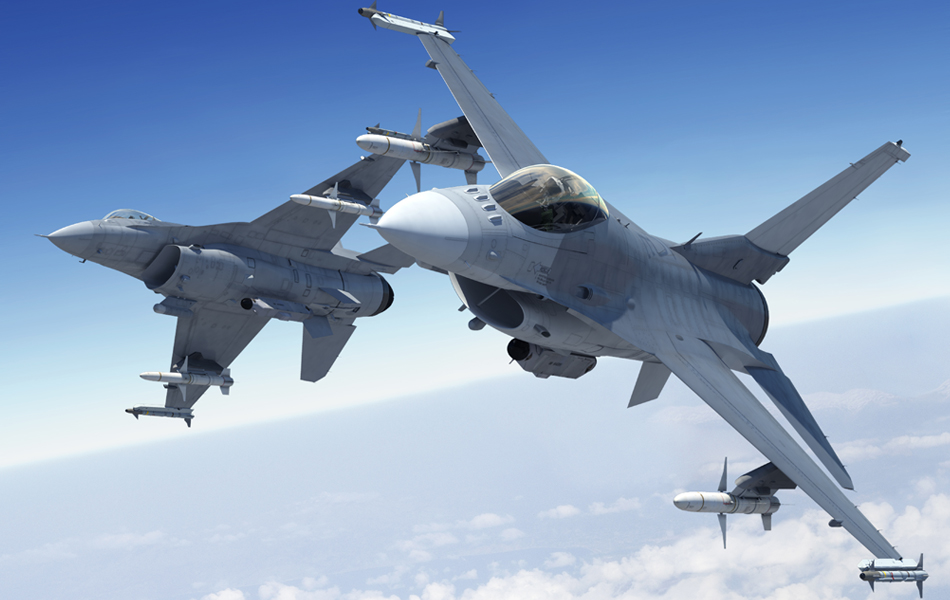
The genius of the design of the Stratos 716X is the aerodynamics of the engine placement. Instead of hanging the engine out in the slip stream and going with a drag inducing V-Tail like Cirrus did, Stratos took some notes from the myriad of single engine military fighter jets out there, placing the engine inside the fuselage. The fuselage is then built around the engine with two air scoops for intake directly in front of the wings. With two intakes instead of one, that leads to more air flow, which again, means more power. The Vision Jet has only one.
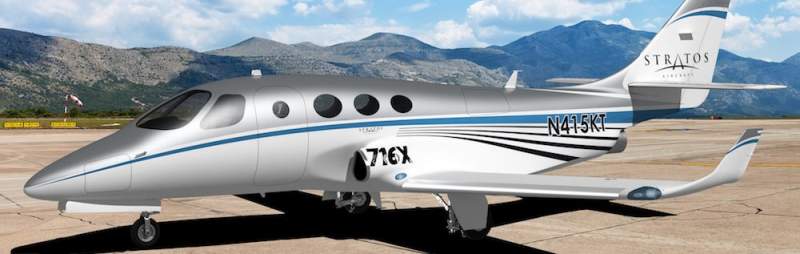
I’m going to keep tabs on the Stratos 716X (as I kept tabs on the Epic E1000). I’m hoping Stratos gets several flying soon (the company expects to do 3 kits a year till the airplane gets certified) and certification comes quickly after.

I got to stick my head in the mockup of the Stratos 716X when I went to Osh Kosh in 2018. I was very impressed and was excited to see the airplane was finally airborne this summer.

For more information about the Stratos 716X, check out the Stratos website.

Similar Posts

  • Cirrus G2 Vision Jet

    Well, that was fast.

    In January, Cirrus announced the Generation 2 SF50 Vision Jet.  After getting the Generation 1 Vision Jet certified in late 2016, Cirrus didn’t waste any time in starting in on improvements.

    The improvements are pretty sweet, making the G2 Vision Jet even easier to fly and step into for Cirrus’ target market, SR22 owners.

    Here are the improvements on the G2 Vision Jet.

    RVSM Approval

    The G2 Vision Jet has received RVSM approval, allowing the airplane to fly at 31,000 feet.  RVSM stands for Reduced Vertical Separation Minimums (read more about RVSM here).  RVSM airspace starts at 28,000 feet, the G1 Vision Jet’s ceiling.  Now that the G2 Vision Jet is RVSM certified, it can fly at 31,000 feet.

    For piston pilots, you are left scratching your head as to the advantage of this.  In a jet, the higher you go, the thinner the air, so the faster you go, and the less fuel you burn since the thin air needs less fuel to mix with.  This caps out at a certain altitude and the speed begins dropping and you start losing efficiency (even though the fuel burn is quite low).

    According to Cirrus, at 31,000 feet, the G2 Vision Jet cruises over 300 KTAS and gets a range boost to almost 1,200 nm.

    Garmin Perspective Touch+

    Cirrus & Garmin have taken the new NXi interface and paired it with the Garmin Perspective Touch to create the Touch+.  You can read about the improvements on the NXi here, all of which are included in the Touch+ in the G2 Vision Jet.

    The big improvement that is included in the Touch+ is Autothrottle capability.  An Autothrottle is integrated with the autopilot.  It automatically adjusts power settings and speeds based on the phase of flight without the pilot having to touch the throttle.  Pretty cool.

    New Cabin

    The G2 Vision Jet has a redesigned cabin as well, making it an extremely passenger friendly airplane.  The second row has been redesigned and equipped with a center console.  There is also a drop down TV screen that allows passengers to connect their mobile devices to it to watch movies or videos while traveling (no internet on board, yet.  That’ll probably be the G3 Vision Jet!).

    Cirrus also put in more noise reduction in the cabin, creating a quieter ride for passengers.  Cirrus also allows for multiple different seating configurations, depending on the needs of the owner.

    As always, Cirrus is on the leading edge of airplane technology, creating airplanes that are easy as well as fun to fly.  I’m excited to see how they continue to improve the design to both the SR22 and the Vision Jet.

  • Is The Approach Active? Flying Garmin Instrument Approaches Seminar

    Hank Gibson from Texas Top Aviation will be presenting a seminar on flying Garmin instrument approaches with the different Garmin GPS units.  Whether you have a Garmin 530/430 unit, a Garmin GTN 750/650 unit, or a Garmin G1000, all will be discussed.  You’ll walk away with some tips and tricks, plus a better understanding of your Garmin unit.

    WINGs credit will be given for attending.  The seminar is hosted by Redbird Skyport at the San Marcos Airport (KHYI) in Redbird’s large conference room.  The seminar will begin at 10am on Saturday, June 30th, 2018.

    It’s always quicker to fly than drive and Redbird has plenty of ramp space to accommodate seminar attendees.

    Registration is required.  Please visit the registration page on FAASafety.gov.  Space is limited to 20 individuals, so please make sure you register if you want to attend.

  • Flying To Mexico

    I took a Piper Malibu to Cabo San Lucas a few weeks back.  This was my second trip flying to Mexico, but the first where I arranged everything.  Cabo is a beautiful place and the MMSL airport is a fabulous facility. For those who haven’t been fying to Mexico before, MMSL is the place to go.  The folks there are extremely helpful and do most of the paperwork for you.  You just have to pass along your information to them.

    Mexico Flying

    Flying to Mexico and back out is different than flying in the US.  First of all, don’t forget your passport. The authorities on both sides frown upon that.  You’ll probably get sent back to the US (or sent back to Mexico if you are on your return trip).  Your aircraft also needs, Mexican insurance (talk to your US insurance agent) a radio license, and a customs decal.

    Second, you’ll have to file an ICAO specific flight plan for flying to Mexico.  This is available on Foreflight now, but I really like Fltplan.com’s way of doing it.  I don’t fly internationally enough to remember what everything means, but Fltplan.com does a great job of walking pilots through the the different classifications.  It’s almost impossible to get confused.

    Third, you have to fill out an eAPIS form.  This has to be done at least 24 hours prior to departure from the US, but it can be done as far in advance as you’d like.  If your departure time changes or your passengers change, you can edit the eAPIS form to bring it current.

    Flying to Mexico IFR is a lot simpler than flying VFR.  I have only flown IFR and it is very easy.  I’m already on a flight plan, already squawking a discreet code, and already on radar, so there really isn’t any way I can mess up the ADIZ penetration.  I really recommend going in and out of Mexico IFR instead of VFR.

    Once you land in Mexico, you have to close your IFR flight plan.  The tower doesn’t do this for you.  After clearing customs, you’ll have to pay a landing fee and sign your flight plan confirming you have arrived and closing it out.

    When departing, you have to file another eAPIS 24 hours in advance.  Wherever you plan on clearing Customs in the US, you’ll need to call the Customs office no less than 1 hour, but not more than 23 hours before arrival.  It’s called an Advanced Notice of Arrival.

    You’ll need to fill out a paper flight plan before departing, clear customs again to leave, then away you go.

    There are a lot of really fun getaways in Mexico and flying there doesn’t have to be difficult.  When you have the right information, flying to Mexico can be a breeze!

  • Introducing…The Aviator’s Academy

    Imagine this …

    You have plans to fly to an airport 218 miles north for a business meeting. Your window is tight; you have an early morning meeting at your office you can’t miss prior to leaving for the airport. The colleagues you are flying to meet must catch another flight within two hours of your target arrival time. 

    You’re comfortable flying in the current weather conditions, but a small southward-moving storm north of your destination might threaten your approach. Additionally, given the time of day, you can expect ATC delays due to vectors and know you’ll have to adjust on the fly.

    Are you confident you can make the meeting in time?

    If the answer isn’t immediately clear, you’re not alone. Good aeronautical decision making is of utmost importance in the air. External pressures, unexpected challenges, and your level of instrument proficiency are among the many factors to consider when considering an IFR flight. 

    While we can’t remove the external pressures or control the weather, we CAN help with instrument proficiency!

    Introducing … The Aviator’s Academy – advanced online pilot training. 

    During my time training hundreds of capable and competent pilots at Texas Top Aviation, my most common observation with seasoned and rookie pilots alike is that the pilot is often aware of knowledge gaps with the airplane’s avionics after initial flight training or after upgrading to a more advanced airplane, but aren’t sure where to get answers.  Simply put – expert glass panel flight training is hard to find.

    They know enough to have earned their license, but still feel uneasy anticipating unexpected challenges. This leaves them feeling at best, uncomfortable, or worse, on edge and unsafe. When you’re not as proficient as you could be, an easy flight can become stressful quickly in unexpected scenarios, and things spiral from there. It doesn’t have to be this way.

    That’s why The Aviator’s Academy offers online courses with real-life scenarios using glass panel avionics. You’ll gain more confidence in the air and be equipped with better aeronautical decision-making skills after learning from the best in the business.

    We understand the pressures you face in the air. We get it because we have been providing expert, personalized, owner/pilot instruction since 2014 at Texas Top Aviation. With over 8000 hours of instruction given in Technically Advanced Aircraft and over 13,000 hours in total flight time, The Aviator’s Academy instructors are qualified to fly and instruct most single-engine aircraft to a level that far exceeds what a flight school can provide. Nowhere else can you get expert glass panel online instruction for Technically Advanced Aircraft.

    If you’re in need of an instrument proficiency check and fly a technically advanced aircraft with glass panel instruments, this is the place to get your ground school training. Conveniently online. Expertly taught. 

    Mastering your glass panel avionics isn’t impossible. You just need a guide. Enroll in the course you need to take your skill to the next level. You’ll receive expert, specialized online training. Then you’ll fly with confidence.

    LAUNCHING AT OSHKOSH! Visit www.aviatorsacademy.com and leave us your email to be notified when our first course drops. Come visit us at booth 3004 at Osh Kosh, July 25th-July 31st, 2022.

  • AOPA’s Emergency In Person Seminar

    Courtesy AOPA.org

    We spend time training for them, but real-world emergencies are rare enough that it’s easy to get complacent. They don’t always happen to “other pilots,” though, and preparation can make a big difference when things don’t go as planned:
    • What if you lose 500 rpm during takeoff, but the engine is running smoothly?
    • What if the ammeter drops to zero during a flight in IMC?
    • What if your left aileron develops a strong vibration in flight?
    Our new seminar is full of expert tips on handling those “up here, but wishing you were down there” scenarios. We focus on how to keep abnormal situations from becoming full-blown emergencies, offer advice on keeping critical problems under control, and give our best advice on off-airport landings.

    Find an AOPA Emergency Seminar near you!

    • Monday January 11, 2016-The Woodlands Waterway, 7pm-9pm
      • 1601 Lake Robbins Drive, The Woodlands, TX 77380
    • Tuesday January 12, 2016-Wyndham Houston West, 7pm-9pm
      • 14703 Park Row Blvd., Houston, TX 77079
    • Wednesday January 13, 2016, Holiday Inn San Antonio Airport, 7pm-9pm
      • 77 NE Loop 410, San Antonio, TX 78216
    • Thursday January 14, 2016, Omni Austin Hotel at Southwark, 7pm-9pm
      • 4140 Governor’s Row, Austin, TX 78744
  • Direct to the FAF

    A common practice when ATC is setting an aircraft up for a visual approach is giving a clearance direct to the Final Approach Fix (FAF) for the approach for that runway.  The theory is, the pilot will fly to the FAF, then he’ll pick up the airport and fly visually in.  It is a handy way of setting the pilot up for a 5 mile straight in visual approach.

    For anyone who flies with a Garmin GPS, whether is be a 430, a G1000, or a GTN 750, you have probably discovered a little nuance with going direct to the FAF.  Once an approach is loaded into the flight plan, whether is is loaded via vectors or via an IAF, all the waypoints on the approach go into the flight plan.  If the FAF is selected in the flight plan and the direct to command is given, the plane turns to the FAF and flies direct to it.

    The fun starts once the plane gets to the FAF.  The Garmin doesn’t sequence to the next waypoint.  It just keeps the FAF as the active waypoint and the airplane just continues on the course it had to get to the FAF. This has probably caused some stress and frustration as the pilot is expecting the airplane to turn inbound (if the autopilot is engaged), but then it keeps flying, usually away from the runway.

    How to fix this?  If a Garmin GPS is closely inspected once the direct to the FAF command is selected, the pilot will notice that the GPS goes into Suspend mode.  The Garmin programers thought this was a good idea to do.  

    How to get it to sequence properly?  Well, once the FAF is the active waypoint and the airplane is flying direct to it, simply unsuspend the GPS, then the airplane will turn inbound on the final approach course and track inbound and the glide slope will pop up.  On the 430 or 530, just press the OBS key.  On the G1000, press SUSP.  On the GTN 750, tap UNSUSP on the bottom of the unit.

    Hopefully, this will lead to reduced frustration on what otherwise should be a simple approach to an airport.

4 Comments

  1. I for one would prefer a yoke to a side stick any day, but I must be in the minority…
    I would also recommend staying with the g3x configuration rather than locking into the airframe tied nxi configuration. This hasn’t, and isn’t working well for legacy g1000 owners at all.
    However, it is a good looking plane, and the thought of 400knots with a jet for less than a meridian is very intriguing!
    Best of luck!

  2. Looks like a cool plane, I’m not a big fan of the vision jet. But I’d prefer a yoke, when the turbulence gets nasty I can’t see a non fbw side stick giving you the ability to have as much control as a yoke, or the Embraer style horns.

Leave a Reply

Your email address will not be published. Required fields are marked *